

Rosh Hashanah
Teshuvah, Prayer, and Charity: Three Keys to Transform Your Year
Discover how teshuvah, prayer, and charity can change us, soften harsh decrees, and help us enter the new year with greater faith, purpose, and compassion
- Yonatan HaLevi
- | Updated
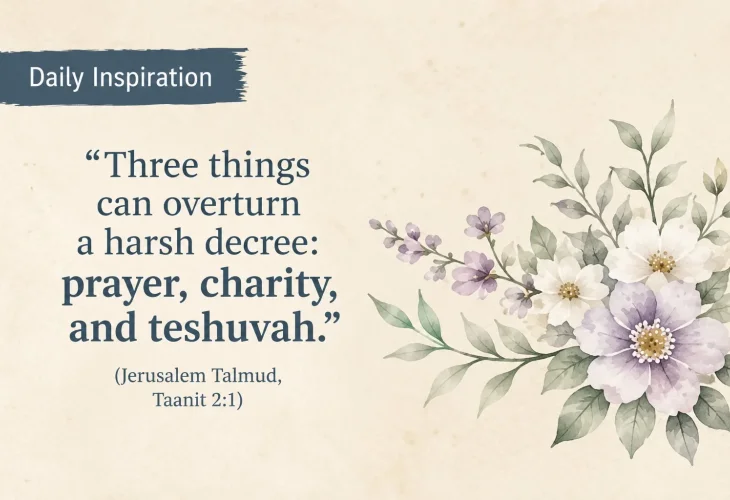
During some of the most moving moments of the Rosh Hashanah and Yom Kippur prayers, we declare: “Teshuvah, prayer, and charity can avert the severity of the decree.” How can these three actions actually change what has been decreed for a person?
The Jerusalem Talmud teaches: “Three things annul a harsh decree: prayer, charity, and teshuvah” (Jerusalem Talmud, Taanit 2:1).
Teshuvah, prayer, and charity are three powerful keys that can transform a person’s judgment. One profound explanation is that these actions change the person himself. The decree was issued upon a person in a particular spiritual state. When that person returns to Hashem, prays, and gives to others, he is no longer standing in the same place he was before.
Sometimes the decree itself may be annulled, while at others, the circumstances may remain, but the severity of the decree is softened. A person may be given greater strength, meaning, and Divine assistance, enabling him to face the situation differently.
In many High Holiday prayer books, three additional words are printed above the words teshuvah, tefillah, and tzedakah. Above teshuvah appears the word tzom, fasting; above tefillah, kol, voice; and above tzedakah, mamon, money.
Teshuvah: Choosing One Place to Change
The Rambam outlines the essential elements of teshuvah: leaving the sin behind, regretting it, resolving not to repeat it, and verbally confessing it before Hashem (Hilchot Teshuvah 2:2).
Choose one area in which you know you can improve, and make a realistic commitment that you can actually keep. Instead of resolving, “I will never speak lashon hara again,” you might decide, “I will not speak lashon hara during lunch.”
Add a brief verbal confession, even if it is whispered quietly. And do not forget the part of teshuvah that involves relationships with other people. If you may have hurt someone during the past year, take the opportunity to ask for forgiveness.
Real teshuvah does not need to begin with an enormous transformation. Sometimes it begins with one small, sincere decision to move in a better direction.
Prayer: Speaking to the One Who Hears You
The Talmud asks, “What is the service of the heart? It is prayer” (Taanit 2a).
Prayer is an opportunity for closeness and conversation with the One who created us and hears every whisper. When we remember that Someone is truly listening, even familiar words can take on new meaning.
Choose one blessing in the Amidah, such as Shema Koleinu, “Hear our voice,” and say it slowly, without rushing, as though you were truly standing before the King.
You can also follow the path emphasized by Rabbi Nachman of Breslov and set aside a few minutes each day to speak simply and personally to Hashem in your own words. Tell Him what hurts. Ask for what you need. Share what you are struggling with. And remember to say thank You for what you have.
Prayer is not merely about reciting the right words. It is about remembering that we are not alone and turning toward Hashem with what is truly in our hearts.
Charity: Opening Your Heart to Another Person
King Solomon teaches, “Charity saves from death” (Proverbs 11:4).
The Talmud tells a remarkable story about Binyamin HaTzaddik, who was responsible for distributing charity funds. During a year of famine, a woman came to him asking for food, but the charity fund was empty.
“If you do not provide for me,” she told him, “my seven children and I will die of hunger.”
Binyamin supported the woman and her children from his own money. Some time later, he became gravely ill. The ministering angels pleaded before Hashem: “Master of the Universe, You said that whoever saves one life is as though he saved an entire world. Shall Binyamin HaTzaddik, who sustained a woman and her seven children, die at such a young age?”
The decree against him was immediately torn up, and twenty-two years were added to his life (Bava Batra 11a).
One practical way to bring tzedakah into your life is to establish a regular amount to give, even if it is small. But the way we give matters too. Give graciously, and accompany the gift with a kind word. Our Sages speak highly of someone who does not merely give money to a person in need, but also comforts and encourages him with words (Bava Batra 9b).
Kindness Goes Beyond Money
Helping another person is not limited to financial giving. Our Sages teach, “Acts of kindness are greater than charity” (Sukkah 49b).
A phone call to someone who is lonely, helping an overwhelmed neighbor, offering practical assistance to someone who is struggling, or simply saying something encouraging to a person who needs to hear it are all meaningful acts of kindness.
Sometimes the greatest gift we can give another person is not money at all. It is our attention, our time, our compassion, or the feeling that someone cares.
Entering the New Year as a Different Person
Teshuvah, prayer, and charity remind us that we are not permanently bound by who we have been. Teshuvah changes our actions and the direction in which we are moving. Prayer reconnects us with our Creator. Charity opens our hearts to the needs of others.
Together, these three paths offer a powerful message as we approach the new year: We are capable of change.
That is the power of genuine teshuvah. We do not merely ask Hashem to give us a different year, but we prepare to enter that year as different people.

