

Personal Stories
The Final Words of Captain Or Mansour
Hours before entering Lebanon, Captain Or Mansour wrote about faith, mission, and trust in Hashem. His journals now reveal a powerful spiritual legacy of courage, grief, and hope.
- Michal Arieli
- | Updated
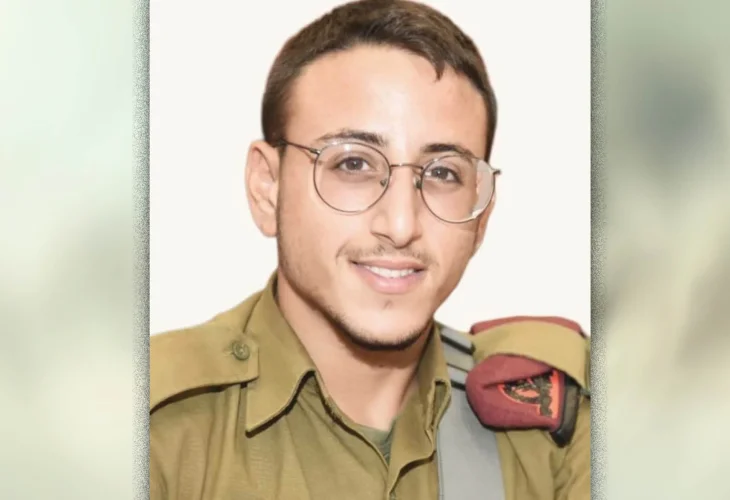 Capt. Or Mansour, of blessed memory
“Tomorrow is Erev Rosh Hashanah. Sadly, I probably won’t hear the shofar. I am grateful for the privilege of taking part in such an important mission. More than anything, I hope the residents of the north will soon be able to return home.”
Captain Or Mansour, of blessed memory, wrote those words in his journal just three hours before entering Lebanon for the first ground operation. He could not have known that they would become, in effect, his final message.
His mother, Yehudit Mansour, now shares passages from the journals he left behind. “I always knew Or kept journals, and he sometimes shared them with me,” she says. “But as time passes and we discover more notebooks, we are astonished by the depth of the spiritual world he lived in. His words have given me a new way of understanding my separation from him, and even a new way of looking at what happens in this world. They have changed the way I see life.”
Carrying Goodness Forward
Yehudit’s experience of loss began long before Or was killed. His father died when Or was only four years old, and from then on she raised him and his younger brother alone.
“Or grew up without a father figure,” she says, “but his father remained deeply present in his life.”
She shares a page Or wrote between his first and second entries into Gaza: “Today is the anniversary of my father’s passing. I feel that the only way I can release what I’m feeling is through writing. I try to reconstruct and remember more memories of my father, but I have very few. I try to focus on whatever I can remember. I simply know how good a person he was.
“I am here to carry his goodness forward as much as I can. I want to grow stronger. Stronger in my faith in Hashem, stronger in prayer, stronger in who I am and in what I expect of myself. Stronger in joy and humility, stronger in my aspirations. I want to be at peace with myself. That is the essence of life: to grow, to become stronger, and to live with joy.
“Today, one of the guys, a really good person, asked me: ‘Why did God create man? What does He gain from it?’ It was a beautiful question, and I thought I had a beautiful answer. I compared it to a father who brings children into the world because he wants to love them, raise them well, and pass something of himself on to them. The idea, so to speak, is to take the goodness within the father and transmit it to the children, to pass on the principles that will help them become good people.”
Was Or always this spiritual and introspective?
“Yes,” Yehudit says. “That was very much who he was. But he was also strikingly handsome, a gifted musician, with a huge smile and sparkling eyes. What was remarkable was that despite the pain of growing up without a father, he developed tremendous maturity and emotional depth. He had broad shoulders, emotionally speaking. He understood life and understood his own inner world, and he was always trying to refine himself further.”
Or studied at the Shaalvim Yeshiva High School. Like many soldiers who were later killed in the war, he left behind words that took on the force of a legacy only after his death.
“Wherever Hashem Places Me, That Is Where It Is Best for Me”
About a month before he was killed, on Rosh Chodesh Elul, Or wrote:
“September 4, 2024, 1 Elul, Wednesday.
“I am still carrying the question, ‘What is right and good in the eyes of Hashem?’ since the last time I wrote it. Right now, I am in a place of tremendous pressure and uncertainty, and I am beginning to understand that the only thing that will keep me sane is faith.
“Faith, and the understanding that wherever Hashem places me, that is where it will be best for me. I will truly do everything I can, but beyond that, it is no longer in my hands.
“In two months I am supposed to begin my discharge leave, which is basically the end of this period. I am really in the final moments of my military service. I keep replaying everything I have been through and everything I am going through now, and the experiences are very similar.”
“It takes great faith to read those words now,” Yehudit says. “Or was killed only a very short time before he was supposed to finish his army service. He was almost at the end.
“You can look at that as a terrible missed opportunity, or as tragic bad luck. But you can also look at it as the decision of the Creator, exactly as Or himself wrote: ‘Wherever Hashem places me, that is where it is best for me.’”
His Final Battle
Yehudit knows what happened during Or’s final hours.
“They were told they were about to cross the border,” she says. “His friends told us that Or moved to the front and declared, ‘I’m first.’
“The force entered the Lebanese village of Al-Adaisseh and fought a fierce battle against Hezbollah terrorists. Or fought at the head of the force with extraordinary courage and self-sacrifice, until his final moment.
“After Or was killed, his fellow soldiers fought under extremely difficult conditions and heavy fog to retrieve him. The first to charge forward in the effort was Captain Harel Ettinger, of blessed memory, who gave his life trying to reach Or. Captain Eitan Oster, Captain Itai Giat, and Staff Sergeant Nezer Itkin, of blessed memory, were also killed in the battle.”
How did that Rosh Hashanah begin for you?
“On Erev Rosh Hashanah, I went to the synagogue to clean and help prepare it,” she recalls. “There is a saying that those engaged in a mitzvah are protected, so perhaps that is why I was spared the knock on the door.
“When I came home, just before the holiday, I saw that the gate was open. I looked toward the entrance and saw three officers standing there.
“My heart started pounding. I understood immediately. There was no way not to.
“For twenty minutes, I stood there without moving. I looked up at the sky and spoke only to Hashem. I said, ‘Father, please, no. I am a widow, You know that, and he is my firstborn son.’
“I felt as though I physically could not move forward.”
Looking back, Yehudit describes that moment as one of the most defining moments of her life.
“As a woman of faith, I felt that even as my life was breaking apart, the Creator was there. I felt Him holding my hand and helping me receive the news. I felt that He was placing a special kind of love and strength into my heart so I could bear the intensity of the pain.
“And already at that moment, I felt that I understood the mission I had been given: to continue Or’s path by strengthening the Jewish people.”
Turning Grief Into a Mission
That mission continues to shape Yehudit’s life.
“I support bereaved families, and I also perform musically for women. I am a singer by profession, and after everything that happened, I did not stop singing. If anything, I sing more. I am now producing an album of songs I wrote. Some are in Or’s memory, and others are songs of praise and gratitude to Hashem.”
Where do you find the strength?
“The Creator gives me strength,” she says. “And He gives strength to every one of us. We simply have to believe that those strengths exist within us and learn how to draw on them.”
She says this is also what she tells other bereaved families. “Not long ago, I was at Mount Herzl and met a bereaved father who said to me, ‘What strength? You’re living in a bubble.’
“What could I say to him? That he is living in a bubble? For me, it is simply so clear that since Or was killed, I have been given special strength. I genuinely feel it.”
Do you think religious people find loss easier to bear?
“I think religious people often have a stronger language of faith and understand the concepts more naturally, but that does not mean acceptance comes easily. There is a very deep emotional process involved. It does not happen in one moment, and each person reaches it at a different stage.”
When Yehudit speaks with grieving families, she often shares the idea that “nothing bad descends from Heaven.”
“People ask me, ‘How can you say your son was killed and that this is not something bad?’ I can see how difficult that idea is for them to accept.”
Yehudit is clear that faith has not removed the grief. “Of course there are still times when it is hard,” she says. “To this day, every morning, afternoon, and evening, I go into Or’s room. It has become my prayer room. And I cry.”
But the tears, she says, hold more than pain. “It is a cry of longing and heartbreak, but there is also a great deal of acceptance and understanding in it. I thank the Creator for giving me this mission and for giving me the privilege of having a son like Or.
“I thank Him that I am able to continue Or’s mission in this world. I was privileged to dedicate a Torah scroll in his merit, establish a music room in his memory at the yeshiva where he studied, produce an album of songs, and publish a book based on his journals.
“These are all ways of preserving my son’s memory. Through them, I feel that he is still with me, that his presence continues in this world.
“People may find that difficult to understand, but it is precisely from within the pain, when I allow myself to experience it deeply, that an extraordinary power of love emerges.”
A Life Filled With Music
From childhood, Or displayed exceptional musical talent. He learned to play clarinet and piano, later taught himself guitar, and at age twenty began playing a drum set he had received for his birthday. He sang, played several instruments, and performed from a young age at community ceremonies.
“Or was always extremely busy, especially after he enlisted and served in the Egoz commando unit,” Yehudit says. “But throughout it all, he never gave up his three daily prayers or his Torah study, even when it meant sacrificing sleep.
“He left behind so many connections, sparks of hope and love, smiles and beautiful memories. How could I not be grateful for that?”
Why did your family decide to publish his writings?
“Because he asked for it,” Yehudit says.
In one of his journals, Or wrote: “My dream is that my music and melodies will make people happy, heal the sick, and strengthen those who have fallen.”
His words and his music, Yehudit says, now form one continuous legacy.
“That is what led us to create the book. It contains 180 pages documenting a military and spiritual journey at the same time, filled with insights, struggles, and emotional tools that he himself used.
“For two years, I worked on it together with my son Yochai. We added passages from Rabbi Abraham Isaac Kook and connected them with Or’s thoughts and ideas.
“In the end, the book received blessings from two prominent rabbis who read it and were deeply moved by the remarkable connection between Rabbi Kook’s teachings and Or’s own words.”
Or wrote many poems about faith and his relationship with Hashem. “If Or was certain that Hashem loved him,” Yehudit says, “then perhaps we too can simply trust and believe.
“May we merit to do so.”

