

Parshat Vayera
From the Rebbetzin's Shabbat Table - Parashat Vayeira
Avraham didn’t wait for kindness to come knocking. His open tent teaches us how reaching out to others can change who we become.
- Rebbetzin Tziporah Heller Gottlieb
- | Updated
Dear friends,
One thing I can say about us is that we generally love guests. The guests who have turned my life into one that is far richer than it would be otherwise are too numerous to list. There was Dov, who had relatives in Meah Shearim who wanted to draw him close to Torah – his father had left Yerushalayim and dropped a good deal of his Jewish identity when he headed to the Golden Medinah. His son was on his way to the world’s spiritual hot spots and was fascinated, the way an anthropologist would be, when he met the Meah Shearim branch of his family. They sent him to us for one reason – we speak English. They did everything wrong. In fact, the father of the Meah Shearim family snuck up behind him and cut off his ponytail. They sent him to a rabbi who told him that what he was seeking in India (his next planned stop) was avodah zarah. It didn’t matter. He knew truth when he saw it. They even had him go to a hafganah (and yes, he was arrested). There was as yet no yeshiva for beginners, so my first husband had him try out Torah Ohr. Even though he knew far less than the other students, he made the shoe fit. Ultimately, he married a Neve girl, and, taking his journey further, became involved with Chabad and was a successful shaliach. Rabbi Berkowitz (otherwise known as Dov) was niftar at a young age. It is a great source of inner joy to know that we were part of his journey.
Some of you know Terry Pico, a woman of enormous strength and a great sense of both humor and adventure. I met her on the bus, took her home, and stood to the side, watching her extraordinary valor, which was manifest in her adopting her sister’s children when her sister was no longer able to take care of them, and preventing them from being put up for adoption in California, where the family lived. In both instances (and the overwhelming majority of cases of our having people enter our lives), situations arose and they ended up sitting around our table.
Avraham’s way of hachnasas orchim was far different.
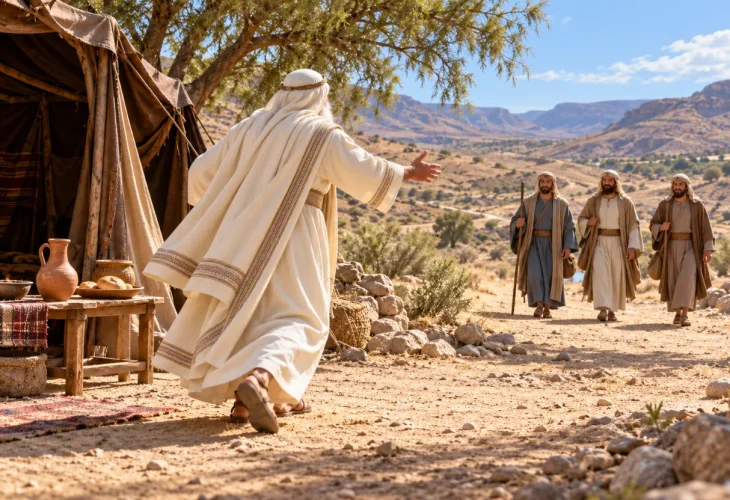
The guests didn’t just happen by. His four-door tent in the desert was there to bring them in, to experience human kindness and then learn its Divine Source, Hashem. The text of the parshah begins by saying that Hashem appeared to Avraham, who was sitting at the entrance of his tent “like the heat of the day.” You would have expected it to say, “in the heat of the day.” Kli Yakar comments that this wasn’t a sort of California way of talking. The pasuk means exactly what it says. He (Avraham) was like the heat of the day. He was burning with desire to draw people close to him, and from there to Hashem. The visitors he longed for didn’t wear rabbinic frock coats and offer expensive wine or chocolates as a hostess gift. They were (on that day, and presumably on many days) whoever happened to pass by.
It’s also very important to realize that Avraham wasn’t bored, waiting for someone to break the thick silence of the desert. He had been deep in meditation when the guests came, and moved beyond the depth of his moment with Hashem to open his house to them. This is the longest narrative about Avraham in the Torah. Even longer than the story of the Akedah.
The three guests were angels. An angel is sent by Hashem to do what He wants to have done in this world. One was assigned to heal Avraham from the brit he had just performed three days earlier. Much like Avraham’s hospitality, a brit brings Hashem’s reality into the physical world, leaving no place empty of His presence – not in the human body, the “miniature world,” where there are places you don’t expect to find Hashem, nor in the great world, which is compared to a giant human being.
The second angel was sent to tell Sarah that she would have a child, and the third angel was sent to destroy Sedom and Amorah.
The text tells us that these cities were evil and sinful. There are those mefarshim who say that “they had evil character traits, and (as a consequence) had sinful deeds,” while other mefarshim say that “they did evil deeds, and (as a consequence) became people with traits that are sinful (such as jealousy and hatred).” This leaves us with a question – which came first, the bad character traits or the sinful deeds? One approach is that you can compare this to drawing a circle. It doesn’t matter where you start. The finished circle has no observable beginning or end. Deeds affect traits, which affect deeds, which affect traits, in a cycle that is hard to break. It seems that whatever affected Sedom could never be redeemed or changed. This can take you back to the many midrashim about how low the people of Sedom fell. That was the end of their story. The story also has a beginning. Evil doesn’t have to be overt or dramatic. In Pirkei Avos, it says that a person who says, “Mine is mine, and yours is yours,” has the traits of a citizen of Sedom. There was no theft in Sedom. Just utter selfishness and egocentric self-concern. The way Avraham loved giving, they despised it, and saw it as self-destructive.
The cycle of bad deeds equal bad middot which equal bad deeds can be broken.
Rut did it. She was a princess of Moav, a descendant of Lot. Lot had every reason to be different, but as we see, he left Avraham to live in Sedom, and after its destruction wanted to maintain his distance from Avraham…. When you read Rut’s story, what you see is how she reversed the process. She did chessed after chessed. She didn’t wait for chessed to come to her. She ran after it against all odds.
We are all waiting for her descendant, Mashiach, to make his appearance and to open the door for all of us to rediscover the part of us that may seem irredeemable, the part that is stuck. There is also in every Jew a part that echoes Avraham’s Chessed and his Emunah.
Love,
Tziporah

