

Parashat Vezot HaBerachah
Moshe Rabbenu's Last Lecture
The Mystery of the Eight Final Verses of Torah
- Rabbi YY Jacobson
- | Updated
The Eulogy
Sol calls the Rabbi. “Rabbi, I am preparing for the end. I am searching for the right rabbi to officiate at my funeral and give the eulogy. So I am shopping around for the right one. It all depends, of course, on the price.”
Sol was wealthy, but stingy, and a tough guy.
“Rabbi, how much would you charge to do my eulogy?”
The Rabbi responds: “Depends on what you want. If you want a super-deluxe package, it costs $10,000. For that, you get a beautiful eulogy, during which I cry.
“For $5000 you can get a deluxe package. I give a beautiful eulogy, I say beautiful things about you, but no tears.”
“Rabbi! That’s too expensive. What can I get for 500 bucks?”
“For 500 dollars,” says the rabbi, “I will say the truth.”
The Final Verses
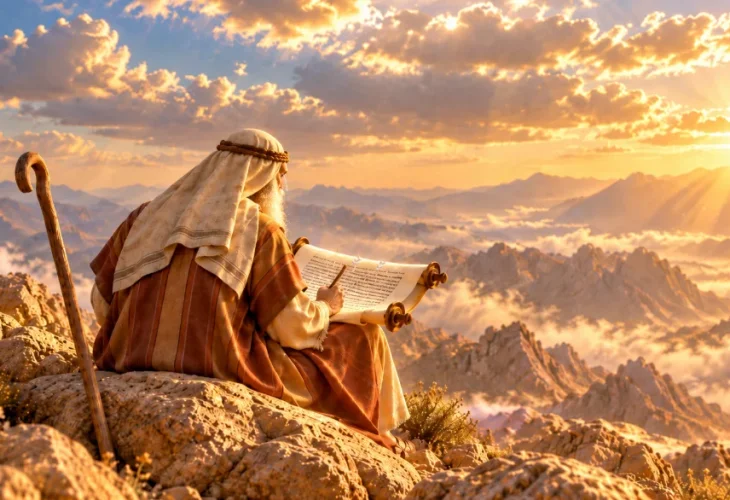
It is a fascinating question. Who wrote the final eight verses of the Torah (which we read on Simchat Torah)? Our tradition maintains that Moshe wrote the Torah. But its last verses describe his death and burial?!
Devarim Chapter 34, verses 5-12, describe the afterlife of Moshe Rabbenu.
And Moshe, the servant of the Lord, died there, in the land of Moab, by the mouth of G-d. And He buried him in the valley, in the land of Moab opposite Beth Pe'or. And no person knows the place of his burial, unto this day.
Moshe was one hundred and twenty years old when he died. His eye had not dimmed, nor had he lost his [natural] freshness….
And there was no other prophet who arose in Israel like Moshe, whom G-d knew face to face, as manifested by all the signs and wonders, which G-d had sent him to perform in the land of Egypt, to Pharaoh and all his servants, and to all his land, and all the strong hand, and all the great awe, which Moshe performed before the eyes of all Israel.
How, asks the Talmud, can a living Moshe write the words “and Moses died there”?
Rabbi Yehudah or Rabbi Nechemya say, that the last eight verses, written after Moses’ death, were written by his disciple and successor, Joshua.
Rabbi Shimon disagreed. The entire Torah was written by Moshe, as G-d tells Moshe “take this Torah Scroll and place it in the Ark.” “What happened was that up to this point G-d dictated and Moshe repeated each word and wrote it down; from this point and on (the final 8 verses of Torah), G-d dictated, and Moshe wrote with tears."
It is a haunting interpretation: ever the teacher and ever the leader, Moshe performed one last heartbreaking mission before his death: He recorded his own end.
With Tears, Not Ink
But how does Rabbi Shimon answer the question? If Moshe was alive, how can he write the untrue words “and Moshe died?”
One of the most moving interpretations comes from the great Talmudic commentators, the Yad Rameh, the Ritva, and the Maharsha. The Talmud does not mean that Moshe wrote these verses while he was crying; it means that he wrote them with tears, instead of ink.
The entire Torah was written with ink on parchment; the final eight verses of the Torah—those that tell the story of Moshe's passing—were transcribed not with ink, but with tears; with Moshe's tears.
Invisible Ink
This is how the Maharsha explains how Moshe could write these words when they did not yet happen. This sort of writing, with tears, is not permanent, its more ethereal, so it could be written even before his actual passing. Moshe's tears functioned as a kind of "invisible ink." They made an imprint on the Torah, but they would need to be revealed and reinforced with ink over time. The two answers in the Talmud are not arguing. Both are true. Moshe wrote the verses in tears, and Joshua completed the task. After Moshe's death, Joshua filled in the tears with ink, completing the Torah Scroll.
The famed Maharal of Prague gives a different explanation of why the Talmud emphasizes that Moshe wrote these words in tears. Moshe's crying marked the beginning of the mourning for his death, so the words he wrote were not false.
Yet the difficulty still exists. Even if Moshe wrote these words not with ink but with tears, how can a living person write these words truthfully, “and Moshe died,” when it did not happen yet? Even according to the Maharal’s insight, weeping for one’s death is not yet death?
A Tale of Two Torahs
It was the Baal Shem Tov (Interestingly, the same idea is shared by the Vilna Gaon) who offered a different interpretation of these Talmudic words.
The original Hebrew word the Talmud uses for tears, "דמע", can also be translated as a mixture. In the Mishnah and the Talmud, we often have a term “meduma,” which means mixed up. Moshe wrote a jumble of letters, not yet intelligible. The final verses were dictated to Moshe as scrambled letters and were thus indecipherable. It was only after his death that Joshua had the letters fall into their rightful place.
What this means is this:
The Torah contains two dimensions: one revealed, and one esoteric. The revealed Torah is the one we have before us today, which we read, learn, and reflect upon. But the very same text of Torah also possesses a different format, in which all the letters are connected, with no word or line breaks. (heresanexampleofthatsortofwriting). Nachamanides writes in his introduction to his commentary on Torah, that the entire Torah can be read as a series of Divine names!
According to this reading of Torah, the very text we have today can be read in many different ways, as it is not defined by the word break we know today. Endless different stories, messages, ideas, truths, predictions, and insights can be gleaned from the Torah, as the words are configured in so many different possible ways, and in infinitely diverse methods. A word consisting of five letters can make up 120 diverse words! Six letters can be configured in 720 ways; 8 letters in 5040 ways, etc.
In how many ways you can read 304,805 letters (the number of letters in the Torah?) in numbers we cannot fathom.
The Bible Codes which have become popular in the last few decades, employ this method. The Bible codes will point to the events of 9-11, or the Holocaust, or the Black Death, or the fall of Communism, or the 2016 victory of Donald Trump, or the Depression in 1929, or the birth and death of Maimonides, or the story of Chanukah, or the Crusades, by highlighting in a particular section a few words, for example, read backward, spelling out the year, name, and location of a particular event.
This explains how the Torah could have preceded the creation of the world, as the sages teach. This seems impossible because most of the Torah is comprised of stories that occurred after creation! How can you write about the Tree of Knowledge, or the Exodus of Egypt, when the Jews were not even there yet? Yet, it all depends which dimension of Torah you are addressing. The esoteric dimension of Torah was present pre-creation of the universe. The revealed and organized text of the Torah took shape as Moshe formatted its readable and logical text structure, with the words, verses, and sections familiar to us today.
That is, says the Baal Shem Tov, the entire Torah besides the last 8 verses! In those verses, “G-d said them and Moshe wrote them in a mixed up (bedama) fashion.” These final verses were given to him in the pre-creation format. They retained their pristine esoteric jumble. He wrote them down, but they did not read the way we read them now: “And Moshe died…”
Thus, the two opinions in the Talmud are not arguing. Moshe did indeed write the final eight verses, yet these verses he wrote in the “esoteric” realm—in which the words did not have their present configuration. He wrote them “bedama,” in their indecipherable format. The text was the same, but the letters were mixed up. It fell to Joshua to form the actual words that described his master’s death for all the subsequent generations to read.
The Final Gift
Why did Moshe weep when he wrote those final verses? Were they tears of gratitude, or of longing? Tears of regret, or joy? Was he overcome by anguish at the prospect of his own demise and him being denied entering the Promised Land? Was it due to his fears of what might become of his people? Was it the feeling of impotence in the face of frightful mortality? Or, maybe, it was the pain he felt saying goodbye to his beloved people? Writing these words, made his departure concrete, and the great lover of Israel, the faithful shepherd of Israel, the man who turned them into a people, and led them through the wilderness, could not stop the flow of tears when it was time to say goodbye?
Or maybe it was all of this, coupled with the overwhelming feeling of the magnitude of the moment. He lived for 120 years; now his soul was about to depart. How do you put that into words? Tears capture the depth of such moments far more than any words can.
Chapters Written in Tears
Is this not true for each of our lives? The Baal Shem Tov said that the Jewish people is a living Sefer Torah, and every Jew is one of its letters. Each of us adds another chapter to the sacred Scroll of Jewish history. Some of our chapters are written in ink; but others are written with tears. There are chapters in everyone's lives which are written with tears— tears of sorrow, tears of gladness, tears of awe, tears of gratitude, tears of ecstasy, and tears of facing the ultimate mystery of life.
A day before Simchat Torah we say Yizkor. How do you describe your bond with your mother? Your father? Your grandparents? Your siblings? Your aunts and uncles? Your best friends? Or, heaven forbid, your departed child? How do you describe the void their death imprinted in your heart and the longing? How do you recall their final moments here on earth, when they gave you that last gaze? How do you describe the moment you watched the earth swallow up the person you loved so dearly?
Moshe taught us—and this the last lecture he imparted to his people—that some verses in our lives, must be written not with ink, but with tears. They may be the only language to capture the magnitude, enormity, and mystery of the experience. At such moments, we need not explanations or solutions, just to be able to cry and know that someone who cares is listening.
What would it be like to name those moments in our lives which are washed with tears not as something to be hidden away or avoided, but as luminous connections with the undercurrent of spirit which enlivens all things? What scripture might we write if we allowed ourselves access to the invisible ink of our cracked-open hearts?
The Indecipherable Life Chapters
Moses left us with one more message of “Bedama.” To the Baal Shem Tov and Vilna Gaon who see in these final verses a history of cryptic confusion, Moshe's final lesson is about the radical instability of our own scroll of life. What made sense in one constellation of words or circumstances might give way to an entire new interpretation years or decades later. The letters can dance and play and move. And we must insist that they continue to do so.
Do we ever really understand our lives? Some chapters seem clear, while others are wrapped and warped in confusion, uncertainty, mystery, and questions. We view certain parts of our life and we can’t figure out how could this happen? Why did this happen? What is the meaning of these events?
But the truth is, even these experiences and events, have their own mysterious and esoteric format, even when their meaning remains unintelligible. Just because the “text” of your life seems so confusing and full of mumbo-jumbo does not mean it does not have its own mystical rhythm, transcending your present understanding. The scroll of life, like the scroll of G-d, needs to be decoded, and suddenly a whole new meaning is revealed.
Chazak!
Perhaps, this is why, as we conclude the final eight verses of the Torah, we dance exuberantly. Moshe taught us how to cry with G-d, and with ourselves, and when we know how to cry, and that the Creator and the universe are not deaf to our tears, we also know how to dance.
Moshe remains a teacher until the very end, showing us the power of tears, and the dynamic nature of the text of Torah and the text of life. From this ending that is not an ending, we may now return to the beginning of the Torah to start all over again.
Chazak chazak ve'nizchazeck.

