

Wonders of Creation
This Strange Sea Creature Can Transform Its Body in Seconds
It crawls slowly across the ocean floor, but when danger appears, the sea cucumber has an extraordinary trick that is fascinating scientists and engineers.
- יהוסף יעבץ
- | Updated
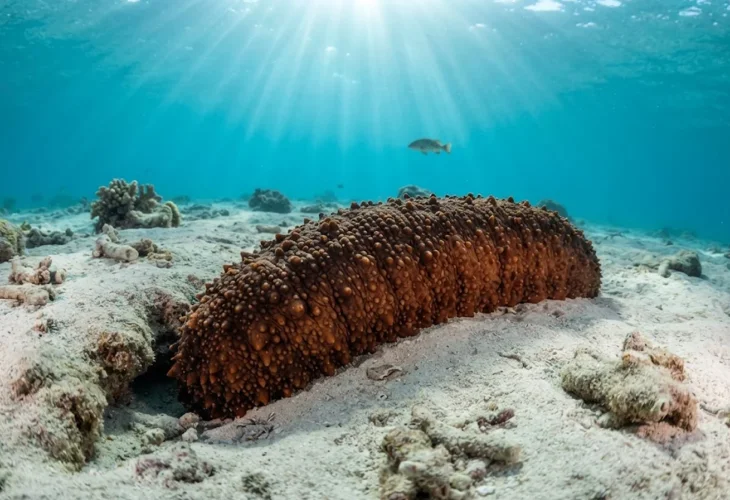
At first glance, it looks a little like an oversized cucumber lying on the ocean floor. But the sea cucumber is neither a vegetable nor a fish. It is an echinoderm, making it a relative of starfish and sea urchins.
And beneath its unassuming appearance is an extraordinary defense system. A sea cucumber can rapidly change the stiffness of its body tissues, becoming softer or more rigid when necessary. Scientists are so interested in this ability that it is inspiring research into adaptable materials for medicine, robotics, and engineering.
Meet the Sea Cucumber
There are well over a thousand species of sea cucumbers living in oceans around the world. They can be found in shallow coastal waters, around coral reefs, and on the deep seafloor.
Rather than swimming through the water like a fish, most sea cucumbers spend their lives moving slowly across the bottom using tube feet and muscular movements.
Many species act almost like underwater vacuum cleaners. They consume sediment or collect particles from the seafloor and extract organic material, including microorganisms and other nutrients. What they cannot use passes back out.
But moving slowly across the ocean floor can leave an animal vulnerable to predators, and sea cucumbers have evolved some remarkable ways to defend themselves.
One of their most unusual abilities comes from their body wall.
Sea cucumbers possess what scientists call mutable collagenous tissue, a specialized connective tissue whose mechanical properties can change rapidly and reversibly. The animal can alter the stiffness of this tissue under nervous-system control.
In practical terms, that means its body does not always have to maintain the same consistency.
When stimulated, the body-wall tissue of many sea cucumbers can become considerably stiffer. Under other circumstances, the tissue can become more flexible. In some species, particularly intense stimulation can even cause the body wall to lose its normal structural integrity.
This remarkable adaptability can help with movement, maintaining posture, and defense.
A Defense System Unlike Almost Anything Else
Some sea cucumber species have another dramatic trick.
When threatened, they can expel long structures known as Cuvierian tubules from the rear of the body. These tubules rapidly elongate and, in some species, become extremely sticky after being released.
A predator can suddenly find itself tangled in a mass of threads rather than enjoying an easy meal.
The sea cucumber's ability to alter its body's mechanical properties, however, comes from a different but equally fascinating system.
Its dermis contains collagen fibrils surrounded by other components of the extracellular matrix. Collagen is also an important structural protein in humans, where it is found in skin, tendons, ligaments, bones, and many other tissues.
What makes the sea cucumber unusual is how dramatically and rapidly the mechanical behavior of its collagen-rich tissue can change.
The collagen fibrils themselves do not simply transform into a different material. Instead, researchers have found important changes in the interactions between the fibrils and the surrounding matrix.
Electron microscopy has revealed small protrusions that can form cross-bridges between neighboring collagen fibrils. Researchers found more of these cross-bridges in stiffer tissue, while the distance between neighboring fibrils was also smaller.
Imagine a three-dimensional network of fibers. When the connections between them allow greater movement, the network is more flexible. Increase the connections and alter the surrounding matrix, and the structure becomes harder to deform.
Sea cucumber tissue can make these mechanical changes remarkably quickly, sometimes on a timescale of seconds.
Could Sea Cucumbers Inspire the Materials of the Future?
Scientists and engineers are particularly interested in this ability because most materials we use do not behave this way.
A material is generally designed to be either flexible or rigid. But imagine one that could remain soft while moving through a confined space and then become stiffer when support or protection was required.
Sea cucumbers offer a biological model for exactly this kind of adaptability.
A 2024 scientific review highlighted mutable collagenous tissue, including the sea cucumber's dermis, as an important source of inspiration for mechanically adaptable materials and devices.
Researchers have explored concepts inspired by these tissues for areas including soft robotics, biomedical applications, mechanically adjustable implants, and other responsive materials.
There is still much to learn about exactly how sea cucumbers control these extraordinary tissues, and translating a biological system into useful technology is far from simple.
But the principle is remarkable.
Sitting quietly on the ocean floor is an animal that can alter the mechanical properties of its own connective tissue in a matter of seconds.
The sea cucumber may not look particularly impressive at first glance. But its strange ability to shift between flexibility and stiffness is showing scientists that the materials of the future may have something to learn from one of the ocean's most unusual creatures.

