

Wonders of Creation
The Fish That Confused Scientists for More Than 2,000 Years
For centuries, researchers could not figure out where eels came from or how they reproduced. The truth turned out to be astonishing.
- Yehosef Yaavetz
- | Updated
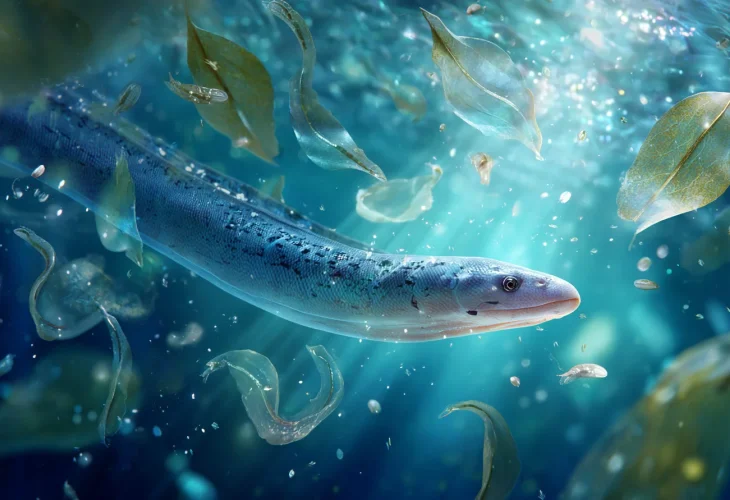
The eel is a well known fish that has fascinated scientists for thousands of years. Although many cultures eat eel, it is not kosher because it does not have the required kosher signs. But beyond the halachic question, the eel carries one of the strangest mysteries in the natural world, a mystery that puzzled humanity for more than two thousand years.
Eels swim, hunt, grow, and travel enormous distances. Yet for centuries, researchers could not answer one seemingly simple question:
Where do eels come from?
No one could find eel eggs, baby eels, or even female reproductive systems. Scientists dissected countless eels, but all of them appeared strangely similar. It was as though adult eels simply appeared out of nowhere.
Aristotle’s Ancient Theory
Around 2,300 years ago, the Greek philosopher Aristotle attempted to solve the mystery.
After failing to find any evidence of eel reproduction, he concluded that eels must somehow emerge directly from mud when warmed by the sun. As strange as that sounds today, it reflected the best explanation available at the time.
Even Sigmund Freud Tried to Solve the Mystery
Centuries later, the mystery remained unsolved.
Before becoming famous as the founder of psychoanalysis, Sigmund Freud spent years dissecting hundreds of eels searching for signs of reproduction. Yet even after examining roughly 400 eels, he still could not find clear evidence explaining how they reproduced.
The Researcher Who Followed the Clues Across the Ocean
Eventually, German researcher Johannes Schmidt dedicated 25 years to solving the puzzle.
He carefully collected and compared tiny eel larvae found across different parts of the ocean. Over time, he noticed a fascinating pattern:
The farther he traveled in one direction across the Atlantic Ocean, the smaller and younger the eels became.
That discovery eventually led him to the mysterious Sargasso Sea, an isolated region of the Atlantic Ocean often associated with the Bermuda Triangle.
There, researchers finally found the youngest eel forms ever discovered.
The Eel’s Astonishing Life Cycle
What scientists uncovered was extraordinary.
The eel undergoes dramatic transformations throughout its life, changing so completely that different stages hardly look like the same creature at all.
Stage 1: The Larva
The eel begins life as a tiny, transparent, leaf shaped creature floating in the ocean. At this stage, it looks nothing like the long eel people recognize.
Stage 2: The Glass Eel
As it develops, it becomes what scientists call a “glass eel,” still semi transparent as it begins moving toward river mouths and freshwater areas.
Stage 3: The Yellow Eel
Once in freshwater rivers and lakes, the eel develops into the more familiar “yellow eel.”
In this stage, it may live quietly for up to 25 years. Strangely, during this entire phase, the eel is not yet fully male or female and has no reproductive capability. That explains why researchers searching for reproduction for centuries found nothing.
Stage 4: The Silver Eel
Only much later does the eel transform again into a “silver eel.”
Its body changes dramatically:
- Its eyes enlarge
- Its coloring changes
- Its body adapts for deep ocean travel
- Its reproductive organs finally develop
At the same time, something astonishing happens:
The eel’s digestive system disappears completely. From that point forward, it never eats again.
One of Nature’s Most Extraordinary Journeys
The mature eel then begins one of the longest migration journeys in the animal world.
Without eating at all, it swims nearly 6,000 miles back to the Sargasso Sea, traveling through deep ocean waters sometimes reaching over a mile below the surface.
The eel survives entirely on energy reserves stored during its years living in freshwater, as though its entire earlier life was preparation for this final journey.
And the Mystery Still Is Not Fully Solved
Even today, despite satellites, tracking devices, and advanced technology, scientists still have never directly witnessed eels reproducing naturally in the wild.
Researchers can follow them almost all the way to the Sargasso Sea, but at the final stage they mysteriously disappear from observation.
The eel remains a powerful reminder that even in the modern scientific age, nature still holds remarkable mysteries humanity has yet to fully understand.

