

Faith (Emunah)
From Tel Aviv High-Tech to Shabbat: Dror Yahav’s Journey to Judaism
Dror Yahav grew up secular, served in Unit 8200, and built a career in high-tech. An unexpected moment in a German synagogue helped set him on a very different path.
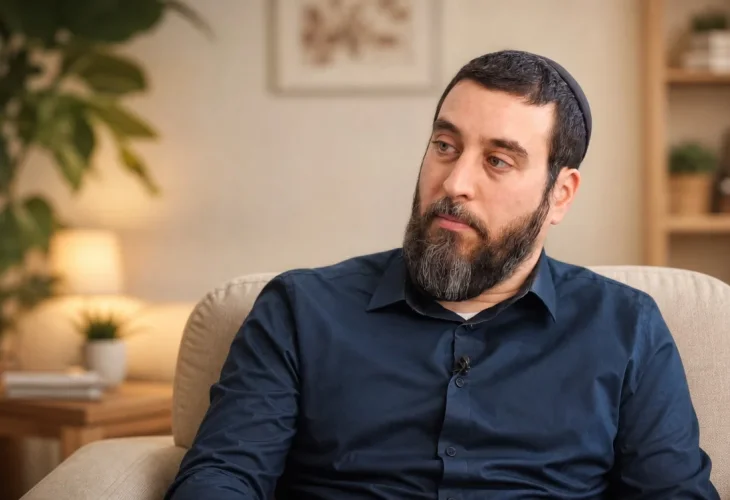
Some people follow a relatively predictable path through life. Dror Yahav’s journey has been anything but.
Raised in a secular home, he went on to serve as an officer in Unit 8200 and build a promising career in Tel Aviv’s high-tech world. But a lifelong search for meaning eventually took him somewhere he never expected: toward teshuvah, Shabbat observance, Jewish learning, writing, and a new mission to bring Jewish wisdom into the worlds of business and popular culture.
Today, at 43, Yahav is married and a father of four. Looking back, however, he says the questions that eventually transformed his life began when he was still a child.
The Search That Began at Age 10
Yahav grew up in Yavne in a secular, book-loving home. Even at a young age, he was searching for answers to questions much bigger than himself.
“At age 10, I was already trying to understand what was going on here, in this world,” he recalls. “I went to my uncle, who was a psychologist, took all of Freud’s books, and started reading about philosophy and Buddhism.”
Judaism, ironically, was not part of that search. At the time, Yahav felt far removed from religious life. He was even active in organizations with an anti-religious orientation and voted for Tommy Lapid.
Then an experience in Germany forced him to confront how little he knew about his own heritage.
Yahav had traveled there as part of an Israeli delegation. One Shabbat, the Israeli and German participants visited a synagogue together.
“We were an entirely secular Israeli delegation and didn’t know anything,” he recalls. “Suddenly, one of the German guys came over to me and said, ‘Can you show me where we are in the prayer service?’”
Yahav was unable to answer him.
“Suddenly, I realized we were in Germany, and I, the Israeli, couldn’t tell him anything about my own tradition. I was deeply embarrassed.”
That moment stayed with him.
Over time, other experiences followed. There were small prayers that seemed to be answered and a growing feeling that when he prayed, someone was listening. Slowly, the distance he had once felt from Judaism began to break down.
But becoming observant was frightening.
Yahav worried about what his friends and parents would think. He also wondered how the change would affect his relationship with his partner, who would eventually become his wife and the mother of his children.
The decisive shift came during an emotional evening on the streets of Givatayim. There, Yahav says, he came to understand the power of sincere prayer offered not only for oneself, but for the good of everyone.
Eventually, he took the step that had once seemed so intimidating and began observing Shabbat.
From High-Tech to a Life of Jewish Meaning
After completing his IDF service, Yahav entered Tel Aviv’s high-tech world and joined a startup. Professionally, he appeared to be on a promising path. Internally, however, something else was pulling him.
It started simply.
Yahav began hanging a weekly parashat hashavua sheet in the company break room. What began as a small initiative soon developed into a popular regular class.
Eventually, he realized that the direction of his life had changed. He left the tech world and moved into writing, editing, and Jewish content.
Yahav became involved in book editing and worked on a number of prominent projects, including a book connected to Hadar Goldin, z”l, as well as books by Rabbi Michael Friedman. He also led digital content projects.
Today, Yahav is among the leaders of “Value,” a business community for young managers between the ages of 25 and 35 from fields including technology and banking.
The group seeks to bring together professional leadership with values, depth, and ideas drawn from Jewish wisdom.
“The dream is to create a new generation of Israeli businesspeople who will change the country and make it far more prosperous, united, and values-driven,” Yahav says.
Bringing Jewish Depth Into a Thriller
Yahav’s writing career also took an unexpected turn.
After publishing the successful nonfiction book Just Curious, written for people beginning their own journey toward Judaism, he decided to try something completely different: a thriller titled Don’t Look at Me Like That.
Why move from Jewish nonfiction to suspense?
“People are on Netflix and HBO today. It draws them in,” Yahav explains. “There is something in human nature that is drawn to stories.”
Rather than fighting that attraction, he wanted to use it.
“I wanted to bring holiness and depth into a genre that is usually saturated with violence, so that the reader would not only enjoy the suspense until 4 or 5 in the morning, but also take something real with them for the soul.”
The novel combines a detective story with experiences drawn from the complex world of people undergoing teshuvah.
Writing fiction also gave Yahav an unexpected perspective on control.
“On one hand, you feel a little like the Hashem of your characters,” he says. “And on the other, you discover that the characters take on lives of their own and lead you into unplanned places.”
The Two Mistakes He Made During Teshuvah
After years of living an observant Jewish life, Yahav can now look back at his early teshuvah journey with greater perspective. In particular, he identifies two mistakes that he believes others beginning a similar journey should try to avoid.
The first is wanting everyone else to change with you.
Discovering Judaism can be exhilarating. When something suddenly brings enormous meaning into your own life, the instinct is often to share it immediately and convince the people you love to experience the same thing.
But pushing family and friends to change at the same pace can have the opposite effect. Instead of bringing them closer, it can push them away.
The second mistake is losing your own identity.
A person beginning to become more observant may feel that becoming religious means adopting an entirely new personality, appearance, or way of being. Yahav learned that teshuvah does not have to mean erasing everything that came before.
Your personality, experiences, talents, interests, and the life you lived before becoming observant can all become part of the person you are building.
For Yahav, that lesson can be seen throughout his own story. The curious 10-year-old reading philosophy, the Unit 8200 officer, the high-tech professional, the editor, the businessman, and the Jewish writer were not separate identities that had to replace one another.
They became different chapters of the same journey.

