Magazine
“My Parents Threatened to Cut Us Out of the Will”
Three Kentucky sisters faced a choice: marry Jewish or lose their inheritance. For Stephanie (Shoshana), that ultimatum led to an unexpected journey to Israel, and a remarkable turn of events.
- Shira Dabush
- | Updated
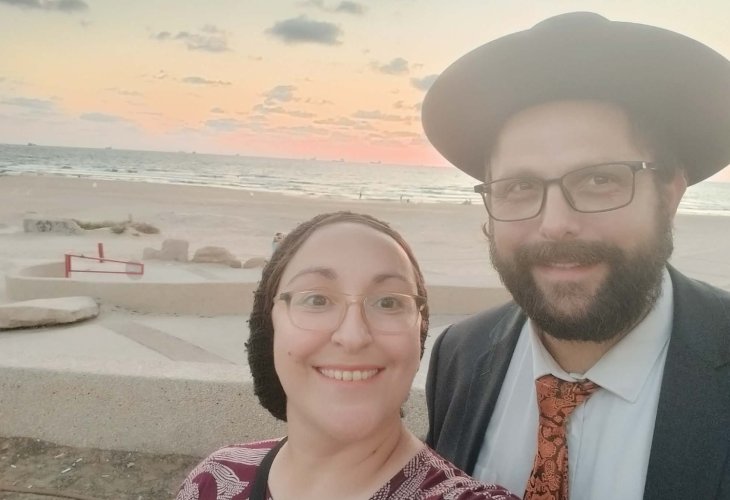 Shoshana Billiack and her husband
The Friedmans of Louisville, Kentucky, were a Conservative Jewish family who never saw a need to make too much of Jewish values. Their three daughters knew they were Jewish and even celebrated a bat mitzvah, but when it came to relationships or personal choices, their parents tended not to interfere.
“We had no boundaries, and so it turned out that in adulthood, all three of us dated non-Jewish partners,” Shoshana Billiack, who was then Stephanie Friedman, tells me today. “We dated whoever we wanted.” Only when her parents realized that everything would be different in the next generation, and that none of their descendants might even remember being Jewish, did the penny drop. They gave their daughters a harsh, almost impossible ultimatum. “They hit a painful nerve: ‘Either you marry a Jew, or we take you out of the will.’”
One could argue about that ultimatum, about its force and the way it was delivered, but one thing was beyond argument: it set the three sisters on a far-reaching change in their lives, so much so that all three eventually broke up with those partners. “It simply made us stop and take a close look at our Judaism,” Shoshana recalls. If Judaism mattered so much to their parents that they were willing to set such an extreme condition, she says, the sisters felt it might be time for them to find out what it meant to them, too. “In fact, it was much more than that, because suddenly it brought us to the question of what place Judaism would have in the home we wanted to build.”
And then they set out on a journey.
“We found ourselves traveling to Israel, to Jerusalem, and signing up for the JEWEL program,” she recalls. JEWEL is a Jewish studies program for women, in which Jewish women from different backgrounds encounter Jewish values, prayer, thought and identity up close. For the three sisters it was an important starting point, because it was from there that their paths began to diverge. “My older sister met her husband through a Jewish dating site, stayed in the U.S., and built her home there. My middle sister met an Israeli in New York, married him, and later made aliyah. And me, well, mine was a bit more complicated,” she says with a smile.
When she finished the JEWEL program, Shoshana decided to enroll at the Neve Yerushalayim seminary, and she stayed there for more than three years. “Neve Yerushalayim was the place where I really got to know Judaism,” she explains. Over those years she was drawn deeply into the Orthodox world, which, on the face of it, she had no chance of ever reaching. Alongside her Jewish studies she continued the academic track she had begun earlier and even completed it, but then she had to choose again. This time the choice was no longer her parents’, but her own: make aliyah for good, marry a Jewish man and build her life as a haredi woman in Israel, or go back to the U.S.?
“In 2009 I made aliyah, and I felt I was closing a circle. Not only did I not marry a non-Jewish man, I chose an Orthodox life, married a haredi man, and we live in Beit Shemesh with our five children.”
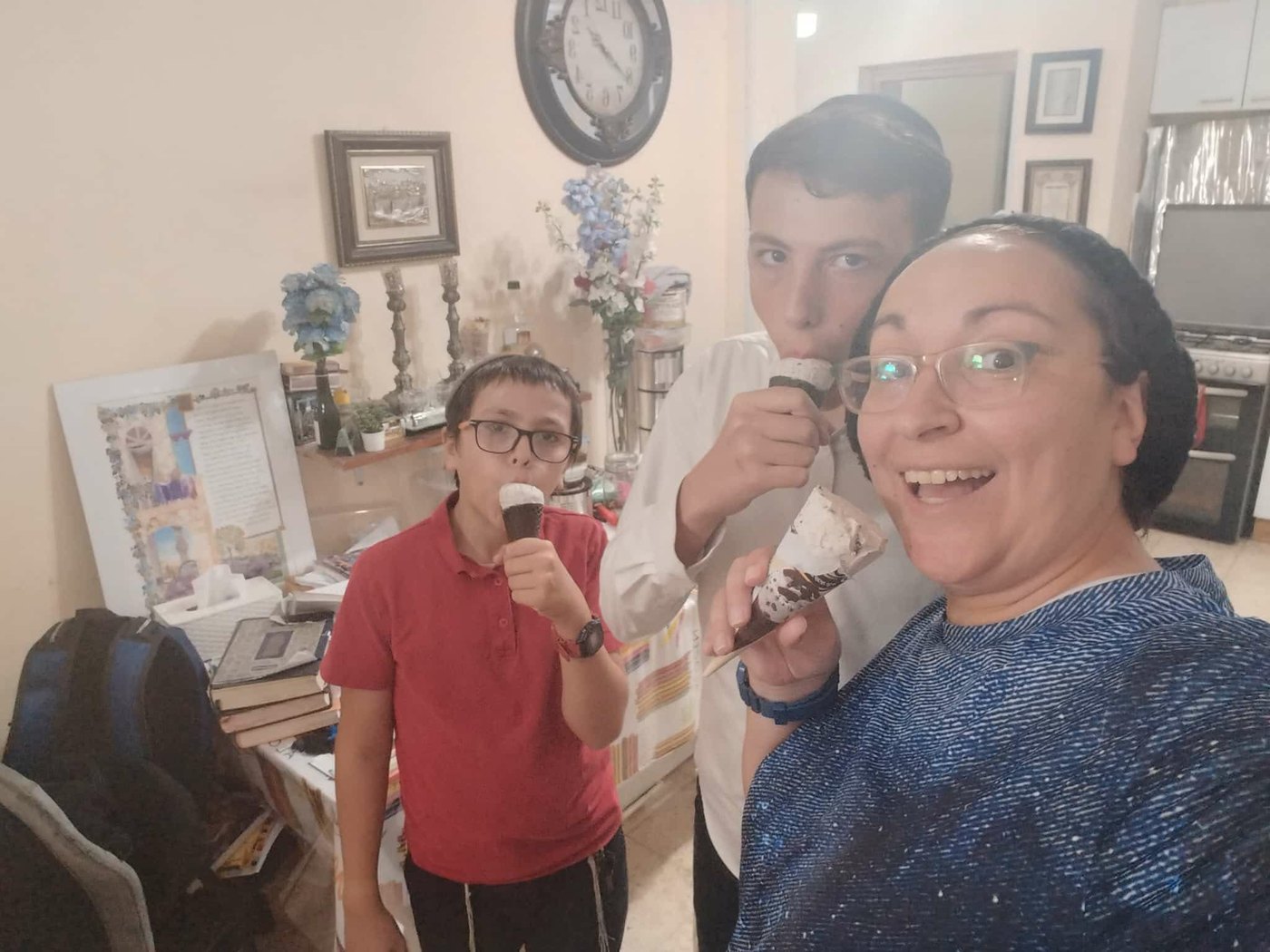 Ice cream break at home with two of her sons
But the move to Israel and the founding of a haredi home were not the end of Billiack’s journey. Throughout her years at Neve Yerushalayim, she didn’t give up on academia either, and she completed a degree in liberal studies through Thomas Edison State University. In a sense she was living between two worlds. On one side was the young American who had arrived with somewhat bourgeois plans and aspirations; on the other, slowly taking shape within her, was a new woman: modest, appreciating the value of Torah and committed to observing the commandments.
How does that conflict work out, in the end? Although she completed the degree, as the years went by it became clearer and clearer to her that the life she wanted to build was no longer in the place she had come from.
The change of her name from Stephanie to Shoshana also became a symbol of this move. After her marriage the couple moved to Beit Shemesh, and it was only natural that her name become more Israeli.
Over the years she and her husband had five sons. But it was after the birth of her fifth child that she faced the hardest test of her life: severe postpartum depression that even antidepressants failed to cure. “They gave me an unusual feeling of being high, and I felt like I was constantly jumping from one thing to the next, without a drop of rest,” she recalls.
“With the fifth birth, everything changed. I felt like I was entering darkness.”
This crisis changed the course of her life once more, but it also created an unexpected link between what she had been through and the profession she chose as a result. “After I came out of that period, I decided I wanted to help other women who go through this and experience what I experienced, and from that place I turned to studying massage and doula work, and I started accompanying women during pregnancy and after birth.”
Why do you think women need support during this period? After all, we all go through it.
“The period of pregnancy and birth can be far from the picture of joy that the people around you expect to see, and many women go through great difficulties during this time and need someone who will truly see them. One of the goals I set for myself after what I went through is to help women come to their birth experience from a good place with themselves, and to feel that they’re not alone in their most vulnerable moments, so to speak.”
In Shoshana’s case, this sensitivity to women after childbirth grew out of a physical and emotional experience that even she struggled, at the time, to explain.
She remembers her first four births as relatively quick and easy. “My first birth lasted about four hours. I gave birth to my second at home, in the bathtub, about an hour after the contractions began. By the third I already knew my births were fast, so with the first contraction I drove to the hospital, and in the end I gave birth in the admissions room, before I even made it to the delivery room. The fourth was similar. Thank God, they were all fast and easy.”
But with the fifth birth, as noted, everything changed.
“My water broke, and I thought that if your water breaks you have to go to the hospital right away, but when I got there I had no contractions at all, so they put me in a bed, gave me Pitocin, and because I was GBS-positive I also got antibiotics. I was like that for 12 or 14 hours, with almost no progress, just two centimeters.”
The hardest part, she says, was the feeling of helplessness. “I felt miserable and trapped. The midwife wouldn’t let me get out of bed and wouldn’t let me walk around. In the end, when her shift was over, I noticed the next midwife and said to her, ‘Get me out of this bed, I have to get up.’ She let me walk around, and within an hour I gave birth.”
Shoshana can’t say exactly what caused the depression that followed, and she is careful not to tie it to a single medical cause. But for her, the experience of that birth marked a clear turning point. “After the birth I felt like I was entering darkness. I didn’t want to get out of bed, I had no motivation to move. I only wanted to sleep. I felt very closed off, as if I wanted to curl up inside myself and not be near anyone. It’s very hard to explain that feeling to someone who hasn’t experienced it.”
What made you keep functioning even though you felt so bad?
“The baby. When you have a baby, there’s still something inside you that wants to be there for him. I wanted to get up, I wanted to help, I wanted to make sure he was okay. I still had that maternal instinct. That’s what held me up.”
At some point she realized she couldn’t go on like that and went to see a doctor. “I told him, ‘I don’t want to feel this way. Something is wrong with me.’ I asked for an antidepressant. Afterward I felt that it might have pushed me into a very high state, almost manic. I started having ups and downs, and then they started talking to me about bipolar disorder.”
Only later, she says, did someone she met explain to her how much the period after birth demands attention to the most basic things. “Women need to sleep. They need to eat. Drink water. Take care of their basic needs. Sometimes, precisely after birth, when everyone is looking at the baby, the mother is forgotten.”
And today, when she accompanies other women, these are exactly the places she returns to.
“I didn’t want to be the most religious in the family”
But the crisis after the birth was not the only struggle that accompanied Shoshana over the years. The move from the Conservative world to a haredi life was also, she says, far less smooth than one might imagine from the outside.
“My family is really a ‘live and let live’ family. The three sisters are at different levels of religious observance, and for years everyone looked at me as if I were the ‘most religious’ one in the family. That was hard for me. I didn’t want to be the most religious. I just wanted to be like everyone else, to get along with everyone and to feel that we could be together without religion becoming a partition.”
Over time, tensions also formed around this gap. “I think it sometimes created a barrier between my husband and my family, and also between me and my husband. It was hard for me to take on the haredi way of life. There were things I told myself, ‘I don’t want to do this, I don’t want to give this up,’ and sometimes I felt pressure to conform.”
She recalls that even after she began studying at Neve Yerushalayim, the change was very gradual. “When I got married I was still wearing denim skirts. I wore socks, not tights. At Neve they don’t force you to take on everything at once. You can progress at your own pace.” Over the years she has also learned to look differently at the differences between religious people. “There are so many ‘boxes’ that people try to put you in. Today I truly think nobody should judge other people. Everyone should be where they are.”
The Shabbat before the wedding that changed her perspective
The gap stood out especially in her relationship with her parents, who don’t observe Shabbat or keep kosher. “It used to bother me a lot,” she admits. “The Shabbat before my wedding I was really angry at them. I said, ‘Come on, just one Shabbat. The Shabbat before my wedding.’”
The wedding was held in Kentucky, at her parents’ request. Some of her friends from Neve came from New York and Baltimore, and a festive Shabbat was held at the family home. But the house was not within walking distance of a synagogue. “My parents wanted to get to synagogue and be part of everything that was happening there, they didn’t want to miss out. I told my mom, ‘Come on, just one Shabbat.’ But she drove. She wanted to be part of the event.”
Almost 18 years later, Shoshana says her attitude has changed.
“Last summer, when we were in Kentucky, we stayed near the synagogue so that we could walk. My parents came to us by car, and it was no longer an issue. I didn’t say anything to them. They drive to synagogue, we walk, that’s the reality and I no longer try to change it.”
“All of this started because I wanted a relationship with my parents”
Beneath the religious change, however, a deeper pain lingered over the years. The very parents who set the ultimatum that sent her to examine her Judaism ended up thousands of miles away from her. “When I was facing the decision of whether to marry a Jew, they told me, ‘If you don’t marry a Jew, we will disown you and we will have no contact with you.’ So I started exploring Judaism seriously, among other reasons because it was very important to me to preserve my relationship with them.”
But life took an unexpected turn. Shoshana became religious, married a Jewish man and moved to Israel, while her parents stayed in Kentucky.
“Today I can talk to them on the phone and see them maybe once a year, but it’s not really the same. Sometimes I think to myself: maybe even if I had married a non-Jew, in the end they would have forgiven me, and maybe then, too, we would have managed to stay in touch.”
So do you sometimes regret the choice to stay in Israel?
“I don’t think it’s regret, but it is definitely a struggle. I would like to live closer to my parents. They also wanted me to live near them. In the first years after I got married they kept saying to me, ‘Now that you’ve married a Jew, why don’t you come back to Kentucky? We’ll even buy you a house here.’”
But Shoshana stayed in Israel.
“In the long run, I truly believe the best place for Jews to live is Israel. I have five sons, and I want them to marry Jewish women and live in Israel, because I think that here they have the best chance of staying connected to Judaism.” She also looks to the story of one of her sisters, who lives in the United States and has moved between different communities without finding a full sense of belonging.
“In Kentucky there are almost no Jews, and the ones who are there are mostly not very religious. It’s very easy to get swept into a different way of life. So even though I miss my parents and even though the distance is hard for me, I still feel that the choice to live here is the right one for my family.”
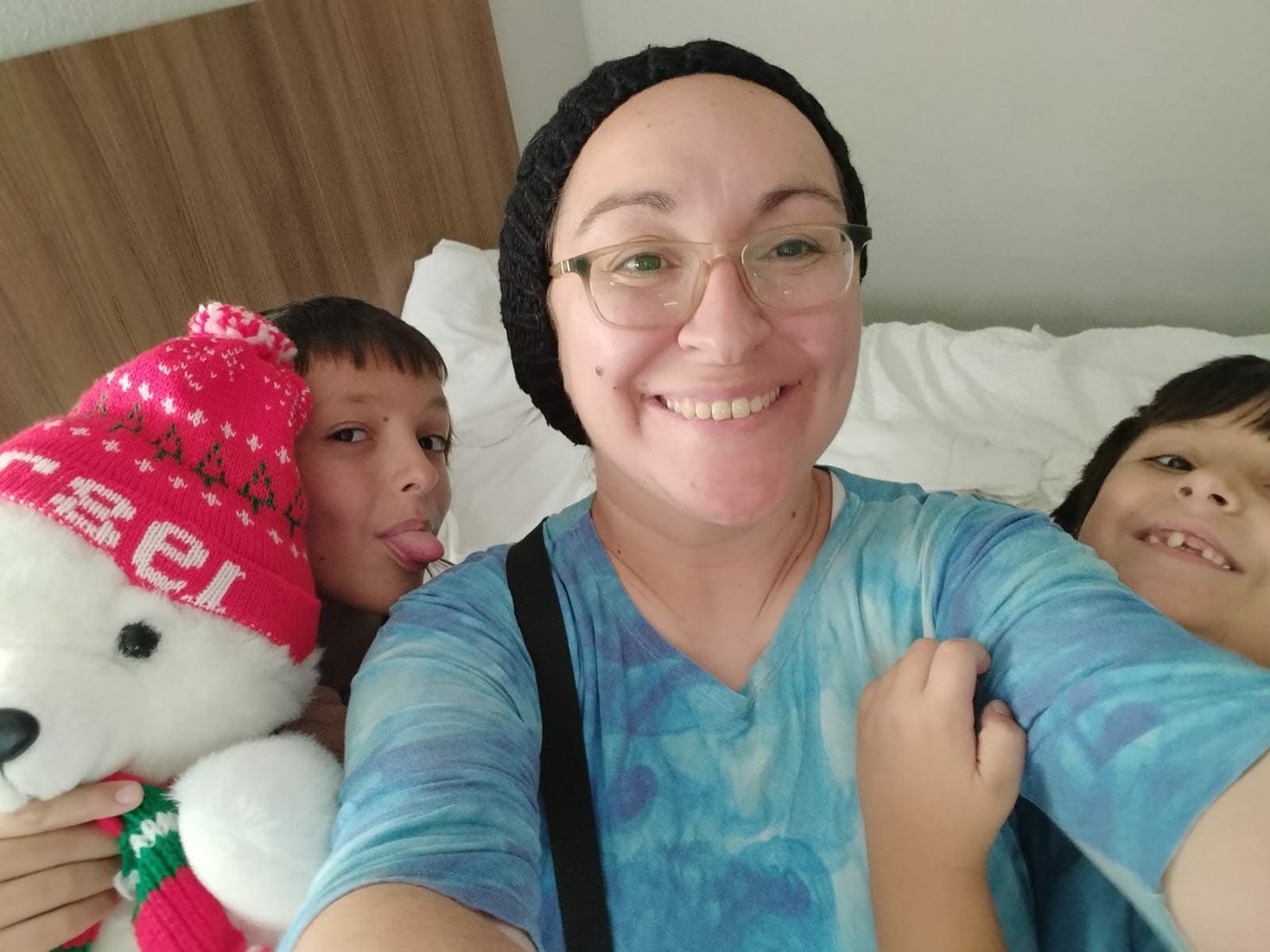 Shoshana with two of her five sons
Still, she doesn’t try to sugarcoat the cost. “I want a relationship with them. I call, I try to keep in touch, but it’s not the same. I wish I could live closer to them.”
Is there a chance that will happen at some point?
Shoshana shakes her head. “I just fell in love with the country,” she sums up. “And with the idea that the Messiah is coming soon, and that I want to be part of it.”