

Torah Personalities
5 Powerful Life Lessons From Rabbi Ovadia Yosef
Discover five inspiring teachings from Rabbi Ovadia Yosef z”l on Torah learning, helping others, personal growth, and leaving a lasting spiritual legacy.
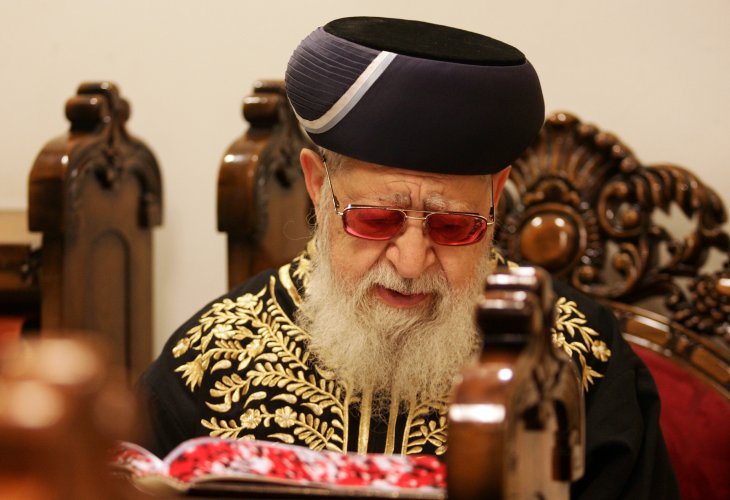 Rabbi Ovadia Yosef (Photo: Kobi Gideon / Flash 90)
Thirteen years have passed since the passing of Rabbi Ovadia Yosef z”l, one of the most influential Torah scholars and halachic authorities of recent generations. A prolific author and spiritual leader, he dedicated his life to spreading Torah, strengthening Jewish observance, and making Jewish learning accessible to people from all walks of life.
In honor of his memory, we look back at five powerful teachings that reflect his approach to Torah study, personal growth, and responsibility toward others.
1. Don't Keep Your Torah Learning to Yourself
Rabbi Ovadia Yosef repeatedly encouraged avreichim, married men engaged in full-time Torah study, to share their knowledge with the wider community.
“Dear students! Dear avreichim! Know that you are learning Torah well. Be strong and courageous! But we must remember: the masses are waiting for us.”
He reminded his students that many Jews spend their days working to support their families and may have limited opportunities to study Torah.
“Every scholar, every avreich, should hold Torah classes, even small ones, for a minyan of people, or fewer than a minyan, in the synagogue where he prays.”
He urged them not to focus exclusively on their own advancement while overlooking those eager to learn.
“A person should not think only about his own learning. There are people waiting for you. They want to learn Torah, they want to hear words of purity. Give it to them!”
For Rabbi Ovadia, sharing Torah was not merely an additional responsibility. It was an essential part of what it meant to be a Torah scholar.
2. Help Those Who Struggle With Learning
Rabbi Ovadia also emphasized the importance of helping fellow students who found their studies difficult.
He explained that some students understand a passage after reading it only once, while others need more time, patience, and guidance.
Those blessed with a natural ability to learn, he taught, should use their gifts to help others succeed.
“They should devote time to those who do not understand. True, he is learning, thank Hashem, and he can advance further, but the other student lacks someone to teach him.”
Rather than viewing time spent helping another student as time taken away from personal progress, Rabbi Ovadia saw it as a tremendous merit.
“Devote time to him; guide him without measure. In the end, that other student will grow as well, and it will all be credited to the one who taught him Torah.”
He connected this responsibility to the Torah's commandment to “Love your fellow as yourself.”
The message is simple but powerful: genuine greatness in Torah is not measured only by how much a person knows, but also by how much they help others learn.
3. Always Look Upward and Keep Growing
To illustrate the importance of striving for greatness, Rabbi Ovadia shared a story about Rabbi Shneur Zalman of Liadi, the author of the Tanya, and his young grandson, who would later become the renowned Tzemach Tzedek.
One day, the grandfather noticed his eight-year-old grandson standing at the top of a tall pole.
When he asked how the boy had managed to climb so high while the other children had failed, his grandson explained that the others had looked down halfway through, become frightened by the height, and fallen.
“I decided not to look down at the ground, only upward,” the boy said. “I looked upward and managed to climb.”
His grandfather turned the experience into a lesson for life.
“My son, let this be a lesson for your entire life. Do not look at people who are smaller than you; look at people who are greater than you. Go from strength to strength in order to learn Torah.”
Rabbi Ovadia connected this teaching to the verse in Proverbs (15:24): “The path of life rises upward for the wise.”
His message was that a person should continually seek inspiration from those who have reached greater spiritual heights, rather than becoming satisfied with their current level.
He reinforced this lesson with another story, this time about Rabbi Yosef Yedid, who longed to dedicate himself to Torah study but was unable to do so because of his family's financial difficulties.
As a young boy, Rabbi Yosef had to help his father teach small children the Hebrew alphabet. Although he wanted to advance in his own learning, his circumstances prevented him from doing so.
One night, he entered a synagogue at midnight and began crying beside the Torah ark.
“Master of the Universe, what will become of me? I want to learn Torah. What will become of me?”
The kabbalist Rabbi Shaul Kassin happened to pass by and heard his cries. After learning about the boy's situation, he promised to help.
Rabbi Kassin approached a wealthy man named Silvera and arranged financial support so that the young scholar could devote himself to Torah study.
Rabbi Yosef Yedid eventually became a distinguished Torah scholar and author of several works on halacha. Rabbi Ezra Attiya z”l later spoke highly of the wisdom and depth of his Torah classes.
Rabbi Ovadia drew an important lesson from the story: when someone sincerely wants to grow in Torah but faces obstacles, they should turn to Hashem in prayer and continue seeking a way forward.
“A person was not created to remain in one place,” he taught. “Whoever stays in one place, that is the beginning of decline.”
4. Never Underestimate What You Can Become
Rabbi Ovadia often reminded his students that even the greatest Torah scholars began as ordinary children.
He recalled his own early years at Porat Yosef Yeshiva, when the institution had only around 70 students.
Looking at the growing number of young men dedicating their lives to Torah, he expressed deep gratitude to Hashem and praised the families who had encouraged their sons to pursue Torah learning.
He also remembered beginning to write Torah insights when he was approximately 18 years old.
“When I was a young student, I would write. Of course, I did not write things that stood at the heights of the world, but I wrote.”
Some people laughed at his efforts and questioned what he hoped to accomplish. Yet he continued writing, particularly about halacha, a subject especially close to his heart.
Years later, he reflected that while those who had mocked him had not produced books of their own, he had already authored 40 volumes.
His message to his students was not to become discouraged by humble beginnings.
“Rambam, of blessed memory, was a child just like you. He was not born Rambam; he was born an ordinary child.”
He reminded them that the Rambam had once been a young boy named Moshe, learning and gradually progressing through his studies.
“Who knew that Rambam would grow from him? No one knew.”
Rabbi Ovadia encouraged every student to recognize their potential and strive toward greatness in Torah and yirat Shamayim, reverence for Heaven.
“Therefore, do not lose heart,” he told them. “Go from strength to strength.”
5. Write Down Your Torah Insights, Even the Small Ones
One of Rabbi Ovadia's recurring messages was the importance of recording Torah insights and eventually sharing them with others.
He believed that writing was not reserved for established scholars. Even a young student who had developed a seemingly small insight should make the effort to preserve it.
To illustrate the lasting influence of Torah writing, he recounted a remarkable story about the author of Chiburei HaLeket, a work of ethical instruction written centuries earlier.
According to the account Rabbi Ovadia related, the author became gravely ill shortly before Shavuot. His condition deteriorated until he lost consciousness, and the doctors believed he had only a short time left to live.
His family even summoned the chevra kadisha, the Jewish burial society, to begin making preparations.
The author later described experiencing a vision of an angel holding a burning candle. He watched the flame grow weaker until it went out, only to light again moments later.
When he asked what the candle represented, the angel explained that it symbolized his life.
Although his allotted years had come to an end, he was told that he would be granted another 15 years because he was destined to publish a book that would inspire many people to return to Torah observance.
Soon afterward, the man regained consciousness and began to recover.
Three days later, on Shavuot, he was called to the Torah for the reading of the Ten Commandments. He then recited the blessing of HaGomel, traditionally said after surviving a dangerous situation.
The congregation, which had been preparing for his funeral only days earlier, was overcome with emotion.
The author went on to complete the book, fulfilling what he described in his account.
Rabbi Ovadia shared the story to emphasize the tremendous spiritual value of bringing merit to others through Torah.
“A person does not learn only for himself,” he explained.
He urged his students to develop the habit of writing down their ideas, even if they initially seemed insignificant.
“Write down every insight, even a small one,” he encouraged. “Bring your insights to light; publish books, write books.”
He reminded them that the writings of Torah scholars continue to influence generations long after their authors have passed away.
“Those who wrote books, we still study their books today, and we live by their words.”
For Rabbi Ovadia, writing Torah was a way of ensuring that one's learning could continue benefiting others far into the future.
His message was one of both humility and ambition: never assume that your knowledge is too limited, your beginnings too small, or your contribution too insignificant to matter.
Thirteen years after his passing, Rabbi Ovadia Yosef's own life stands as a powerful example of these teachings. Through his books, rulings, lessons, and the countless students he inspired, his Torah continues to reach people around the world.
His legacy reminds us that Torah learning is not only about personal achievement. It is about growing, helping others grow, and sharing whatever wisdom we have been privileged to receive.

