

Genesis
The Promise of New Beginnings
As we return to the opening stories of the Torah, the Israeli autumn reminds us that the end of one season can be the beginning of another.
- Rachel Wigman
- | Updated
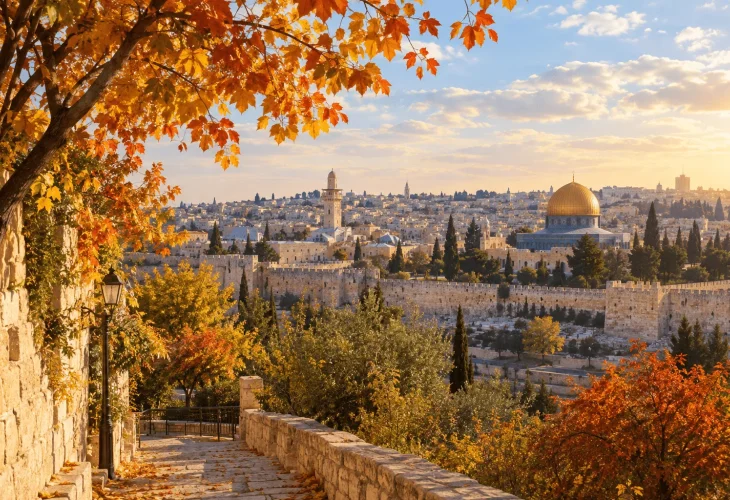
Fall in the American northeast, where I grew up, is something magical. The various hues of green from the summer give way to a riot of colors blanketing the landscape. If you’re lucky enough to find yourself at a lookout or, say, a mountaintop, it’s enough to steal your breath away. And the sunrises at this time of year are absolutely magnificent—the angle at which the sun rises, combined with the signature autumn moisture in the air, makes for the most beautiful sunrises of the year.
And yet, as much as I loved the beauty of the fall, it was always tempered by the fact that it signified an ending. After the leaves changed colors, they fell from the trees, leaving a canopy of bare branches against a cold sky. The days grew increasingly shorter, with fewer and fewer hours of daylight, and the long nights inspired nothing more than curling up under a blanket with a hot drink.
To that end, restarting the Torah cycle with the book of Genesis following the holiday of Sukkot always came with mixed feelings. On the one hand, there’s the excitement that comes along with starting from the beginning, even if it’s a beginning that we’ve seen again and again and again. On the other hand, though, was the winding down of summer and moving into the human version of hibernation, which seemed counter to the freshness that should come along with that restart.
Truth be told, I love the book of Genesis. It is absolutely loaded with themes that continue to instruct us, with characters who continue to inspire us, and with stories that continue to instruct us. In fact, Nachmanides names it, “The Book of Creation,” for it contains not just the story of creation (which takes all of thirty one verses), but it contains the stories of our forefathers which portend that which will happen to their children—us. As Nachmanides explains in a comment on Genesis 12:6, “Everything that happened to our fathers is a sign for their children…all of [the stories] come to teach us about the future.”
The book of Genesis, then, as much as it is exciting and full of wonderful stories that we love to learn, is really a book that is pregnant with possibility. Abraham, Isaac, and Jacob cannot be compared to Achilles, Nestor, and Odysseus; although there is much to learn from the latter three, these archetypical characters are mythological figures whose actions—real or imagined—do not make waves across the space-time continuum. By contrast, we find history itself playing out in the footsteps of our ancestors, beginning with Adam and Eve at the dawn of humanity and ending with the peaceful death of Joseph in Egypt at the close of Genesis in twelve weeks’ time.
It was not until I moved to Israel that I fully appreciated the worlds that are laid open for us in Genesis, because it was not until I lived in Israel that I could begin to reconcile the discord that existed between the season, which signified an end, and the book, which signified a beginning. If I’m being brutally honest, the fact that it took me so long is probably a poor reflection of my character, yet for so many years, I could not bridge that gap. Until, that is, that I lived in a country where fall itself signifies a beginning.
When I first made aliyah, everyone warned me that there’s no such thing as fall here in Israel. And while they are correct that fall here does not look like the fall I grew up with, it absolutely does exist. The heat of the summer breaks as the days grow steadily cooler with nights even colder. Already in Jerusalem, you need an extra layer when going out at night because of the chill in the air. There’s dew on the ground in the morning, there are clouds in the sky, and the storks are beginning their winter migration through Israel’s skies. It has already rained, and with the kind of winter that is being predicted, we are in for a very wet, very cold winter this year.
Which means that the hillsides that are currently dry and yellow will soon become verdant. It means that the bushes that have been brittle and dry since the spring will come back to life. It means pomegranates and citrus fruits will be back in stores. It means that fields are being plowed and planted now, as the days grow shorter and the nights grow longer, because while we’ll be inside with a warm drink and a cozy blanket, God will send the rains of blessing for us to reap the benefits of the bounty of the land.
And so, as we roll the Torah scroll back to the beginning, as the days cool off and the nights get long, we open up a world of possibilities in which some leaves will fall, but they’ll make room for the new life that will come in their wake. We’ll read the stories of our ancestors and see echoes of our lives within those stories. And we’ll take the opportunities that come with the new year to plant ourselves anew and be showered with the gentle drops of God’s blessings.

