Genesis
The First Revolutionary
Are You Brave Enough to Go Against the Current?
- Rabbi Akiva Tatz
- | Updated
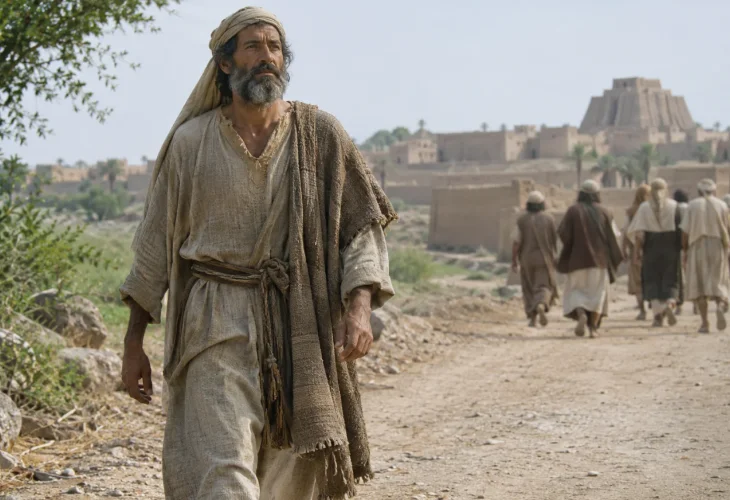
Avraham, the originator, was the archetypal iconoclast, dismantling all that was previously accepted. There was nothing that he did simply because it had been done before…
“These are the generations of the heavens and the earth b’hibar’am – in their being created” (Genesis 2:4). The word b’hibar’am comprises the same letters as b’Avraham – with (or for) Avraham. The heavens and the earth are created for this man; he is the radical chooser, that form of man for which the creation exists. “Avraham” is numerically equivalent to the number of parts of the human body and the corresponding number of positive commandments (248); his essence corresponds to the number of occasions for choice that will express the entire human form.
Avraham chose to stand against the whole of human society; he rejected an entire culture. He forged a road where none existed; he followed no-one. His father represented the values of the current society, its outlook and its religion; Avraham went against all that. He expressed his identity in the world not as a son, but as a father; not as a flow of continuity, but as a point of origin (“Avraham” implies “father of multitudes” – Genesis 17:5). Avraham does the surprising act of abandoning his father (Rashi, Genesis 11:32); this appears strange because honoring parents is a most basic element of the spiritual path. But he did that precisely because he was in every way a radical beginning; his essential identity had nothing to do with his natural origin (Gur Aryeh, Genesis 11:32). He does not continue his father’s history; he begins his own. Avraham is all newness, a product of choice and not heritage.
That is the essence of the Jewish character and its work in the world. It is a character driven to choose, to create radically, constantly to bring new things down to the world. Jews are inveterate revolutionaries; that goes back to Avraham, the original revolutionary.
Choice is real, alive, when it is made against the stream of habitual forces. Going along with no conscious assertion against innate forces is a failure of choice. When no intelligent control is asserted no choice is being made and that is a demotion of man to the material. Fish moving with the current may be alive or dead, it may be impossible to tell; but fish moving against the current are certainly alive.