

Torah Personalities
My Father Our King
A heartfelt tribute to a father who transformed his family's Shabbos table into a place of warmth, inspiration, and holiness, where every guest felt welcome, every child felt valued, and every moment became a lasting memory.
- Hidabroot
- | Updated
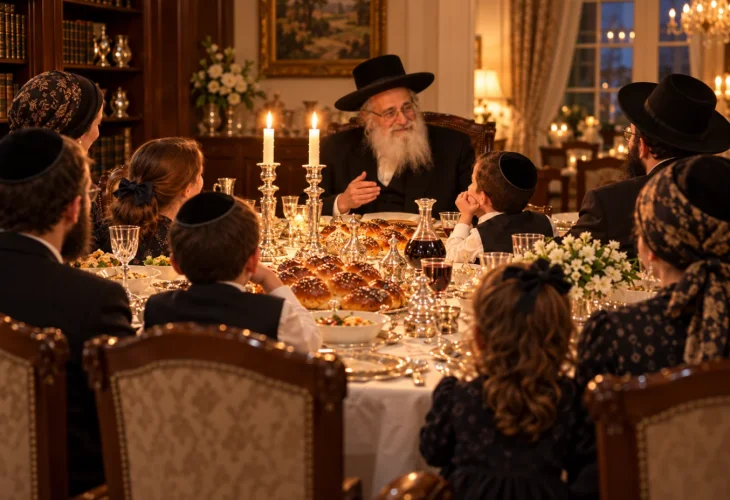
The Shabbos table in my parent’s home during my father’s lifetime was special. It was something we all looked forward to. The smell of the fresh homemade Challah, the Shabbos candles and the set tables all gave a special atmosphere. But it was my father, and his Shabbosdik behavior that raised it above the ordinary.
My father always made it his business to help prepare for Shabbos. I still remember, from when I was very young, watching my father wash the kitchen floor and getting all the last things ready for Shabbos; the Blech, the candles, the Shabbos clock. When we children grew up, we washed the floor but he never stopped helping. It was very important to him to take part in the Shabbos preparations.
Friday night after Shul my father came home – we all stood up for him. He greeted us with a warm ‘Good Shabbos’ and then went to rest for a few minutes until all the guests came and were seated. My father made a royal entrance, with his Shabbos robe – he would enter like a king, take his place at the head of the table with my mother as well next to him and start singing Shalom Aleichem.
As a young child I learned in kindergarten that when a father comes home from Shul he has two Angels walking him – that was no news to me, it was always felt in the air. After Aishes Chayil and Kiddush, my father would bless each and every one of us – My father blessed every one of the children and grand children. It was B"H a long, long line; guests could not control themselves, they would stare as if they were at a Simcha when we were more than 50; If anyone could have taken a photo on Shabbos that picture would be a best seller; it was so beautiful, moving and inspiring. Not even one grandchild would give up a blessing from Saba!
No one would dare touch a thing at the table before my father was served. Even if we knew he was not going to eat something – maybe for health reasons or if he didn't like it – it was passed to him and he would still find something nice to say like; “This smells good!”
Introducing everyone at the table to my father took place after the Challah then my father would ask everyone a friendly question like. “Where are you from?” “How long are you here for?” “Where do you work?” My father was no schmoozer. He asked to show interest and care to the extent that when the same person returned, he would remember to ask a question referring back to their prior conversation weeks or even months earlier.
The most important part of the Shabbos table came when my father spoke. Even the grandchildren who didn't understand the language, kept silent. My father invested lots of time in preparations for the Shabbos table. In later years my father would tell a story and translate it into either English or Hebrew and we all knew what came after the story. The question: “What does this have to do with the Parsha?” Then the discussion would start when we would all try our luck to guess the best answer.
Only now at the Shiva did I hear the story behind the story. When I was a little girl there were no stories at the table. My father always had a Dvar Torah to say. And when my father started with the stories I thought he wanted to get the grandchildren's attention. But what I heard from my mother at the Shiva is that one of my siblings (I would never know who; my parents never shared other peoples issues with us, even though there were plenty) while doing well with their studies, seemed to be spiritually empty.
Father went to ask a shaila and was told that the best way to improve your child’s Yiras Shamayim is with stories. This was a very big Avoda for him. He worked on this all week, listening to stories so that he would have three different ones all related to the Parsha. He wanted to be able to remember them well enough to ‘say them over’ at the table.
Before the story days he had a plan of what he would say. It was not the latest Vort he heard, it was something he thought was important to talk about at the Shabbos table. At the Shloshim of my father, his Chavrusa Rabbi Yaakov Asher Feldman who learned with my father for over 30 years mentioned in his hesped that he always liked to hear from my father what he’d said at the Shabbos table that week.
If all three meals had Zemiros Shabbos it was the third meal that was most special. My father had his favorite songs and we all sang them. Each week those same songs left us with a spiritual taste for the following week.
There are countless stories of interesting people who came through our home on Shabbos, from the priest to the beggars at the Kotel. There was the famous one about the American Mafia Lawyer who ran into hiding on a boat. One night, during a storm, as the water was getting dangerously high, he feared for his life, thinking it was his last day. This was what got him to become a real Baal Teshuva.
Rabbi Meir Shuster – may Hashem send him a refuah shelema – had no problem coming to our home Friday night with as many people he had no places for – their was always room at the table and enough food.
The sick and the needy, sem girls and yeshiva bochurs, divorcees, religious and irreligious all got equal attention from my parents. No one was honored more or less - everyone was a jew - even the lady who came on Pesach with the falafel she picked up on the way to our home!
May this give us much chizuck in having a Shabbos table with the Shechina at the table in the zechus of my father Avraham Dvid Ben Zeev zt’l and Leiluy Nismoso – Amenled Title
This article was written by Rachel Greenblat and Devorah Glicksman (Heller)

