

Parashat Noach
Noah's Ark May Have Carried Far Fewer Animals Than You Think
Did Noah really bring every animal species onto the ark? A surprising Torah interpretation offers a fascinating answer to this age-old question.
- Daniel Bles
- | Updated
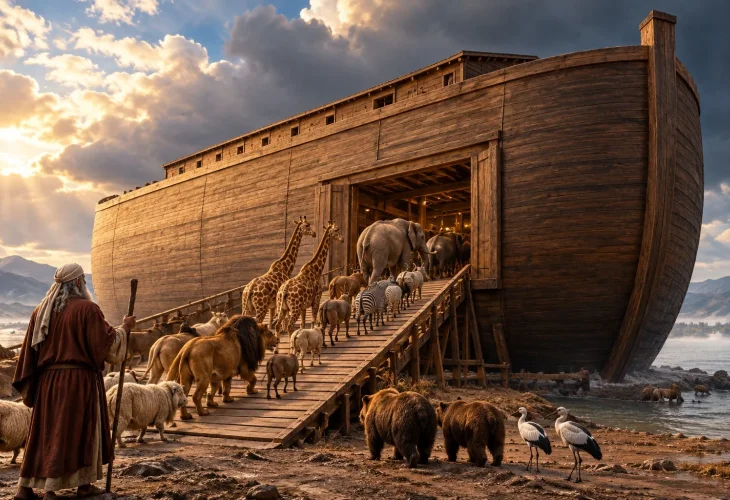
It's one of the most familiar questions about Noah's Ark, asked by children and adults alike: How could Noah possibly fit all the animals in the world onto a single boat?
The Torah describes an enormous vessel, but with so many different kinds of animals on Earth, it's natural to wonder whether there was really enough room.
An intriguing explanation from the Jewish sages suggests that Noah may not have needed to bring nearly as many animals aboard as we imagine.
Just How Big Was Noah's Ark?
According to the Torah, Noah's Ark had three decks, with one level traditionally understood to have been used for food storage. Unlike the familiar children's illustrations showing giraffes stretching their necks out of an open boat, the ark was an enclosed structure designed to protect its occupants throughout the Flood.
Its dimensions were impressive: 300 cubits long, 50 cubits wide, and 30 cubits high (Genesis 6:15).
Using a cubit of approximately 18 inches, the ark would have measured about 450 feet long, 75 feet wide, and 45 feet high. Its three decks would have provided roughly 101,250 square feet of total floor space, although the precise measurements depend on the length of the cubit used.
To put that into perspective, the ark would have been a substantial vessel, with considerable space for animals, people, and supplies.
Today, scientists recognize thousands of species of mammals, reptiles, and birds. Yet most animals are relatively small. While elephants, giraffes, rhinoceroses, and hippopotamuses require considerable space, many other creatures take up far less room.
But there's another possibility worth exploring: What if Noah didn't need to bring every individual species we recognize today?
What the Talmud Teaches About Animal Varieties
The Talmud, in Chullin 63b, states that there are 120 varieties of non-kosher birds in the East, all belonging to the ayah family, a category of birds mentioned in Jewish law.
This teaching highlights the existence of many distinct varieties within a broader group of birds.
Animals can differ considerably within related groups, whether in size, color, shape, or other characteristics. We see this clearly in the many breeds of dogs and the wide variety of birds found throughout the world.
The distinction between a broader ancestral group and its many descendants provides the basis for an interesting interpretation of the animals that entered Noah's Ark.
The Radal's Explanation: Noah Brought the Original Animal Types
Rabbi David Luria, known as the Radal, was a prominent 19th-century Torah scholar and commentator.
In his commentary on Pirkei D'Rabbi Eliezer (chapter 23), the Radal discusses differences among animal varieties and the influence of their environments.
Based on these ideas, he explains that Noah brought into the ark only the original ancestral types, or the "roots" of the animal groups created by Hashem during the six days of Creation.
According to this interpretation, Noah did not need to gather every variety of animal that would eventually exist. Instead, he brought representatives of the original groups from which later varieties would emerge.
After the Flood, these animals spread across the world, multiplied, and developed different characteristics as they adapted to their surroundings.
For example, Noah would not have needed to bring every breed of dog onto the ark. A representative of the ancestral canine group would have been sufficient. The same principle, according to this explanation, could apply to other groups of animals.
This would significantly reduce the number of creatures that needed to be accommodated aboard the ark.
The precise number is not established by this interpretation, but the Radal's approach suggests that the total may have been far smaller than the number of animal species recognized today.
It's important to distinguish this traditional Torah interpretation from a scientifically established reconstruction of the Flood. Modern biology recognizes that species diversify over time, but it does not establish that all modern animal species descended from a few thousand ancestors aboard Noah's Ark.
Still, the Radal's explanation offers a fascinating perspective on an age-old question. Rather than imagining Noah gathering every animal variety we know today, it invites us to consider the possibility that the ark carried representatives of broader ancestral groups.
And with that understanding, the question of how all the animals fit aboard Noah's Ark takes on an entirely different dimension.

