

Parashat Noach
Noah’s Dove and the Olive Leaf: The Hidden Meaning Behind Its Return
Discover how the Kli Yakar explains the dove’s return at evening, revealing a surprising connection between Noah’s Ark, olive oil, and the light of the Temple Menorah
- Tzvi Yehuda
- | Updated
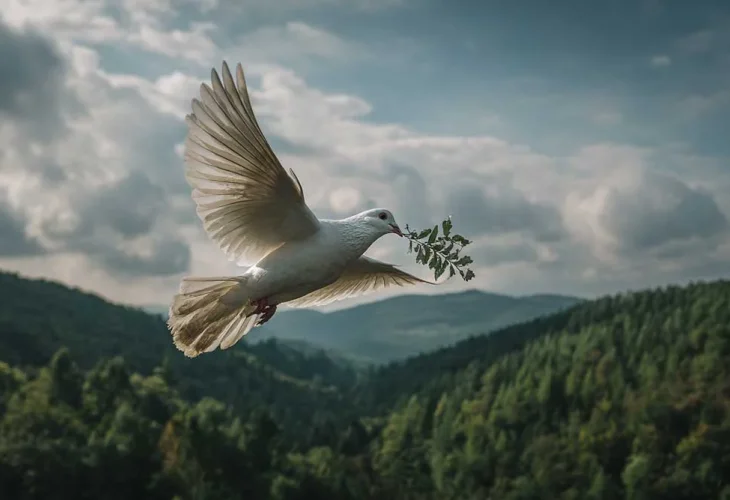
“And the dove came back to him toward evening, and behold, an olive leaf was freshly plucked in its mouth. So Noah knew that the waters had subsided from the earth.” (Genesis 8:11)
Rabbi Shlomo Ephraim of Luntschitz, author of the Kli Yakar commentary on the Torah, examines the seemingly unnecessary words “toward evening” in this verse. Why does the Torah specify the time of day when the dove returned to Noah? What difference would it make whether the dove returned in the evening or in the morning?
The Kli Yakar suggests that the timing of the dove's return reveals a deeper purpose behind the olive leaf it carried. According to his interpretation, the leaf was not merely a sign that the floodwaters had receded. It also served as a source of illumination for Noah and his family inside the Ark.
How Was Noah's Ark Illuminated?
God commanded Noah, “You shall make a tzohar for the Ark” (Genesis 6:16). But what exactly was this tzohar? The Midrash offers two explanations, both suggesting that it served as a means of illuminating the darkness inside the Ark. According to one interpretation, the tzohar was a window that allowed natural light to enter. According to another, it was a precious stone or pearl that radiated light throughout the Ark.
Various Torah commentators discuss these interpretations, each offering a different understanding of how the Ark was illuminated. The Chizkuni, however, presents a unique explanation. He suggests that the word tzohar is connected to yitzhar, meaning oil, which was used to provide illumination. According to this interpretation, Noah used oil lamps to light the Ark at night, while daylight entered through its window during the day.
The Kli Yakar explains that the Chizkuni's interpretation provides an answer to the question of why the dove brought Noah an olive leaf. The leaf was associated with the production of oil, which could be used to illuminate the Ark during the night. This also explains why the Torah specifically states that the dove returned “toward evening,” precisely when Noah would need a source of light.
As the Kli Yakar writes:
“What difference does it make to us whether it came in the evening and returned in the morning, or vice versa? It would appear that the dove brought him an olive leaf so that he could produce light from it, something specifically needed in the evening. For according to the opinion that the tzohar was a window, the question arises: What provided illumination at night? Therefore, the Chizkuni explains that tzohar is related to the word yitzhar (oil), meaning that Noah lit oil lamps inside the Ark at night, while during the day, light entered through the Ark's window, as it is stated, ‘And Noah opened the window of the Ark that he had made.’”
The Dove That Brought Light to the World
The Kli Yakar strengthens his interpretation by citing a Midrash found in Midrash Tanchuma and Yalkut Shimoni on Parshat Tetzaveh. The Midrash draws a comparison between the dove and the Jewish people, based on the verse, “Your eyes are like doves” (Song of Songs 4:1).
Just as the dove brought light into the world, the Jewish people are commanded to bring olive oil and kindle lamps before God in the Temple. The Midrash thus establishes a connection between the olive leaf carried by Noah's dove and the olive oil used to illuminate the Menorah.
However, the Kli Yakar raises an important question about this comparison. The Torah tells us that the dove brought an olive leaf, but it does not explicitly say that the leaf was used to produce light. How, then, could the Midrash conclude that the dove brought illumination into the world?
The Kli Yakar explains:
“And there is proof for my words from what is stated in Midrash Tanchuma and Yalkut Shimoni on Parshat Tetzaveh, concerning the verse ‘Your eyes are like doves’ (Song of Songs 4:1): Just as the dove brought light into the world, so too you shall bring olive oil and kindle lamps before Him.
“However, this raises a difficulty: How does the author of this Midrash know that the dove brought light into the world? And how did he derive this from the verse, ‘And behold, an olive leaf was freshly plucked in its mouth’?
“Rather, he must certainly have learned this from the words ‘toward evening,’ as explained above.”
According to the Kli Yakar, the answer lies in the seemingly insignificant words “toward evening.” These words reveal that the dove's return was connected to Noah's need for illumination after nightfall. The olive leaf was therefore associated not only with the receding floodwaters but also with the restoration of light.
The Deeper Significance of the Olive Leaf
Through this interpretation, the Kli Yakar reveals the significance of a detail that might otherwise appear unnecessary. The Torah's mention of the evening is not simply a description of when the dove returned. It provides an explanation for the purpose of the olive leaf and establishes a connection between the dove's mission and the light produced by olive oil.
This understanding also sheds light on the Midrash's comparison between the dove and the Jewish people. Just as the dove brought a source of illumination to Noah, the Jewish people bring olive oil to kindle the Menorah before God.
What initially appears to be a minor detail in the Torah thus becomes the key to understanding a broader spiritual connection between Noah's Ark, the olive leaf, and the sacred light of the Temple.

