

Parashat Noach
Noach's Ark: Living to Give
Why did Hashem make Noach spend an entire year caring for thousands of animals? Rav Dessler reveals a powerful lesson hidden in the story.
- Rabbi Avi Wiesenfeld
- | Updated
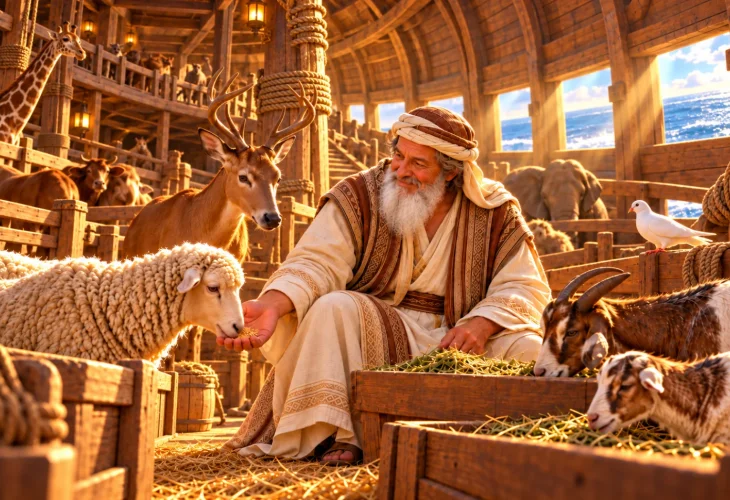
The Torah describes to us the way that Noach and his family were commanded to bring into the teivah every type of animal. In order to be able to feed all the animals in the teivah, superhuman strength was needed by Noach and his family. They spent an entire year feeding thousands of animals of all species. This burdensome task required tremendous devotion to ensure that each animal was fed at the correct time. It was a great act of chesed and selflessness on their part.
Why, though, was all of this necessary? We are taught that, according to some opinions, the flood did not reach every part of the world (such as Eretz Yisrael; see Zevachim 113a). Why did the Ribono Shel Olam specifically use the method of the teivah to save the animals? Noach and his family could have simply taken the animals to Eretz Yisrael, where they would live naturally and be saved in a much easier way!
They could have all been relocated to Eretz Yisrael to wait out the flood before returning to their original habitats. Why did their upkeep have to be done in such a way that required so much hard work and effort on Noach’s part?
Rav Dessler, in Michtav me’Eliyahu, explains that the specific way Hashem chose for Noach and the animals of the world to be saved points to a fundamental principle. The Torah earlier tells us that the sin of the generation of Noach which caused Hashem to bring about the destruction of the world’s population through the flood was the sin of stealing.
"ותמלא הארץ חמס" – “And the earth became full of robbery.”
The Targum Onkelos explains this to mean, "ואתמליאת ארעא חטופין" – “And the earth became full of snatchers.”
That is, the inhabitants of the world were very selfish people who were interested only in their own needs and they disregarded the existence and rights of the other. Since every person lived in a reality that included only himself, Hashem deemed it necessary to destroy the world and rebuild it from scratch. The punishment points to the severity of the selfishness that prevailed in that generation.
For this reason, the Ribono Shel Olam specifically placed Noach and his family in the teivah in an environment that required them to be constantly engaged in giving. The preoccupation with the needs of the animals demonstrated the exact opposite of what Noach’s generation was guilty of.
Hashem wanted to show that "עולם חסד יבנה" – the world is built on, and continues to exist only because of, chesed (Tehillim 89:3).
Hashem created us specifically to live among each other and to make an effort to step into the world of the other by putting aside our own needs and thinking of the needs of the other. It was specifically in this manner that the world was to be recreated, rebuilt, and reborn.
By Noach tending to the needs of the animals around the clock throughout their stay in the teivah, he was embodying the midah of chesed. Rav Dessler says that this was the only way to recreate the world so that it would continue to exist.
I recently looked out of my window and saw an older woman in an electric wheelchair. She opened her car door and she skillfully wheeled herself into the driver’s seat, folded up the wheelchair and lifted it into the car, and started to drive.
I commented to my wife how amazing it was to see a disabled woman who is so independent, sitting behind the steering wheel driving herself around. My wife commented that in fact the woman’s story was much more remarkable than that.
“She doesn’t just drive,” my wife explained. “She drives a big van around Yerushalayim picking up other people and taking them to the hospital for medical appointments.”
The woman made herself into a chesed vessel to be able to help others. She demonstrated chesed par excellence by transcending her own disability, thinking not of her own difficulties but tending to the needs of others.
When we make the effort and take the time to think of ways to help another, we are enabling the world to continue to exist. By making chesed a focal point in our lives, we are emulating Hashem Himself and making the world one of love and kindness, as Hashem wants it to be.

