

Israel News
Israel Unveils HawkGuard: New AI-Powered Drone Defense System
Israel Aerospace Industries introduces HawkGuard, a new counter-drone system that uses AI-powered detection and explosive-free interceptor drones to protect military vehicles and critical infrastructure
- Yuval Aviv
- | Updated
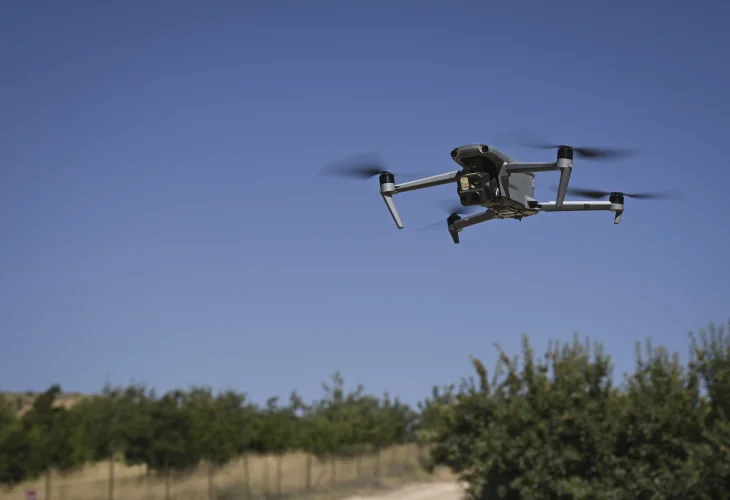 An IDF drone (Photo: Michael Giladi, Flash90)
Israel Aerospace Industries (IAI) unveiled HawkGuard, a new active defense system designed to counter attacking drones, at the AUSA 2026 defense exhibition in Washington on Monday. The system uses interceptor drones that destroy incoming threats through direct physical collisions, eliminating the need for explosive warheads.
The unveiling comes amid the growing use of explosive drones in modern warfare, as demonstrated by the war in Ukraine and fighting against Hezbollah. Small, inexpensive drones have become a significant threat to soldiers and armored vehicles, creating an urgent need for effective and affordable defense solutions.
Addressing the Growing Threat of Attack Drones
The increasing use of small attack drones has presented military forces with a significant challenge. These relatively inexpensive weapons can threaten soldiers, armored vehicles, and strategic installations, while existing defense technologies often provide only partial protection.
In Israel, the IDF, the Directorate of Defense Research and Development (DDR&D), major defense manufacturers, and startup companies are working to develop a range of counter-drone technologies. These include laser systems, microwave weapons, electronic jamming equipment, and interceptor drones designed to neutralize threats before they reach their targets.
One of the central challenges is developing interception systems that can respond quickly and effectively without the high costs associated with many traditional air defense solutions.
AI-Powered Technology Enables Multiple Drone Interceptions
HawkGuard combines radar, electro-optical sensors, and an artificial intelligence-based command and control system to detect, track, and intercept multiple aerial threats simultaneously.
Unlike conventional interception systems that rely on explosive warheads, HawkGuard uses interceptor drones that physically collide with incoming targets to destroy them. According to IAI, this approach reduces the risk of collateral damage caused by explosions and blast effects.
The system is designed to provide an additional layer of protection against small attack drones, particularly in environments where rapid detection and interception are essential.
Modular Design for Military Vehicles and Strategic Facilities
HawkGuard features a compact, modular design that allows it to be installed on armored vehicles alongside existing defense systems. This enables military forces to integrate the technology into their current protective capabilities without necessarily replacing other equipment.
Beyond battlefield applications, the system is also intended to protect critical infrastructure, military installations, strategic assets, and offshore platforms.
Its modular structure is designed to accommodate different operational requirements, making it suitable for both mobile military units and fixed facilities requiring protection against aerial threats.
Successful Testing and Low Interception Costs
Israel Aerospace Industries reported that HawkGuard has successfully completed a series of tests and offers an exceptionally low cost per interception. The company believes that affordability could make the technology particularly valuable as militaries confront increasing numbers of inexpensive attack drones.
However, IAI has not disclosed whether the system has been purchased by military customers or entered operational service.
IAI CEO Guy Bar Lev emphasized the importance of developing multiple defensive capabilities to address evolving aerial threats. "In a world of complex aerial threats, no single solution is suitable for every scenario," he said.
Dror Bar, CEO of IAI subsidiary ELTA and an IAI executive vice president, echoed this assessment, noting that military technology must continue evolving to meet changing operational needs.
"The battlefield is changing rapidly, and with it, the threats and operational requirements," he said.
A New Approach to Counter-Drone Defense
The introduction of HawkGuard reflects a broader shift in modern air defense, as military forces seek affordable and adaptable solutions to counter the rapidly expanding use of attack drones.
By combining advanced detection technology, artificial intelligence, and interceptor drones that neutralize threats through physical impact, IAI aims to provide an effective alternative to more expensive interception methods.
Although the system's operational deployment status remains unclear, its development highlights the growing importance of counter-drone technologies in protecting soldiers, military vehicles, and critical infrastructure against emerging aerial threats.

