

Parashat Noach
Why Do So Many Ancient Civilizations Tell the Story of a Great Flood?
From Mesopotamia to ancient Greece and the Maya, discover remarkable flood stories that share surprising similarities with the biblical account of Noach.
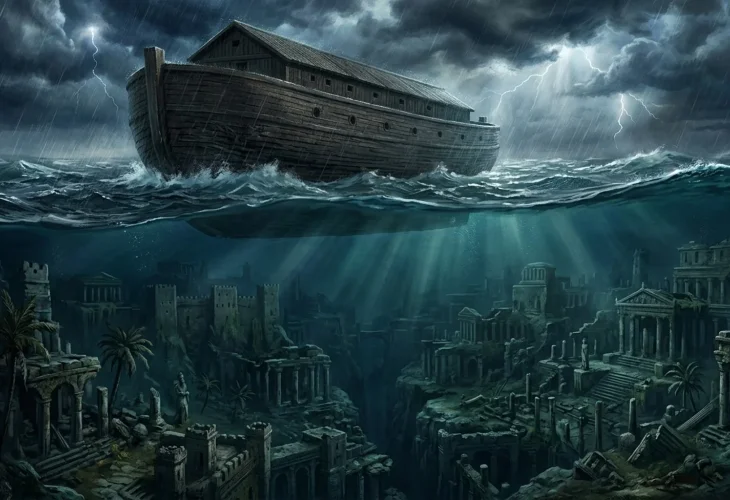
The Torah tells us about the Great Flood, a catastrophe that destroyed the world of Noach's generation, leaving only Noach, his family, and the creatures sheltered inside the ark.
But here's something fascinating: The story of a devastating flood isn't found only in the Torah. Similar accounts appear in ancient traditions from around the world, including Mesopotamia, India, Greece, Central America, and the Pacific islands.
Some collections of flood traditions identify accounts from more than 200 cultures, with one frequently cited figure placing the number at 217. Although the stories differ considerably, many share striking themes: a great flood, widespread destruction, a warning of impending disaster, and survivors who begin life anew. Could these ancient traditions preserve memories of catastrophic floods experienced by earlier generations?
Mesopotamia: Ancient Flood Stories Written on Clay Tablets
Some of the oldest surviving written flood accounts come from Mesopotamia, the region between the Tigris and Euphrates rivers.
One Sumerian text describes a man who receives a warning about a flood that will destroy humanity. Although much of the original tablet is missing, the surviving passages tell of a large vessel battered by winds and water for seven days and seven nights. When the storm ends, the survivor opens a window in the vessel and offers sacrifices. The account also refers to the preservation of animals and the continuation of humanity. The text and its translation are preserved in the Electronic Text Corpus of Sumerian Literature at Oxford University.
Another ancient account appears in the Babylonian Epic of Atrahasis. The British Museum holds a tablet of this work dated to approximately 1635 BCE. In this version, the central figure receives advance warning of a devastating flood and constructs a vessel to protect himself, his household, and animals.
Perhaps the most famous Mesopotamian flood narrative appears on Tablet XI of the Epic of Gilgamesh. Its hero, Utnapishtim, learns that a great flood is coming and builds a ship to save his family and other living creatures. The tablet, commonly known as the "Flood Tablet," was discovered among the remains of King Ashurbanipal's library at Nineveh and dates to the seventh century BCE.
The similarities to the Torah's account of Noach are especially striking: a warning, a vessel, the preservation of life, and survival after a devastating flood.
India: The Fish That Warned of a Coming Flood
An ancient Indian flood tradition appears in the Shatapatha Brahmana (1.8.1). Its central figure is Manu, who encounters a small fish asking him for protection. In return, the fish promises to save Manu from a future catastrophe.
Manu cares for the fish, which eventually grows to an enormous size. The fish then warns him that a great flood is approaching and instructs him to prepare a ship. When the floodwaters rise, Manu boards the vessel and ties it to the fish's horn. The fish guides the ship toward a northern mountain, where Manu secures it to a tree. As the waters gradually recede, Manu is able to descend from the mountain.
Although the story includes mythological elements absent from the Torah, several familiar themes remain: advance warning, preparation of a vessel, survival through a flood, and arrival at a mountain.
Greece: Deucalion and the Great Flood
Ancient Greek mythology also preserves a story of a devastating flood. In the Library attributed to Apollodorus (Book 1, Chapter 7), Deucalion receives a warning from Prometheus and prepares a large chest, filling it with food before entering with his wife.
Heavy rains then flood much of Greece, forcing some inhabitants to seek refuge on high mountains. Deucalion and his wife remain inside their vessel for nine days and nine nights as the waters carry them away. Eventually, the chest comes to rest on Mount Parnassus. When the rain stops, Deucalion emerges and offers a sacrifice.
Once again, we find several elements familiar from the Torah's account: a warning before the disaster, a vessel prepared for survival, overwhelming floodwaters, arrival at a mountain, and an offering afterward.
Central America: Ancient Worlds Destroyed by Water
Flood traditions also appear among the ancient peoples of Central America. The Popol Vuh, a sacred text preserving the traditions of the K'iche' Maya of Guatemala, describes an earlier creation in which human-like beings were made from wood. These beings were eventually destroyed in a catastrophe involving overwhelming rain and floodwaters.
In his scholarly translation of the Popol Vuh, Allen Christenson discusses the descriptions of the disaster, including references to heavy rain and resin.
Other Mesoamerican traditions also describe worlds destroyed by water. Christenson refers to an Aztec account of an age known as "Four-Water," during which the inhabitants of the world were destroyed by a flood and transformed into fish.
Unlike the Mesopotamian accounts, these stories do not necessarily center on a family surviving inside a ship. Instead, the flood forms part of a broader cycle of creation, destruction, and renewal. Nevertheless, the idea of an ancient world devastated by water appears here as well.
New Zealand: Escaping the Flood by Climbing a Mountain
Flood stories were also preserved in the oral traditions of the Māori people of New Zealand. According to an account described in New Zealand's national encyclopedia, the figure Tāwhaki leads his people and their families to a fortified settlement high on a mountain. Water then descends from the heavens and floods the surrounding land.
In this tradition, survival is connected not to a vessel but to reaching higher ground before the waters arrive. Although the details differ significantly from the story of Noach, the central image of a devastating flood and people seeking refuge remains recognizable.
Why Do So Many Cultures Remember a Great Flood?
From ancient Mesopotamian tablets to Indian religious texts, Greek mythology, Mesoamerican traditions, and Māori oral histories, stories of destructive floods appear across widely separated regions.
The similarities are intriguing, particularly when they involve warnings, the preservation of life, vessels, mountains, and the rebuilding of human society after disaster. At the same time, these accounts are not identical, and their existence does not independently establish that every tradition describes the same worldwide event. Flooding has affected many civilizations throughout history, and stories can also spread between neighboring cultures.
For readers of the Torah, however, the widespread presence of flood traditions offers a fascinating perspective on the story of Noach. The Torah presents the Flood as a defining event in human history, while other ancient peoples preserved their own accounts of overwhelming waters and the survival of life.
Different cultures told these stories in different ways, but the recurring memory of a great flood remains one of the most remarkable themes shared by ancient civilizations.

