

Interesting
Missing for 89 Years: Could Amelia Earhart’s Plane Finally Be Found?
Nearly 90 years after Amelia Earhart vanished, researchers are investigating a mysterious object in a Pacific lagoon that could be part of her missing plane.
- Shira Dabush
- | Updated
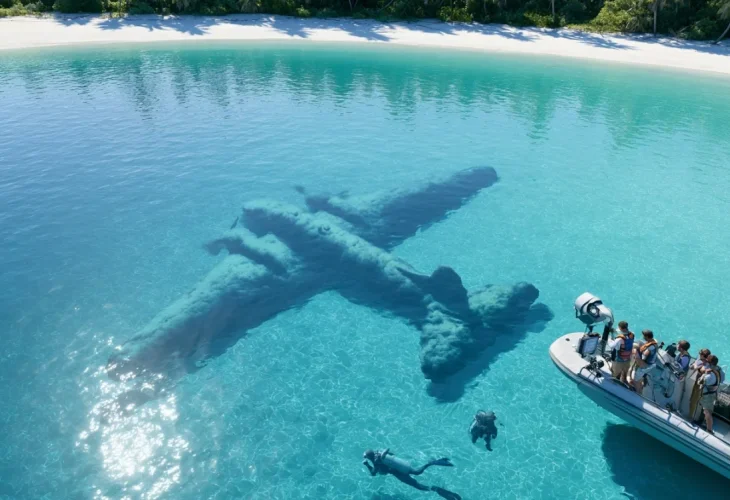
Nearly 90 years after Amelia Earhart vanished during her historic flight around the world, researchers are investigating a mysterious object in a remote Pacific lagoon that could potentially be part of her missing airplane.
On July 2, 1937, Earhart and her navigator, Fred Noonan, departed New Guinea aboard a Lockheed Electra, heading toward Howland Island in the Pacific Ocean. They never arrived, and their disappearance became one of aviation history's most enduring mysteries.
Now, a research expedition involving the American Archaeological Legacy Institute and Purdue University is hoping to uncover new evidence on Nikumaroro, an isolated coral island in the Pacific nation of Kiribati.
The focus of the investigation is an unusual formation known as the "Taraia Object," whose appearance in satellite and historical aerial photographs has raised the possibility that it could be the remains of an aircraft.
The expedition is traveling aboard the Marin Mainiku, making the approximately 830-nautical-mile journey (more than 950 miles) from Tarawa, Kiribati's capital, to Nikumaroro.
In an October 9 update, Purdue University reported that the ship was making progress under favorable sea conditions and was expected to reach the island around noon on October 12, local time.
The researchers plan to spend approximately two weeks investigating the site, transporting specialized equipment from their ship to smaller boats capable of navigating through openings in the surrounding coral reef.
A Mysterious Object Visible in Photographs From 1938
One of the most intriguing details about the Taraia Object is that it may have been visible for decades.
According to Purdue University, researchers first identified the unusual formation in satellite imagery in 2020. Further investigation revealed that the same object appeared in aerial photographs taken in 1938, just one year after Earhart disappeared.
Although this discovery doesn't establish that the object is part of Earhart's aircraft, its presence in photographs dating back to shortly after her disappearance makes it an interesting target for investigation.
The research team plans to begin by photographing and filming the area to document the object's location and appearance.
They will then use sonar equipment and magnetometers, instruments that detect variations in magnetic fields and can help identify buried or submerged metal objects.
If conditions allow, the researchers will use underwater excavation equipment to expose the object and determine what it actually is.
Expedition director Richard Pettigrew described the possibility of discovering Earhart's aircraft as a once-in-a-lifetime opportunity.
However, the researchers emphasize that the purpose of the expedition is to investigate the evidence, not to assume that the object has already been identified.
Who Was Amelia Earhart?
Amelia Earhart was born on July 24, 1897, in Atchison, Kansas, and became one of the most celebrated pioneers in aviation history.
At a time when opportunities for women in aviation were limited, Earhart challenged expectations and achieved a series of remarkable milestones.
In 1928, she became the first woman to cross the Atlantic Ocean by air as a passenger. Four years later, in 1932, she became the first woman to fly solo across the Atlantic, establishing herself as one of the world's most accomplished aviators.
Earhart also had a close connection to Purdue University.
In 1935, she joined the university as a career adviser for women and an adviser on aviation. The Purdue Research Foundation later helped finance the Lockheed Electra aircraft she used during her final journey.
That historical connection makes Purdue's involvement in the current search especially meaningful.
The university and its research foundation are now helping investigate whether the airplane they once supported could have ended up near Nikumaroro.
Could Nikumaroro Hold the Answer to Her Disappearance?
The expedition is examining a longstanding theory that Earhart and Noonan, unable to locate Howland Island, may have continued flying and eventually reached Nikumaroro.
The island's remote location and surrounding coral reef have made investigating this possibility particularly challenging.
If the Taraia Object turns out to be part of an aircraft, researchers will still need to establish whether it has any connection to Earhart's Lockheed Electra.
For now, the theory remains unproven, and the object has not been identified.
But nearly nine decades after Earhart and Noonan disappeared over the Pacific, the investigation offers another opportunity to search for physical evidence that could help explain what happened during their final flight.
Whether the mysterious object proves to be part of Earhart's aircraft or something entirely unrelated, the expedition could bring researchers one step closer to understanding one of aviation's greatest mysteries.

