

Israel News
Israel Unveils Armed Drone With Machine Gun in Successful Live-Fire Test
The new FIRE STORM 250 drone can fly for three hours, carry 200 rounds of ammunition, and provide ground troops with aerial surveillance and firepower.
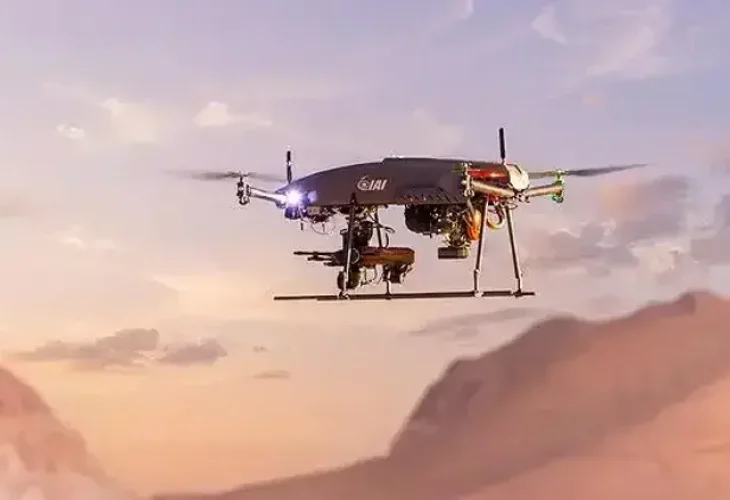 (Photo: Israel Aerospace Industries)
Israel Aerospace Industries and SIG SAUER announced today (Tuesday) that they have successfully completed a live-fire trial of the FIRE STORM 250 system, an unmanned aircraft equipped with an M250 machine gun. The system is designed to provide ground forces with both aerial surveillance and strike capabilities.
The aircraft can remain airborne for up to three hours and carry 200 rounds of ammunition, allowing troops to deploy aerial firepower without the need for a runway or dedicated aviation infrastructure.
According to the announcement, "During the trial, the system hovered over an area simulating a battlefield, located and identified targets using an onboard camera, and fired at them in single-shot and semi-automatic modes. The firing was carried out from various altitudes and ranges."
The companies said the trial evaluated the system's accuracy, firing stability, and ability to operate under changing operational conditions.
The FIRE STORM 250 combines Israel Aerospace Industries' unmanned platform with SIG SAUER's MICROLIGHT weapon station, a remotely controlled mount equipped with an M250 machine gun. The entire weapon assembly, including the station, machine gun, and 200 rounds of ammunition, weighs approximately 24 kilograms. According to SIG SAUER, it is the lightest airborne weapon station in the world.
One of the system's key advantages is its ability to take off and land vertically, allowing it to operate from forward positions alongside combat troops. It is powered by a multi-fuel internal combustion engine and can be refueled in the field using fuel already available to ground forces, eliminating the need to wait for batteries to recharge.
Beyond its strike capabilities, the system is designed to provide ground forces with a continuous aerial view of the battlefield. Sensor data is integrated with fire control information, allowing operators to track targets, aim the weapon, and reduce the time between identifying a threat and opening fire.
The decision to fire remains entirely in human hands. While the system displays real-time sensor images, target tracking data, and attack options, the authority to approve firing is never transferred to the system itself.
Guy Bar Lev, CEO of Israel Aerospace Industries, said the trial demonstrates how battlefield capabilities are evolving.
"The future of the battlefield will be determined not only by the power of weapons systems, but also by the ability to connect intelligence, technology, and operational force into a single, precise, and effective response."
He added that the partnership with SIG SAUER enables the companies to combine their complementary capabilities and develop advanced operational solutions.

