

Parashat Noach
Noach and the Inner Ark: Finding Peace in Times of Emotional Overwhelm
Parshat Noach offers a powerful metaphor for turning inward during crisis, making space for conflicting parts of ourselves, and emerging with greater inner peace, clarity, and wholeness
- Inbal Elhayani
- | Updated
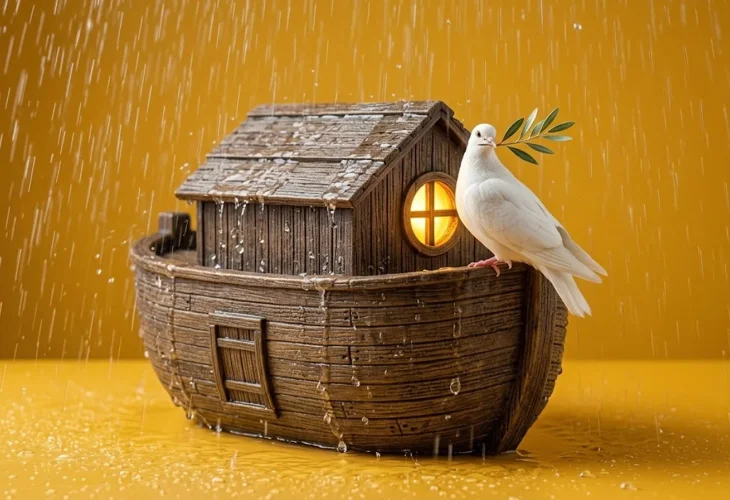
Life inside the ark could hardly have been comfortable. Noach spent an entire year confined within a crowded vessel, surrounded by animals and immersed in the demanding work of caring for them. And yet, when the flood came, the ark was precisely where he needed to be.
On a deeper level, the flood can be understood as a metaphor for those moments when life becomes overwhelming. Sometimes the waters rise around us in the form of external chaos, pressure, and uncertainty. At other times, the flood is internal: anxiety, confusion, emotional turmoil, or a sense that the structures we once relied upon are beginning to collapse. In such moments, the instinct to retreat inward can be profoundly protective.
Entering the “ark” means turning toward our inner world and creating a space in which we can listen to what is happening inside us. That space is not necessarily peaceful. When we slow down enough to look within, we may encounter parts of ourselves that are uncomfortable, contradictory, or even frightening. Feelings we have suppressed, needs we have ignored, and conflicts we have tried to avoid may suddenly become much harder to overlook.
In this sense, Noach’s ark offers a striking image of the inner world. It contained opposites: pure and impure animals, males and females, predators and herbivores. Likewise, each of us contains different and sometimes conflicting parts. One part longs for closeness while another seeks distance. One wants change while another clings to what is familiar. One feels strong while another feels frightened and vulnerable.
The task is not necessarily to silence these contradictions, but to allow them to exist together long enough for us to understand them. The ark becomes a place where nothing within us has to be expelled simply because it is inconvenient or difficult. Instead, we begin to create enough inner space to recognize the different voices within us and listen to what each one is trying to say.
Paradoxically, it is often the flood itself that makes this work possible. A crisis can strip away distraction and force us to confront questions we might otherwise avoid. When familiar routines no longer protect us from ourselves, we may finally be able to see what has been waiting beneath the surface.
From Inner Conflict to Inner Peace
There is something meaningful about reading Parshat Noach as the rainy season approaches. The changing seasons can also mirror movements within the human soul. After the intensity of the holidays, with their themes of reflection, renewal, and spiritual rebirth, we may feel an urge to rush back into ordinary life. Yet perhaps the soul still needs time to settle.
Sukkot itself offers an image of shelter and containment. For several days, we step into a protected space, almost like returning to a womb. When the holidays end, it may be tempting to immediately turn outward again, but inner change does not happen all at once. Something within us may still be forming.
The ark represents that protected inner space. It is where the different layers of the self can begin to meet one another. The goal is not to erase tension or force every part of ourselves into agreement, but to create dialogue between them. When the parts that once seemed irreconcilable can begin to coexist, something inside us becomes calmer and more whole. Only then does the moment come to leave the ark.
The dove returning with an olive leaf becomes a powerful symbol of that transition. It signals that the floodwaters have begun to recede and that dry land has appeared. On an inner level, it can represent the emergence of peace after turmoil: not a return to who we were before the storm, but the beginning of a more integrated and grounded way of being.
From that place, our relationship with the outside world can also change. When we are less divided within ourselves, we are better able to meet other people and the challenges of life with clarity, stability, and compassion. The inner work of the ark does not separate us from the world forever, but it prepares us to return to it from a healthier place.
Inbal Elhayani, M.A., is a certified therapist in NLP, mindfulness, and guided imagery, as well as a writer and lecturer in the field.

