

Torah Personalities
The Rabbi Who Envisioned a Jewish State 50 Years Before Herzl
Decades before Theodor Herzl, Rabbi Yehuda Alkalai envisioned a Jewish homeland. Discover his remarkable plans and surprising connection to Herzl's family.
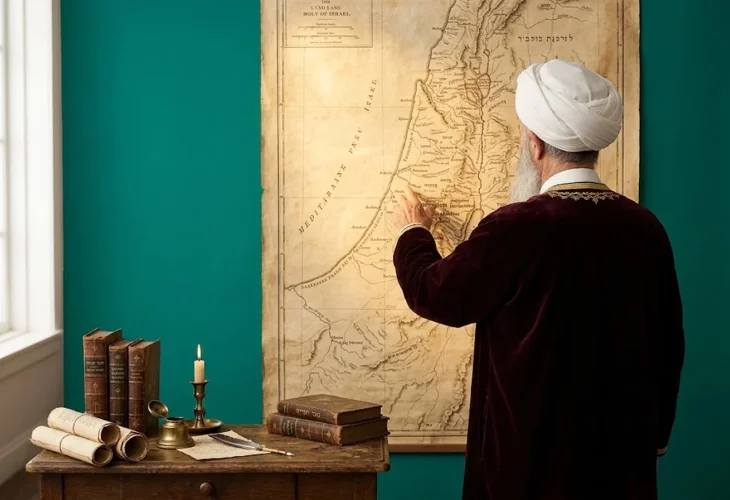
In 1843, more than 50 years before the First Zionist Congress, a Sephardic rabbi living on the banks of the Danube was already developing a remarkable plan for the Jewish people's return to the Land of Israel.
His vision went far beyond prayer and expressions of longing for Jerusalem. He proposed establishing Jewish leadership, negotiating with European governments and the Ottoman sultan, purchasing land, organizing immigration, and creating an economy capable of supporting Jewish settlement.
Decades before Theodor Herzl became the face of modern political Zionism, this rabbi was laying out many of the ideas that would eventually become central to the movement.
His name was Rabbi Yehuda ben Shlomo Chai Alkalai, and his story is one of the lesser-known chapters in the history of the Jewish return to Zion.
A Sephardic Rabbi With a Vision for the Jewish People
Rabbi Yehuda Alkalai was born in Sarajevo in 1798 to a Sephardic Jewish family. As a child, he spent time in Jerusalem, where he studied Torah and was deeply influenced by Jewish mystical teachings, particularly Kabbalah.
Among the rabbis who influenced him were Rabbi Eliezer Papo, author of Pele Yoetz, and Rabbi Yehuda Bibas, who later served as rabbi of Corfu.
In 1825, at approximately 27 years old, Rabbi Alkalai became the spiritual leader of the Sephardic Jewish community in Zemun, a town near Belgrade that was then part of the Austrian Empire's border region.
The community primarily spoke Ladino, the traditional language of many Sephardic Jews. Rabbi Alkalai devoted himself to religious leadership, education, and teaching Hebrew to younger generations.
His first book, Darchei Noam, was published in Ladino in 1839. Most of his later writings appeared in Hebrew.
But Rabbi Alkalai was interested in far more than language and religious education. He believed that the Jewish people's ancient longing to return to their homeland needed to become a practical reality.
A Different Understanding of Repentance
One of Rabbi Alkalai's most significant ideas concerned the meaning of teshuvah, the Hebrew word commonly translated as repentance.
The word literally means "return," and Rabbi Alkalai believed it could be understood on two levels.
There was personal repentance, in which an individual turns away from wrongdoing and returns to Hashem. But there was also national repentance, in which the Jewish people return to the land of their ancestors.
In his writings, he distinguished between these two forms of return, arguing that the spiritual renewal of the Jewish people was connected to their physical return to the Land of Israel.
Already in Darchei Noam, published in 1839, he called for Jews to take an active role in bringing about redemption.
"When Israel make the effort to go up to Jerusalem," he wrote, "immediately Hashem's mercies are aroused and He will reveal His redemption."
This was a striking position at a time when many Jews viewed the return to Zion primarily as a future event to be awaited through prayer.
Rabbi Alkalai believed that human effort could play an essential role in preparing the way for Divine redemption.
The Event That Strengthened His Convictions
In 1840, the Damascus Affair shook Jewish communities across the world.
Jews in Damascus were falsely accused of murdering a Catholic priest and his servant for ritual purposes. Several were arrested and tortured, and the accusations provoked widespread outrage.
Prominent Jewish figures, including Sir Moses Montefiore and Adolphe Crémieux, intervened on behalf of the accused, while European diplomatic pressure helped bring about their release.
For Rabbi Alkalai, the affair highlighted two important realities.
First, Jews living in exile remained vulnerable to persecution. Second, organized Jewish action, supported by political influence and international cooperation, could make a meaningful difference.
He began to envision a future in which the Jewish people would organize themselves politically and economically to secure their future in their ancestral homeland.
That same year, he published Shalom Yerushalayim, expanding on his ideas about repentance, redemption, and the return to Zion.
He also proposed that Jews contribute a tenth of their income to support Jewish settlement in the Land of Israel.
Three years later, in 1843, he published Minchat Yehuda, dedicated to the Jews of Damascus.
The book marked an important development in his thinking. Rather than simply encouraging immigration, Rabbi Alkalai outlined the institutions, leadership, and resources needed to make large-scale Jewish settlement possible.
A Practical Plan Decades Before Political Zionism
Rabbi Alkalai's proposals were remarkably detailed for their time.
He called for an assembly of Jewish leaders who could represent the Jewish people, negotiate with governments, purchase land, organize immigration, and establish the economic foundations of a growing Jewish community.
He believed that Jewish settlement could not succeed through enthusiasm alone. It required planning, funding, employment, agriculture, and organized leadership.
His thinking was also shaped by the nationalist movements emerging across Europe.
Living near the Balkans, he witnessed the political changes surrounding Serbian autonomy and Greek independence. These developments demonstrated how national identity, political organization, and international diplomacy could help transform a people's future.
Rabbi Alkalai considered whether a similar political arrangement might be possible for the Jews within the Ottoman Empire, which then controlled the Land of Israel.
In his work Goral LaHashem, he proposed establishing a Jewish joint-stock company to raise funds, acquire land rights, and develop Jewish settlement.
He also suggested approaching the Ottoman sultan to seek a degree of Jewish self-government in the Land of Israel, within the broader framework of Ottoman rule.
These ideas appeared decades before Herzl began advocating for organized political action to establish a Jewish homeland.
Why Hebrew Was Essential to His Vision
Rabbi Alkalai also understood that rebuilding Jewish national life would require a shared language.
After centuries of dispersion, Jews spoke many different languages, including Ladino, Yiddish, Arabic, and the languages of the countries in which they lived.
He viewed this linguistic fragmentation as an obstacle to national unity.
In Minchat Yehuda, he expressed his concern that Hebrew had lost its central place in everyday Jewish life.
"I testify about myself that all my days I have been pained by this matter," he wrote, lamenting that the Jewish people had become divided among many languages.
He called upon Jews "to raise up our language and establish it and make it primary."
These words were written in 1843, decades before the modern revival of spoken Hebrew became a defining feature of Jewish settlement in the Land of Israel.
For Rabbi Alkalai, Hebrew was not merely a sacred language used in prayer and Torah study. It was also a potential foundation for a renewed Jewish society.
Turning His Ideas Into Action
Rabbi Alkalai did not limit his efforts to writing books.
In 1851 and 1852, he traveled across Europe to promote his vision, meeting Jewish leaders and seeking support for organized settlement in the Land of Israel.
He reached Britain, published material in English, and attempted to establish a society dedicated to Jewish settlement.
Although that organization did not survive for long, he continued his efforts.
He later became involved with settlement initiatives associated with Chaim Luria and worked to persuade influential Jewish figures to support immigration and development in the Land of Israel.
Throughout his life, Rabbi Alkalai published approximately 20 books and pamphlets, along with numerous articles in the Hebrew press.
His works included Mashmia Shalom, Shema Yisrael, Menachem Tzion, Petach K'chudah shel Machat, and Goral LaHashem.
One statement captures the practical nature of his vision:
"The first mitzvah for those who come up from exile is working the land."
He believed that Jews returning to their homeland needed to cultivate its soil, establish livelihoods, and build communities capable of supporting themselves.
In this way, his ideas anticipated the emphasis on agricultural labor and settlement that would later become central to practical Zionism.
At the same time, Rabbi Alkalai remained deeply committed to traditional Jewish observance.
He opposed religious reforms that weakened the connection between Jewish prayer and the hope of returning to Jerusalem. He criticized efforts to remove references to Jerusalem, the Davidic monarchy, and the ingathering of the exiles from the prayer service.
For him, the return to the Land of Israel was not a departure from Judaism's religious traditions. It was an expression of them.
His Final Years in Jerusalem
In 1874, when he was already in his seventies, Rabbi Alkalai and his wife, Esther, fulfilled the dream he had spent decades promoting.
They moved to the Land of Israel and settled in Jerusalem.
Even in his later years, Rabbi Alkalai continued to write and advocate for Jewish settlement.
He did not live to witness the emergence of the large-scale Zionist movement that would take shape toward the end of the nineteenth century.
He passed away in Jerusalem in 1878 and was buried on the Mount of Olives.
The Surprising Connection to Theodor Herzl
One of the most fascinating details in Rabbi Alkalai's story is his connection to the family of Theodor Herzl, the founder of modern political Zionism.
Herzl's paternal grandfather, Simon Loeb Herzl, belonged to Rabbi Alkalai's Jewish community in Zemun and held positions in its synagogue.
According to the Encyclopaedia Judaica, he was a follower of Rabbi Alkalai, and there is evidence that he owned an early copy of Goral LaHashem.
This connection has led some historians to suggest that Rabbi Alkalai's ideas may have reached Theodor Herzl through his family.
However, direct evidence that Herzl himself drew inspiration from Rabbi Alkalai's writings remains uncertain.
What is clear is that many of the ideas later associated with political Zionism had already been developed by Rabbi Alkalai decades earlier.
He envisioned organized Jewish leadership, international diplomacy, land acquisition, economic development, Hebrew revival, and the return of the Jewish people to their ancestral homeland.
His life offers a powerful reminder that the movement to rebuild Jewish national life did not begin with a single leader or a single congress.
Long before Herzl stood before the First Zionist Congress in Basel in 1897, Rabbi Yehuda Alkalai had already imagined a future in which the Jewish people would take practical steps toward returning home.
And unlike many visionaries who never see the places they dream of, Rabbi Alkalai ultimately made that journey himself, spending his final years in the Jerusalem he had worked so tirelessly to help rebuild.

