

Magazine
From Struggling Yeshiva Student to Successful Chef: Yisrael Dudek's Inspiring Journey
Discover how Yisrael Dudek turned his passion for cooking into a thriving culinary career, proving that delicious food doesn't require expensive ingredients and that true success means making time for family
- Michal Arieli
- | Updated
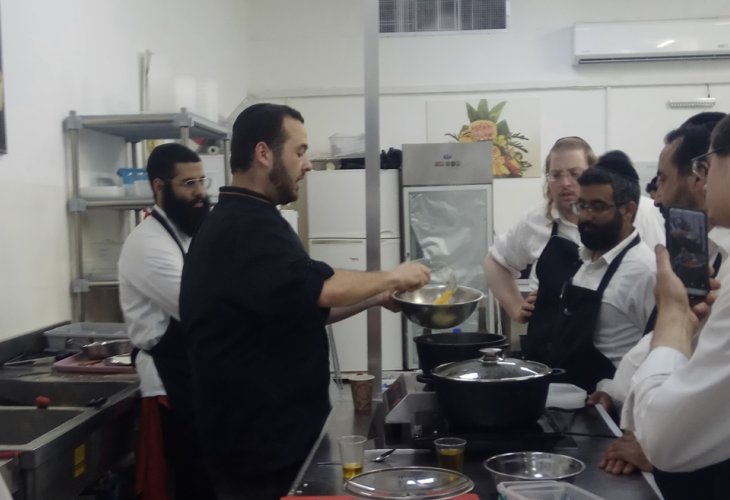 Chef Yisrael Dudek
You may have come across the name Yisrael Dudek in a newspaper, alongside an elaborate recipe featuring ingredients such as acorn squash, tomato chantilly, shallots, and caramelized carrots. If you've attended an upscale catered event, you may even have seen his name printed on an elegant menu. Today, Dudek is a successful chef known for his creative dishes, professional expertise, and passion for fine cuisine. But fourteen years ago, his life looked very different.
Back then, Dudek was a young yeshiva student struggling to concentrate on his studies. Restless and frustrated, he found himself increasingly drawn to the kitchen. "To tell you the truth, I was never particularly strong academically," he admits. "I couldn't sit in the study hall for long periods, and somehow I always found myself in the yeshiva kitchen. Even at home, I was interested in cooking."
Fortunately, his mother recognized something that others might have overlooked. "At a certain point, my wise mother realized that studying was difficult for me. She also understood that if I continued struggling in the same environment, I might eventually head in the wrong direction. Around that time, Radio Kol Chai announced a cooking competition, and she decided to register me." That decision would change the course of his life.
A Cooking Competition That Changed Everything
Dudek entered the competition with very little professional experience. Apart from a basic pastry course and some nighttime work in a bakery, he had no formal culinary background. Nevertheless, his mother believed in his abilities and encouraged him to compete. To his surprise, he reached the finals and finished in second place.
"I was actually the only male contestant," he recalls. "At the time, there were very few men in our community who knew how to cook or bake. People generally considered the kitchen a woman's domain." The following year, Dudek entered the competition again, and this time, he won first place.
But the most important outcome of the competition was not the prize. It was an encounter with professional chef Miri Zorger, who recognized his potential and offered him an unexpected opportunity. A hotel in Bulgaria had hired a head chef who suddenly couldn't come, and Zorger wanted to know whether Dudek would be willing to take his place.
He was stunned. With so little experience, how could he possibly take responsibility for a hotel kitchen in a foreign country? Despite his doubts, he accepted the offer and traveled to Bulgaria. There, he discovered that although he lacked culinary experience, he possessed another essential skill: exceptional organizational ability.
"Today, I understand that organization is one of the most important elements of running a successful kitchen," he explains. "Good organization helps the entire kitchen operate efficiently, produces more attractive dishes, saves preparation time, and ultimately saves money."
To this day, organizing a kitchen remains one of his favorite responsibilities. "When I arrive at an event, I actually enjoy arranging the storage area. Even when we're catering an outdoor event, the first thing I do is establish a proper miniature kitchen. I don't want people pulling serving spoons and supplies out of random cardboard boxes. I create an organized pantry and working environment."
According to Dudek, poor organization can undermine an otherwise promising event. "Many events fail simply because the kitchen hasn't been set up properly. Organization was something I was good at from the beginning. Back then, I didn't really know how to cook professionally. I worked mostly by instinct, but apparently the food still tasted good."
Finding His Place Outside the Study Hall
Leaving the familiar world of yeshiva and entering the professional culinary industry was a major transition. Yet Dudek believes it was the right decision. "Learning was always difficult for me," he says candidly. "I wasn't a troublemaker, but academic study wasn't my strength. I understood that if I didn't get up and do something productive with my life, I might end up in places I didn't want to be."
Rather than allowing his difficulties to define him, he began recognizing his natural abilities. "I realized that Hashem had blessed me with talented hands, and I decided to do something with that gift."
He also discovered that the culinary world attracts people with a wide range of backgrounds and abilities. "I'm certainly not the only person who found his way into a kitchen after struggling in other areas. Professional kitchens are full of people who may not have followed conventional academic paths. You won't necessarily find many high-tech professionals there. Our strength is in our hands, quite literally."
Learning to Run a Kosher Kitchen in Bulgaria
Dudek's first professional assignment was a crash course in nearly every aspect of kitchen management. "Before starting, I received training in kashrut so that I could serve as a kosher supervisor. But beyond that, I had to manage everything myself."
He was responsible for establishing and koshering a kitchen in a non-Jewish hotel, a task that presented constant practical challenges. "Problems arose in every direction, but those problems became my greatest teachers. I learned how a professional kitchen operates, how it should be organized, what matters most, and what can be handled differently."
He remained in Bulgaria for approximately three months, gaining invaluable experience. "It was my first real introduction to professional cooking. I also learned something fascinating: people who don't speak the same language can still work together successfully in a kitchen because they understand the universal language of cooking."
When he returned to Israel, Dudek immediately enrolled in advanced culinary studies. At the same time, he began cooking at major events in Israel and abroad, frequently working alongside Chef Miri Zorger. The schedule was demanding, with long working days and very little sleep.
"I worked incredibly long hours, sometimes opening a kitchen at four in the morning and closing it at two the following morning, if I managed to close it at all. But I never stopped studying." Even after establishing himself professionally, he continued investing in his education. "In fact, I still haven't stopped learning."
"A Cook Knows How. A Chef Knows Why."
Given Dudek's natural talent, one might wonder why he places such importance on formal culinary education. His answer is simple: talent alone is not enough.
"Cooking school teaches you something different. It takes you back to the foundations, and those foundations are essential," he explains, comparing culinary training to learning how to drive.
"Almost anyone who spends enough time behind a steering wheel in an empty parking lot will eventually figure out how to operate a car. But that doesn't mean the person truly knows how to drive. A driving instructor teaches you about road conditions, traffic signs, the vehicle itself, and the relationship between drivers and pedestrians."
Cooking, he explains, works much the same way. "Anyone can eventually learn to prepare food through trial and error. The challenge is understanding how to do it properly." He summarizes his philosophy in a sentence he regularly shares with his students: "A cook knows how. A chef knows why."
For Dudek, this distinction captures the difference between merely following a recipe and understanding the techniques and principles that make a dish successful. His determination to learn even led him to attend culinary schools outside the religious community, including one that did not maintain kosher standards. "It wasn't something I wanted to do, but at the time there were very few alternatives," he explains.
The experience was difficult. "When I first entered the classroom in my traditional black-and-white clothing, the other students were shocked. I sat quietly to the side, listened, and tried to absorb as much knowledge as possible." While the other students sampled the meals they had prepared, Dudek ate sandwiches he had brought from home.
"I appreciated the education, but I certainly didn't enjoy the environment. That's why I believe the kosher culinary schools established in the Haredi community in recent years are such an important development."
Even today, he continues to develop his skills whenever possible. "I recently completed a professional butchery course. I'm always happy to learn something new and deepen my understanding."
Delicious Food Doesn't Have to Be Expensive
Dudek has developed a reputation for creative, unconventional recipes featuring unusual combinations of ingredients and flavors. "I enjoy developing interesting and distinctive dishes," he acknowledges with a smile. "In my independent work, I can explore my culinary ideas, experiment with new combinations, and create experiences for people who enjoy discovering different flavors."
His creative process also involves studying scientific research related to food and using that knowledge to develop new dishes. Yet his professional life has another side. "In addition to my independent work, I have a regular position in a restaurant and catering business that serves familiar, affordable food. The goal is to offer high-quality meals at prices ordinary people can afford."
At first glance, the two areas of his work might appear completely different. Dudek, however, believes they are based on the same principles. "People often assume that inexpensive food must be inferior. That's simply not true."
He points to the disappointing meals sometimes served at budget events. "If you arrive at a wedding hall and receive inedible schnitzel and poorly cooked rice, the problem isn't necessarily the budget. It's often that the cook didn't put enough care into preparing the food." Rice, he notes, requires only a few basic ingredients. "You need rice, water, salt, and oil. The difference between a cheap variety of rice and an expensive one might be only a few shekels. What matters is knowing how to prepare it correctly."
In Dudek's experience, even inexpensive ingredients can produce excellent results when handled with proper technique and attention. He recalls attending a family celebration in Bnei Brak where the food was exceptionally good. When he asked how much each portion had cost, he was told approximately sixty shekels.
For him, that meal demonstrated an important principle. "You don't need to be a genius or have an unlimited budget to produce good food. You need to care about the result and understand a few essential cooking techniques."
He believes the food industry suffers from a shortage of properly trained cooks. "Too many people are hired as cooks without sufficient professional knowledge. With the right training, they could achieve much better results without significantly increasing costs."
He also identifies a lack of financial understanding among some restaurant owners. "People open food businesses and sell meals at low prices, assuming they're making money. But in reality, they're sometimes just moving money around without generating a genuine profit."
Creating Luxury Dishes With Simple Ingredients
Dudek has noticed a growing interest in sophisticated cuisine within the Haredi community. "People are increasingly interested in unique, beautifully prepared dishes rather than simply looking for the cheapest possible option. I find that exciting because it challenges me creatively."
One of his greatest professional challenges comes when he is hired to cater fundraising dinners. "A fundraising dinner is supposed to be an elegant event. Guests should feel valued and appreciated, and the food should reflect that."
At the same time, he points out, the purpose of such an event is to raise money for a charitable cause. "If you spend too much on luxurious ingredients, you're defeating the purpose of the dinner." The challenge is finding the right balance between impressive presentation and responsible spending.
"I love creating impressive dishes from simple ingredients and finding ways to make affordable food look and taste exclusive," Dudek explains.
He applies the same philosophy to his regular recipe column in the magazine Betoch HaMishpacha. "The editors insist that I use ingredients readers can find in an ordinary supermarket. If I include something like purple potatoes, they remove it immediately."
The objective, he explains, is to show home cooks that impressive dishes do not require expensive or exotic ingredients. With creativity, professional techniques, and careful preparation, ordinary ingredients can become something extraordinary.
A Mission to Change the Way People Cook Meat
Toward the end of the interview, Dudek reveals a project that he considers especially meaningful. "It's the project of my life," he says. "I'm investing an enormous amount of time and effort into it."
Over the years, he has become increasingly aware of how little many home cooks understand about different cuts of beef. "People buy expensive cuts of meat and ruin them because they don't know how to prepare them. Others avoid cheaper cuts because they assume a lower price means inferior quality."
The result, he explains, is that certain popular cuts remain in constant demand, driving up prices, while equally flavorful alternatives are overlooked. "Take cut number five, for example, the shoulder cut commonly used in many recipes. You'll find it everywhere. But how often do you see recipes using ribs for slow cooking?"
According to Dudek, less popular cuts can deliver excellent flavor at a fraction of the cost. "Sometimes the price difference is half, or even two-thirds. Cuts numbered three and seven, for example, can also be juicy, flavorful, and particularly suitable for our style of cooking."
The real problem, he believes, is a lack of knowledge. "People simply don't know what to do with these cuts."
To address the issue, he has been developing a comprehensive project bringing together practical information about different cuts of beef and how to prepare them. This project genuinely excites me because I feel there's an important mission in helping people understand how to cook meat properly."
Choosing Family Over Professional Success
For all his enthusiasm about the culinary world, Dudek has made a deliberate decision not to allow his career to come at the expense of his family. "Baruch Hashem, I'm happily married, and a father."
Earlier in his career, he loved traveling abroad and working at prestigious events. But after becoming a father, he began reconsidering the demands of his profession. "One day, I had a very honest conversation with my wife. I told her, 'Look at what's happening. Whenever everyone else is enjoying time off, whether during vacations, Shabbat, or holidays, I'm the one who has to work so they can enjoy their meals.'"
The realization troubled him. "I understood that the nature of my profession made ordinary family life very difficult. I wanted to be present for my wife and children, not spend every evening working at another event."
He also wanted to enjoy family celebrations as a guest rather than spend them behind the scenes in the kitchen. "When I attend a family event, I want to sit with my relatives and enjoy their company, not stand in the kitchen preparing elaborate dishes."
Eventually, Dudek decided to reduce his event work dramatically. "Today, I rarely accept outside events. I choose only very specific opportunities."
He acknowledges that the decision occasionally involves a sense of professional sacrifice. "Sometimes I do feel that I'm missing out. But when I come home early in the evening, see my children smiling, and sit on the floor to play with them, I know it's worth everything."
What Does a Professional Chef Cook at Home?
And what about his own family's meals? Do his wife and daughters enjoy the same elaborate creations that appear at luxury events?
Dudek smiles. "My wife and I divide the cooking equally. She prepares the delicious, familiar dishes, while I like introducing our children to unusual flavors." Recently, for example, he made them a watermelon salad with salty cheese and black olives. "They absolutely loved it."
His daughters have developed an adventurous approach to food. "They can sit and play while happily nibbling on a lemon," he says with amusement. "I believe it's important to expose children to different tastes and help them develop their palates."
He also encourages them to explore food through their sense of smell. "When my children enter the kitchen, the first thing they ask is, 'Can I smell it?' They often help me cook as well."
For Dudek, these simple moments capture something more meaningful than any elaborate culinary creation. His journey began as a struggling yeshiva student who found comfort and purpose in the kitchen. Through determination, professional training, and a willingness to recognize his own strengths, he built a successful career in a field he loves.
Yet his understanding of success has evolved. Today, he values not only the dishes he creates and the people he serves, but also the time he spends with those closest to him. After all, even for a professional chef, some of life's most satisfying experiences have nothing to do with the food on the plate.

