

Magazine
When the Town Hall Burns
What Jewish law teaches about the limits of protest, the duty to pursue justice, and what we must preserve even when we fight for change.
- Maayan David
- | Updated
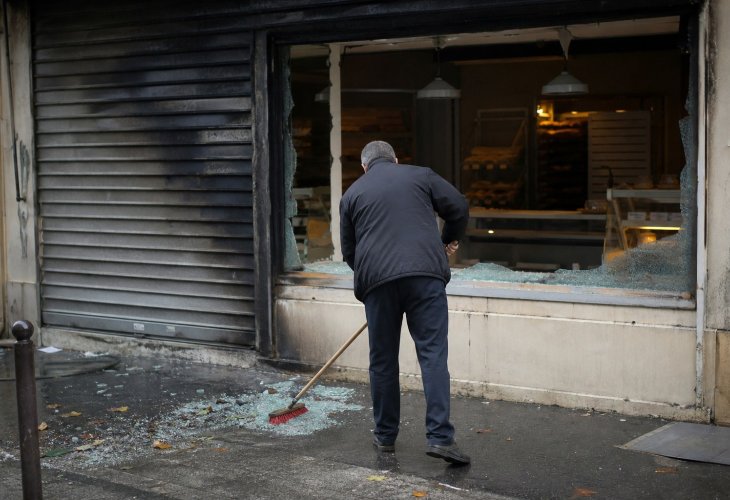 A shop owner sweeps up glass the morning after the riots
The protests of October 17 in France began largely peacefully, and some 550,000 people marched across the country over the rising cost of living, fuel prices and the state of the schools. By evening it had become something else. In Paris a huge crowd gathered around the Place de la République, vehicles were set on fire and shops were looted. In Limoges, the town hall was firebombed and collapsed. The BBC reported that some 1,500 shops and businesses were destroyed or ransacked and another 3,000 looted. The Prime Minister said 1,200 people were arrested and 150 police officers were hurt, and reports said one police officer and one protester were killed.
A week later, on October 24, some 400,000 people marched again, with 70,000 police deployed to prevent a repeat, and nearly 1,000 people were detained. Curfews had already been imposed in Paris and Marseille. French people on social media were openly expressing their dismay.
This is not new, and it is not only French. France saw weeks of rioting in 2005 and the Yellow Vest unrest of 2018. Britain had its riots in 2011, and the United States in 1992, in the 1960s and again in 2020. Every time, the same argument comes back. Are riots a regrettable but necessary tool of the powerless, or simply a failure of civic life?
The case for necessity is serious and deserves a hearing. Democratic institutions are slow and often captured by those who already have power, and people who have tried petitions, elections and marches without effect may feel that nothing else gets noticed. Martin Luther King, who rejected violence, still called rioting the language of the unheard. Some historians argue that disruption has moved governments when polite protest did not, and that even the American Revolution began with property destroyed in Boston harbor.
The case against is just as serious, and the evidence for it is hard to wave away. Rioting usually lands on the neighborhoods that can least afford it. It hands governments an excuse to answer with force instead of with reform, and it frightens the very middle-ground voters a movement needs. Political scientist Omar Wasow's work on the 1960s found that nonviolent protest moved public opinion toward the protesters' side, while violent unrest pushed it away. Whatever the truth about their effectiveness, riots do not stay aimed at their targets. In Limoges the building that burned was the town hall, which belongs to all its citizens, including the ones who marched.
Do not destroy
Judaism does not have a position on French fuel prices, but it has a lot to say about the question underneath, which is what we may destroy while pursuing something we believe is right. The clearest starting point is a verse about war. When you besiege a city, the Torah says, you may not cut down its fruit trees, "for is the tree of the field a man, that it should be besieged by you?" (Deuteronomy 20:19–20). This is a war that is permitted, against an enemy, and even then the trees are protected. The Torah allows trees that are not fruit-bearing to be cut for siege works, so the rule is not absolute, but the permission is narrow and tied to real military need. Destruction has to be justified by necessity, and the burden of proof falls on the one who destroys.
The rabbis took this specific law and made it a principle. Bal tashchit, "do not destroy," came to cover clothing, vessels, food, springs and buildings, so that wanton destruction of anything useful to people is forbidden. Maimonides, in the laws of kings, writes that whoever breaks vessels, tears clothes, demolishes a building, stops up a spring or ruins food in a destructive manner violates this prohibition (Hilkhot Melakhim 6:8–10). He adds a point that applies directly to rioting: if the Torah is this careful with trees in the middle of a war, then how much more careful must we be with everything else, and especially with human beings. The Sefer HaChinukh (529) goes further and describes the kind of person the law is meant to shape. Such a person loves peace and good, and grieves when anything is destroyed, even something small, and rescues it if he can.
There is also a plain legal side to this. Judaism treats looting as theft and arson as damage, both with ordinary civil liability. The Talmud, in tractate Bava Kamma, spends many pages on one who starts a fire and what he owes for the damage it causes. The tradition has no category of "justified" destruction that frees the destroyer from paying. Someone who torches a shop owes the owner for it, whatever the grievance behind it. Jewish law also does not accept the idea that a righteous cause converts a crime into something else. The prophets did not burn cities to demand reform; they stood in the gates and said what was wrong, sometimes at great personal cost.
This does not mean Judaism asks for silence in the face of injustice. "Justice, justice shall you pursue" (Deuteronomy 16:20) repeats the word for a reason, and the tradition has always held that you must cry out against oppression. The repetition is also read to mean that the pursuit has to be just in its means as well as its ends. A protest that robs bystanders and burns public property has already abandoned the thing it claims to be fighting for.
The deeper message of the verse about the trees is that even when we are right, and even when the stakes are real, the world is not ours to wreck. The tree, the building and the shop belong to someone, and they are part of the shared life we are trying to improve. A cause that can only win by destroying that shared life has already lost something it was supposed to protect. Judaism asks us to hold both ideas at once: the demand for justice is legitimate, and so is the duty to leave things standing.

