

Interesting
Australia's Pink Lake: How Heavy Rain Transforms the Desert Into a Colorful Wonderland
Discover the science behind Lake Eyre's stunning pink and green waters, how microscopic organisms create its unusual colors, and why this rare desert transformation occurs after heavy rainfall
- Shira Dabush
- | Updated
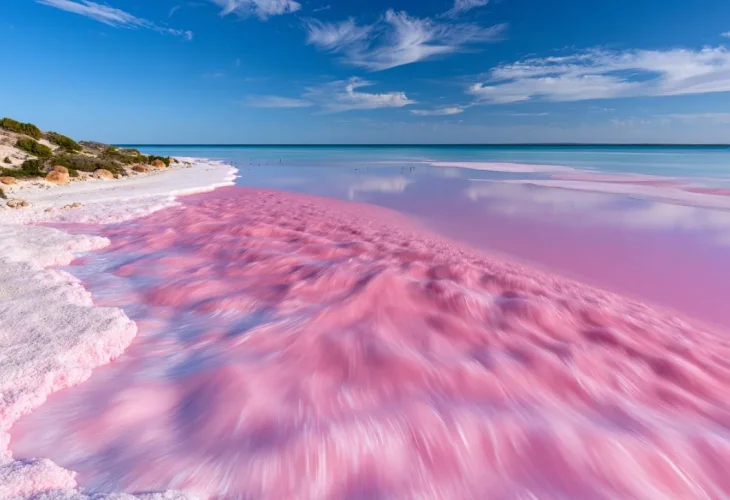
Kati Thanda–Lake Eyre, located in the heart of the South Australian desert, is usually characterized by a dry, barren landscape. Recently, however, visitors to the region captured a rare and spectacular sight: stretches of pink and green water surrounded by flourishing vegetation.
According to experts, this remarkable transformation can occur at the beginning of winter, particularly following periods of heavy rainfall. What is normally an arid salt lake can temporarily become a colorful body of water, dramatically changing the appearance of the surrounding desert.
Lake Eyre's drainage basin covers an enormous area, extending across approximately one-sixth of Australia. Rivers and streams carry water into the lake from distant regions, sometimes following heavy rainfall hundreds of kilometers away. However, much of this water eventually evaporates.
In 2025, NASA documented the remarkable changes that occurred in the region following intense rainfall in Queensland. Its observations showed that the lake filled within several weeks, while the surrounding landscape continued to change for months after the rains had ended.
What Makes the Water Turn Pink?
The lake's striking pink color is associated with a natural process that occurs as the water begins to evaporate. As the lake dries, the water gradually disappears, but the dissolved salts remain behind, causing the salinity to increase.
These increasingly salty conditions provide a habitat for microscopic organisms, including certain algae and bacteria. Some of these organisms produce pigments in shades of pink, orange, and red. When they multiply in large numbers, their colors can become visible across extensive areas of the lake, creating the spectacular pink appearance captured by visitors.
The lake has no outlet to the sea, meaning that water flowing into it accumulates and is eventually lost primarily through evaporation. The surrounding region receives an average of approximately 140 millimeters of rainfall annually, while evaporation rates are high. Under these conditions, water cannot remain in the lake for extended periods without a continuous or renewed supply.
How long the lake stays filled depends largely on temperatures and the amount of incoming water. As evaporation continues, the water level gradually falls and the remaining water becomes increasingly concentrated with salt.
This delicate interaction between rainfall, evaporation, salt, and microscopic life is what makes Kati Thanda–Lake Eyre such an extraordinary natural phenomenon. For brief periods, one of Australia's driest landscapes can transform into a breathtaking display of color, revealing the surprising beauty hidden within the desert.

