

History and Archaeology
How Did Jews Pray Before Siddurim? The Story of a 750-Year-Old Book
How did Jews pray before siddurim were widely available? Discover the fascinating history of the 750-year-old Worms Machzor and its remarkable survival.
Walk into almost any synagogue today, and you'll find shelves filled with siddurim (prayer books). Worshippers take one from the shelf or pull their own from a tefillin bag and begin praying. We take this convenience for granted, but for much of Jewish history, owning a prayer book was far from common. Every book had to be copied by hand, requiring expensive materials, a skilled scribe, and weeks or even months of painstaking work.
So how did entire Jewish communities pray when most people didn't have a siddur of their own?
The answer is surprisingly simple: they prayed from memory. Children learned the prayers by listening to the adults around them, gradually memorizing the words through repetition. Over time, the familiar melodies and passages became deeply ingrained, allowing worshippers to participate in communal prayer without needing a written text.
But relying on memory wasn't always easy. The Mishnah discusses situations in which a chazzan (prayer leader), serving as the shaliach tzibbur (representative of the congregation), becomes confused or makes a mistake while reciting the prayers. Jewish law even establishes rules for when a prayer leader must be replaced because of an error.
One particularly interesting ruling concerns Birkat HaMinim, the blessing directed against heretics. If the chazzan makes a mistake in this blessing, he may be removed immediately, because his hesitation could raise suspicions that he sympathizes with heretical beliefs and is therefore unfamiliar with, or reluctant to recite, the blessing.
The importance of memorization also helps explain why the Amidah, the central standing prayer, is repeated aloud by the chazzan. In earlier generations, not everyone could recite the entire prayer accurately. The repetition allowed those who did not know the words to fulfill their obligation by listening to the prayer leader.
How Did the Jewish Prayer Text Become Standardized?
In his Laws of Prayer, the Rambam (Maimonides) explains how the familiar wording of Jewish prayers came to be established. Following the exile, Jews lived among different nations and spoke a mixture of languages. Many struggled to express their prayers clearly in lashon hakodesh, the holy tongue.
To address this difficulty, Ezra and his court established a structured order of blessings and prayers, providing the Jewish people with a shared text that everyone could learn and recite. The goal was not simply to preserve the prayers in writing, but to make their wording familiar to ordinary worshippers, rather than leaving prayer knowledge in the hands of Torah scholars alone.
Over the centuries, leading Jewish scholars recorded the prayers in their writings. Rav Amram Gaon, for example, compiled the order of prayers and sent it from Babylonia to Spain, helping communities establish the correct text. His work, known as Seder Rav Amram, remains an important historical source for understanding the development of Jewish prayer.
The Rambam later included the wording and order of the prayers in his own writings, while students of Rashi preserved prayer traditions in Machzor Vitry. Other sages also recorded the prayers and customs followed by their communities.
Yet even though the texts existed, producing individual copies remained difficult and expensive. Most people continued to pray by heart. Some synagogues possessed a prayer book for the chazzan, particularly for the High Holy Days, when the services were longer and more complicated.
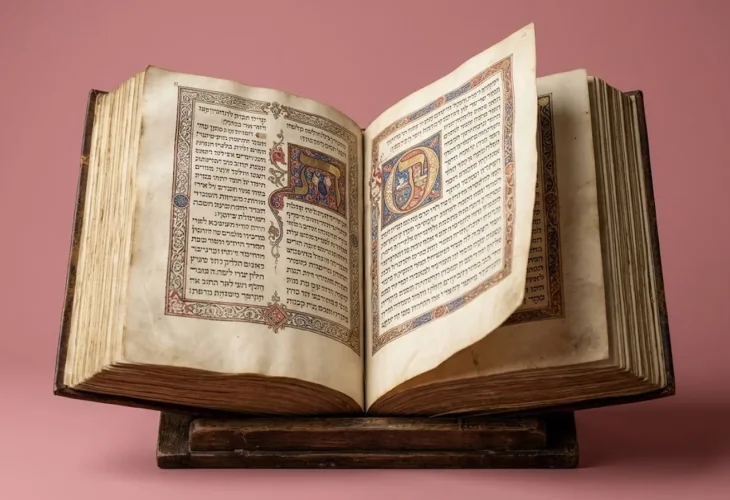
One remarkable example of such a communal prayer book is the Worms Machzor, a magnificent medieval manuscript dating back to 1272. Created for synagogue use, it continued serving Jewish worshippers for hundreds of years.
The Worms Machzor: A Prayer Book That Took 44 Weeks to Write
Because handwritten prayer books were so valuable, enormous care went into their creation. They were often produced on parchment or thick paper, with elaborate lettering, illustrations, and decorative designs. Some were much larger than the prayer books we use today.
The Worms Machzor is a striking example. Its first volume measures approximately 15 inches (39 centimeters) tall and 12 inches (31 centimeters) wide, with hundreds of parchment pages. Carrying such a substantial book to the synagogue was no small task.
In fact, hidden within the opening letters of the prayer for dew is a special blessing dedicated to the person who carried the volume to the synagogue. Written in early Yiddish, it is considered the earliest known dated text in that language.
Although the manuscript is known as the Worms Machzor because it was used for generations in the German city of Worms, scholars believe it was originally produced in Würzburg.
The first volume was completed on the 28th of Tevet, 5032, in early 1272. Its scribe, Rabbi Simcha ben Rabbi Yehudah, recorded that he had spent 44 weeks completing the work. He copied the machzor for his uncle, Rabbi Baruch ben Rabbi Yitzchak, who intended to place it in a synagogue for the entire community to use.
The manuscript also contains fascinating evidence of local prayer customs. Beside a passage recited on the seventh day of Pesach (Passover), a handwritten instruction tells the chazzan to recite it aloud, explaining that this was the custom in Würzburg. This small note later became an important clue in identifying where the manuscript originated.
According to one scholarly theory, Jewish refugees from Würzburg brought the machzor to Worms following the Rindfleisch massacres of 1298.
The original Worms Machzor consisted of two matching volumes, but the second was eventually lost. The community later paired the surviving first volume with another machzor, written around 1280, to complete the collection.
The first volume contains prayers for the Four Parashiyot (four special Torah readings), Purim, Pesach, Shavuot, and Tisha B'Av. The replacement second volume contains the prayers for the festivals of Tishrei, including Rosh Hashanah and Yom Kippur. It is slightly larger, measuring approximately 18 inches (45 centimeters) tall.
Unusual Illustrations and Ancient Prayer Traditions
The Worms Machzor is remarkable not only for its age but also for its artistic details. Written in square Ashkenazi Hebrew script, it features elaborate opening words, decorative frames, and illustrations carefully incorporated into the pages.
Major sections begin with designs resembling gates and arches, while certain letters and words are given generous space and ornamentation. The scribe appears to have planned where the illustrations would be placed, leaving designated areas for the artist and possibly providing instructions about what to draw.
Some of the illustrations are particularly unusual. They include human figures with birds' heads and others whose faces have been altered or obscured. Similar artistic features appear in other Jewish manuscripts produced in Germany during the 13th and 14th centuries, although the reasons behind this style remain uncertain.
In the margins of a liturgical poem for Pesach, colorful circles depict zodiac signs and activities associated with different months of the year. One illustration shows a bird-headed figure warming himself beside a fire, while another contains images of fish.
The manuscript's vocalization, or vowel markings, is equally fascinating. Researchers have identified traces of early Jewish reading traditions, including elements associated with the Land of Israel. This means that a prayer book copied in medieval Germany may preserve linguistic and liturgical traditions that originated centuries earlier.
The machzor was also a living document. As it continued to serve the Worms community, additional notes and instructions were written into its pages, reflecting local customs and changes in practice. Some of these additions date to the late 14th century.
How the Worms Machzor Survived the Holocaust
For centuries, the Worms Machzor remained part of the community's religious life. But its survival was threatened in November 1938, when the Nazis destroyed the synagogue in Worms during the November pogroms, commonly known as Kristallnacht.
Although the synagogue was destroyed, the manuscript survived. It eventually came into the possession of the Gestapo, along with documents from the Jewish community's archives.
According to the National Library of Israel, in 1943, the municipal archivist Dr. Friedrich Illert was asked to help identify manuscripts being held in a cellar in Darmstadt. There, he recognized the Worms community archive, including the two volumes of the machzor.
Illert arranged for the documents to be moved to a hiding place, and they were subsequently stored in the cathedral in Worms, where they survived the war.
After World War II, negotiations began over transferring the manuscripts to Israel. In June 1957, the two volumes finally arrived at the Jewish National and University Library in Jerusalem, now known as the National Library of Israel.
Today, the Worms Machzor has been digitized, allowing people around the world to explore its pages and appreciate the extraordinary details preserved within them. Its colorful illustrations, ancient vowel markings, handwritten instructions, and even the blessing for the person who carried it to synagogue offer a glimpse into Jewish communal life hundreds of years ago.
What began as 44 weeks of painstaking work by a medieval scribe became a treasured prayer book used by generations of worshippers. Having survived centuries of Jewish history, including the destruction of its synagogue during the Holocaust, the Worms Machzor now rests in Jerusalem, preserving the prayers, traditions, and memories of a community whose legacy lives on through its pages.

