

Wonders of Creation
Living Stones: The Amazing Plants That Disguise Themselves
Discover Lithops, the remarkable succulents that survive in harsh deserts by looking like stones, storing water, and absorbing sunlight while hiding underground
- Tehila Cohen
- | Updated
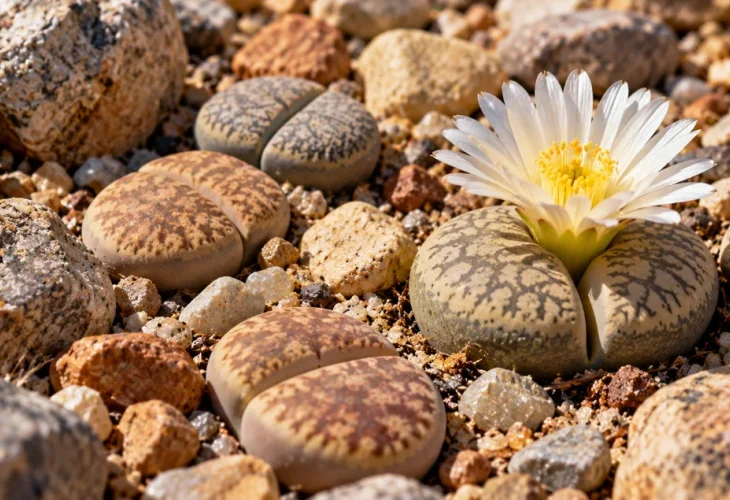
In the arid regions of South Africa and Namibia, unusual plants grow almost invisibly among the surrounding rocks. Lithops belong to the succulent family, a group of fleshy plants with specialized water-storing cells, and are known for their remarkable camouflage, which helps them survive in their harsh environment.
Lithops are also known as "living stones." Their name comes from Greek, combining words meaning "stone" and "appearance." Most of the plant remains hidden beneath the soil, with only the upper portions of two thick, fleshy leaves typically visible above ground. A narrow slit separates the leaves, which store water and enable the plant to survive prolonged periods of drought. Keeping most of its body underground also helps minimize water loss in the hot, dry climate.
For herbivorous animals, a succulent plant filled with water is an especially attractive food source. By blending into the surrounding stones, Lithops avoid drawing attention to themselves, giving them a significant survival advantage.
How Does a Plant Hidden Underground Get Enough Sunlight?
The upper surfaces of Lithops leaves contain transparent or translucent areas known as "windows." These allow sunlight to penetrate the leaves and reach the internal tissues where photosynthesis takes place. This remarkable adaptation enables the plant to remain largely protected underground while still absorbing the sunlight it needs to survive.
The plant's stone-like appearance becomes even more surprising during flowering season. A striking flower, usually white or yellow and sometimes relatively large compared to the plant itself, emerges from the slit between its two leaves.
Lithops also have a unique growth cycle. A new pair of leaves develops inside the plant, drawing on the water and nutrients stored in the older pair. As the new leaves grow, the older ones gradually shrink and dry out, eventually being replaced entirely.
This process is particularly important in an environment where fresh water cannot be relied upon to arrive when the plant needs it. By recycling its stored resources, Lithops can continue growing even under extremely dry conditions.

