

World News
She Is Not Jewish, but Is Learning Hebrew to Save the Jewish Memory of Wales
Laura Henley Harrison has been accepted into an international Jewish heritage preservation programme, and now she must learn the Hebrew alphabet. Behind this small task lies a big story: Jewish communities that lived among the ports and industrial towns of Wales, and a heritage that dedicated people are trying to preserve for future generations
- Shira Dabush
- | Updated
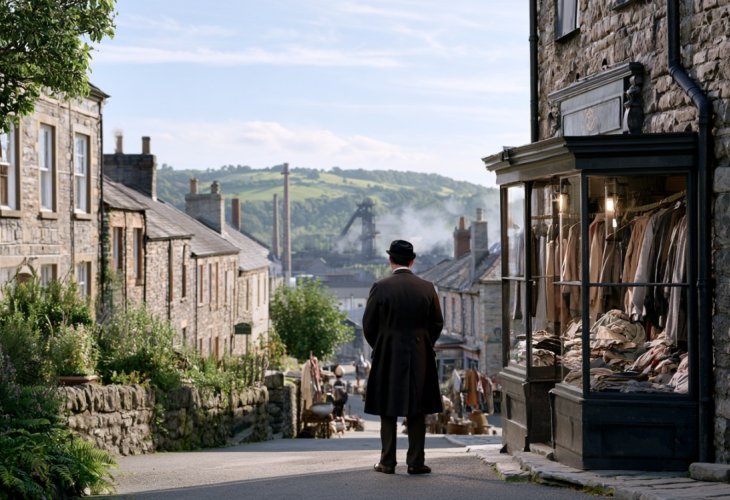 Illustrative image: a Welsh industrial town in the 19th century
By this coming November, Laura Henley Harrison must learn to recognise the letters of the Hebrew alphabet, and for a researcher who is not Jewish, this may be a rather unusual task. Harrison, Project Manager at the Jewish History Association of Wales, has been accepted into At the Source, the National Library of Israel’s international training programme. As such, she will apparently be one of just 20 participants in a programme that will include studies along the Jerusalem-Prague axis.
The programme is intended for library, museum and archive professionals working with Jewish collections, and its aim is to provide participants with knowledge that will help them identify, understand and preserve the materials. For Harrison, it is also an opportunity to introduce a wider audience to a chapter of Jewish history that many people know almost nothing about. The association where Harrison works was founded in 2017 as the Jewish History Association of South Wales, and Harrison herself is also researching Jewish contributions to medicine in Wales.
The Community That Began in Swansea
When people think of British Jewry, the cities that usually come to mind are London and Manchester, but what about Wales, where Jewish communities with a long history once developed? According to the National Library of Wales, the first Jewish community in the region became established in Swansea, where Jews were already living in the 1730s. One of the prominent names in its early history is David Michael, a silversmith who came from Germany and did much to help the Jewish community in Wales flourish. In 1768, he managed to purchase land for a Jewish cemetery, and later built a synagogue behind his home, until, by the 19th century, additional synagogues had been established in other towns.
The Marks family, who came from the town of Neath, laid the foundations of the Cardiff community in 1810, and later synagogues were also established in Merthyr Tydfil, Newport and other places. Between 1881 and 1914, an estimated 4,500 Jews from Eastern Europe settled in Wales, seeking safety from persecution and the possibility of a better life.
Jews in the Land of Iron and Coal
The town of Merthyr Tydfil was an important industrial centre, and the Jewish life that developed there was connected to the world of iron, steel and coal. The first Jewish settlers arrived in the 1820s, and among them were second-hand clothing dealers and peddlers. Alongside the merchants were also Jewish workers from Russia who worked at the Dowlais ironworks.
The community was formally organised in 1848. The Victorian synagogue built there later in the century, with a women’s gallery upstairs, served a community that numbered around 400 people at its peak. It is the oldest surviving synagogue building in Wales. One of the most prominent preservation projects focuses on the synagogue in Merthyr Tydfil. The building, which ceased to be used for prayer in 1983, is intended to become the Welsh Jewish Cultural Centre. According to an announcement by the local authority, the project is worth approximately £6 million, with construction work expected to begin in 2027 and the opening planned for autumn 2028. The National Lottery Heritage Fund, which is supporting the project, notes that the restoration will include the historic building’s interior, including the gallery and the remaining Star of David windows.
But alongside economic establishment and communal life, this history also includes difficult events: in August 1911, riots broke out in the town of Tredegar, during which Jewish shops and property were damaged. A report delivered to the British Parliament that month described the smashing and looting of Jewish-owned shops, and troops were sent to the town to help restore order. The same report noted that the violence later spread to other businesses as well.
But preserving history does not end with buildings. The Jewish History Association of Wales also collects personal testimonies to document what life within the communities was like: the association began recording interviews in 2018, and although interviewers initially visited interviewees’ homes across Britain, online interviews later made it possible to reach people living in other countries as well.

