

Interesting
The Fascinating Secret Behind Pears Grown Inside Glass Bottles
Discover the fascinating technique farmers use to grow pears inside narrow-necked bottles and why these unusual fruits are used to create specialty beverages
- Tehila Cohen
- | Updated
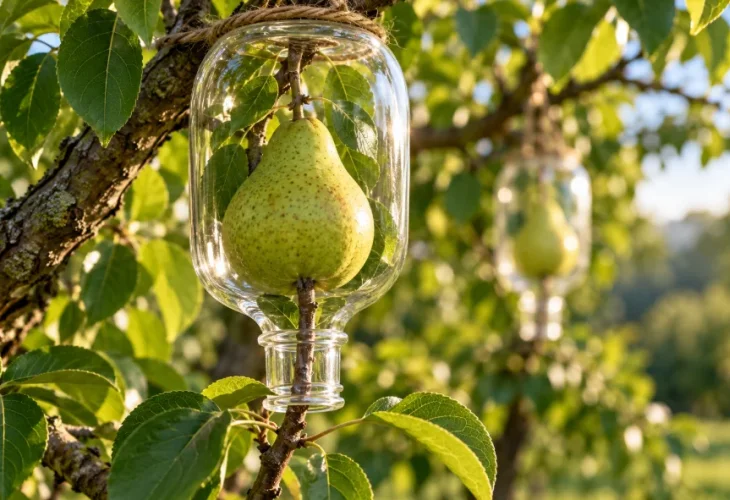
At first glance, it seems impossible. A perfectly formed pear sits inside a glass bottle, even though the bottle's narrow neck is far too small for the fruit to pass through. How did it get there? The answer lies in an unusual cultivation technique in which the pear is grown inside the bottle itself. Rather than squeezing a fully grown fruit through the opening, farmers place the bottle around the pear while it is still tiny, allowing nature to do the rest.
This traditional method, practiced by specialty fruit growers and beverage producers, requires patience, careful positioning, and regular monitoring throughout the growing season.
How Does a Pear Grow Inside a Bottle?
The process begins when a pear is still in the early stages of development. Farmers carefully slip an empty glass bottle over the young fruit and secure it to the tree, ensuring that the pear remains attached to its branch through the bottle's narrow opening. As the weeks pass, the pear continues to receive water and nutrients from the tree, growing naturally inside its glass enclosure.
The fruit is positioned in the bottle's wider section, giving it enough space to develop its characteristic shape. The bottle is generally angled downward or positioned to allow moisture to drain, helping prevent excess water from accumulating around the fruit. Throughout the growing season, farmers inspect the bottle and its contents to ensure that the pear is developing properly.
The technique has been documented at Babylonstoren, a farm in South Africa, where the process of growing pears inside glass bottles has been recorded.
Why Grow a Pear Inside a Bottle?
Although the sight of a pear growing inside a bottle is fascinating in itself, the technique is for the specific purpose of producing an alcoholic beverage containing an entire pear. Once the fruit reaches the desired stage of maturity, it is detached from the tree. The bottle is carefully cleaned and filled with the beverage, leaving the pear intact inside.
The result is a distinctive product in which the whole fruit becomes part of the presentation and may also contribute to the drink's flavor.
The variety most commonly associated with this process is the Williams pear, known in the United States as the Bartlett pear. However, not every pear variety is suitable. Growers must consider the fruit's expected size and shape, as well as the dimensions of the bottle, to ensure that the pear will develop properly inside the glass.
Interestingly, some manufacturers achieve a similar appearance through a different method. Instead of growing the fruit inside the bottle, they insert a mature pear through an open bottom and then seal the bottle afterward.
What makes this technique so remarkable is its simplicity. There is no need to shrink the fruit, stretch the glass, or perform an elaborate trick. By placing the bottle around a tiny pear and allowing it to grow naturally, farmers create something that appears impossible but is actually the result of patience, careful planning, and an ingenious use of nature.

