

Magazine
Is It in Our Genes, or Is It in Our Hands?
How heredity, family environment, and free will shape the people we become.
- Chana Weissman
- | Updated
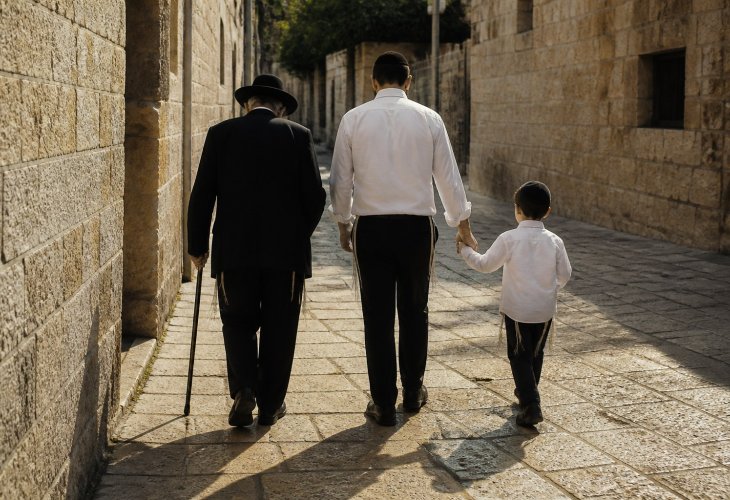 Illustrative image: three generations walking together through Jerusalem
In my family, we have a running joke that our sister who looks nothing like us, is forever searching for her biological parents. To celebrate her birthday one year, we deliberated over getting her a DNA kit to finally put the subject to rest (she’s one of us), but instead we filled a basket with all her favorite products from the Asian food aisle.
While there’s no denying that genetics have a marked impact on our health, development, and who we become, this is only one piece of the puzzle. Judaism of course places great importance on biological lineage, but also recognizes the significant role of those who raise and educate a child. On the mitzvah of honoring parents, Sefer HaChinuch (Mitzvah 33) explains: “He should take to heart that his father and mother are the cause of his being in the world... for they brought him into the world, and they also exerted themselves greatly for him when he was small.”
Further, in the Talmud (Sanhedrin 19b), we find a discussion about King David and his relationships with the daughters of King Shaul, Merav and Michal. The question is asked why Merav’s five sons are referred to as the sons of Michal, and it is explained: “Merav gave birth to them, and Michal raised them; therefore they were called by her name.” The Talmud then states: “This teaches you that whoever raises an orphan in his home, Scripture regards it as though he gave birth to him.” Clearly, the responsibility and impact of child-rearing extends beyond biology itself.
When my children were young, their dentist detected many cavities at almost every visit. As she would list the number of fillings required, I would try to make sense of how it could be possible, as our pantry was most certainly not full of candy. She explained quite matter-of-factly that my children simply have weak teeth, and that it’s genetic. But we didn’t have weak teeth! I was stumped.
In her attempts to reassure me, she noted that all her patients have severe tooth decay (the plot thickens), and based on what she sees in her practice, her recommendation is that sweets are only given on special occasions, including birthdays, Shabbat (weekly), Rosh Chodesh (monthly), the two days of Rosh Hashanah, the seven days of Sukkot, Simchat Torah, the eight days of Chanukah, Tu Bishvat, Purim, the eight days of Passover, the two days of Shavuot, Tu B’Av, and of course also on erev Shabbat and motzei Shabbat. By then I must have passed out because when I did the math, almost every day became a reason to celebrate, and my children were within earshot!
At the end of the visit, she rewarded each child with a frozen treat (loaded with sugar and food coloring), that they sucked so hard, like their lives depended on it. As I made my way to the front desk to make the payment, I noticed other children being soothed by the same pink ice on a stick. If I was bewildered until then, this truly boggled my mind. We were at the dentist after all, where the top priority would be oral health. (Well yes, we were at the dentist after all, and this was her livelihood.)
So, are weak teeth genetic, or are we feeding our children too much sugar?
In families where there is a history of heart disease, members are encouraged to undergo clinical screenings and to take protective measures for their health. There may be serious conversations about the great grandfather’s heart failure, the grandfather's heart attack, and fears for the children. Upon taking a closer look however, you may find that the generational diet is rich in red meat, fast food, saturated fat, high sugar, and processed foods. If your great grandfather’s favorite food was hot dogs, and this was a staple in your grandfather’s home, what chance did your father have?
In a similar vein, families are often branded with distinctive reputations. It’s not uncommon to be told about the local car dealer with a temper, “Well, he’s a Levy, so what do you expect?” seeming to imply that the guy has no choice because he has the Levy genes. But if we can get an inside look at the dynamics in this family, we may find that the culture in the home resulted in a particular style of relating. Patterns in family systems tend to be transgenerational, and are apt to impact the nature of those raised in them.
So is it genetics, or is it something else?
The study of epigenetics finds that beyond biological DNA, genetic risk factors can be switched on and off as a result of the developmental environment which can act as a trigger. While the discussion of nature versus nurture continues, these findings illustrate quite clearly how both heredity and environment determine who we become. And so, while genetic DNA creates the propensity for certain conditions, epigenetics plays a significant role in determining if these tendencies will ultimately find expression.
It is therefore not surprising that while mental health conditions appear to run in families, research shows that they are not directly caused by one single inherited gene, but are the result of a combination of genetic, environmental, and lifestyle factors.
And so, if our tendencies are indeed determined by both nature and nurture, do we possess any agency over who we become? It almost seems warranted to assert that if I am angry, dishonest, disrespectful, or unkind, it is simply beyond my control. In fact, you may even know individuals who use genetics as an excuse for the way they function, and perhaps on occasion you have done the same for others, in an attempt to explain away questionable behavior.
And yet, the Talmud (Shabbat 156a) teaches "He who is born under Mars will be a shedder of blood. Rav Ashi said: Either a surgeon, a thief, a kosher slaughterer, or a circumciser." Hence, while our innate temperament may be ingrained, the expression of it is not. We are each granted free choice about how we will utilize our predispositions, and even a trait that appears to be negative, can still be used towards something positive.
In Hilchot Teshuvah (5:1), Maimonides teaches: “Free will is granted to all men. If one desires to turn himself to the path of good and be righteous, the choice is his. Should he desire to turn to the path of evil and be wicked, the choice is his.” Evidently, there is no excuse that can absolve us of undesirable conduct. Although we may have every reason to operate a certain way, this does not grant us the permission to do so.
When I left the dentist with my children that day, I was still in a daze. The next morning, as I reached for the chewable multivitamin that I had been dispensing on a daily basis, I stopped to look at the ingredients. There, right at the top of the list was sucrose, and all my questions were answered.
To be fair, our dentist wasn’t completely off (those gummy vitamins were high in sugar), but that discovery was a sobering lesson for me. While I hope that by now licensed dentists are using better aligned incentives to motivate patients, (and that the Jewish calendar no longer serves as a treat schedule), we mustn't be complacent in the name of genetics. DNA can certainly influence susceptibility to decay, but that’s not the end of the story. Our children may have the perfect genes for strong and healthy teeth, but even with the best of intentions, we may be creating an oral microbiome that is far from ideal.
Beyond our genetic footprint, a family takes shape through a patchwork of moments and experiences, which over time, become familiar trademarks of the generational fabric, like a well-worn shoe. Perhaps this is why we’ll never want our sister to do a DNA test. Because if it confirms that which we already know, what will we laugh about? By now it is part of our story, and it feels just right.

