

Raising Children
How to Lose a Boxing Match
Why we lose control when emotions run high, and how we can learn to respond rather than react.
- Chana Weissman
- | Updated
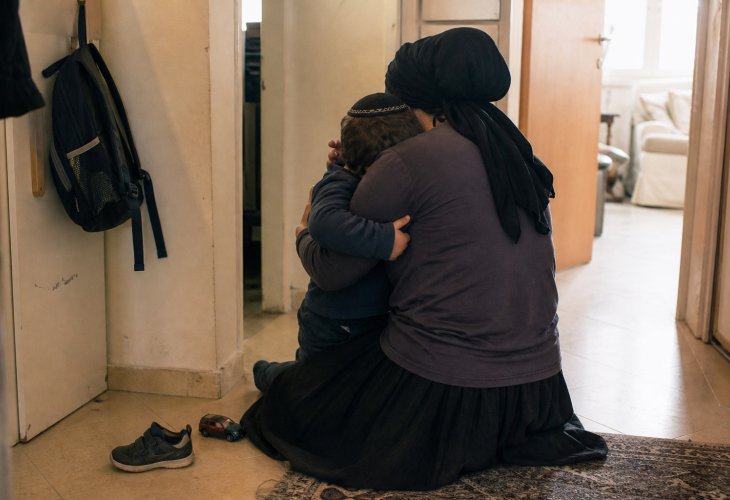 Illustrative image: a mother calmly comforting her upset child in the hallway at home
Every so often, life seems to call on us to prepare for a fight. It may be a relatively trivial one, like dodging a tailgater in early morning traffic, or the heavier stuff like an overdrawn account that throws us off balance. At times, even day-to-day responsibilities can present a high chance of emotional overwhelm.
I’m sure there are those who remain composed when their toddler refuses to cooperate, who stay professional when their boss is unpleasant, and who are unfazed while being blamed for something they didn’t do. Good for you. But for those who feel everything deeply, intense emotions tend to sweep us up and carry us away.
If when your child misses the school bus you spend the day crying in bed, if piles of laundry make you reach for a stiff drink, or if working through a disagreement with your spouse makes your blood boil (for over a week), you may be struggling with emotional regulation.
Studies show that there are biological, neurological and environmental factors that may predispose an individual to intense reactions, but whatever the reason, emotional outbursts can be overwhelming to oneself (and others) when left unchecked. While it’s healthy to feel your feelings, if every experience becomes an emergency, it’s time to take a closer look.
When the brain perceives a physical or psychological threat, the sympathetic nervous system mobilizes to self-protect, known as fight-or-flight. While preoccupied with survival, our thinking brain goes offline, and cognition becomes impaired. This explains why in the heat of the moment you may say things you wish you hadn’t, punish your child with something impossible to enforce, attempt to outdo your teen when he talks back, or have a noisy tug-of-war with a coworker. In each of these situations, you have entered the boxing ring for a match you can’t win.
Reish Lakish taught: “Anyone who becomes angry, if he is wise, his wisdom departs from him…” (Talmud, Pesachim 66b). The Talmud then cites Bamidbar (31:14) where we learn that Moshe became angry, resulting in an oversight in Jewish law. On this, Rashi states (31:21): “Because Moshe came into a state of anger, he came into a state of error.” Even a great leader is not immune to the inevitability that anger clouds judgement and reason. The same effect proves true of fear, panic, and severe stress.
As adults, we are expected to possess the resources to regulate our emotions. And yet, this is not an inherent trait, but a learned skill that begins at birth. When a parent remains steady and listens calmly while a child is overwhelmed, this models a healthy response and supports the child, thereby creating enough stability to return to baseline. Because a child does not yet have the brain development to do this for himself, he “borrows” the parent’s nervous system during high stress moments. This process by which we share emotional safety with another, is known as co-regulation. The instruction to put on your own oxygen mask before helping your child, is most certainly not only for high-altitude emergencies. It is simply impossible to help a child regulate big feelings, when we ourselves are activated.
With this in mind, we can understand where things go wrong. If instead of remaining calm while our child is losing it, we join him in his meltdown, this becomes co-escalation, which is of course the opposite of what we want. In such an instance, we are feeding off the intensity of one another which only makes matters worse.
Have you ever had a tantrum together with your toddler? Have you traded insults with the road rager who is having an episode? Does chaos make you so dysregulated that those around you run for the nearest exit? Exactly.
With the understanding that nervous systems are in constant communication, it becomes clear why we may feel calm around some people, and very irritable around others. For highly sensitive people, this experience is heightened, so that every emotion is felt to a greater degree, and also transmitted with increased intensity.
And yet, while a highly charged experience can cause us to feel flooded, Rabbi Schneur Zalman of Liadi (the Alter Rebbe) teaches in the Tanya (Chapter 12): “The mind rules over the heart by its innate nature.” While our automatic response may be to get swept away by the storm, this foundational Chassidic concept teaches that we can in fact choose how to respond.
The Alter Rebbe identifies ways that this can be done, one of which is especially relevant here. In his words: “As soon as there rises from his heart to his mind any animosity or hatred, God forbid, or jealousy, anger, or a grudge and their like he will bar them from his mind and will. On the contrary, his mind will prevail over and dominate the feelings of his heart to do the exact opposite of that which the heart desires, namely, to conduct himself toward his fellow with the quality of kindness and to display toward his fellow a disproportionate love… without being provoked into anger, God forbid, or to take revenge in kind…”
Choosing Our Response
When our nervous system senses an emergency, our survival instincts will mobilize to protect us. If however we can take a moment, this allows our prefrontal cortex to get back on the scene so that our mind can reclaim mastery. As the Alter Rebbe asserts, our system is built for this capacity, so long as we exercise it.
And so, while when someone is shouting at us, our reflex is to yell back (at a higher volume), if we choose not to fuel the escalation, but respond in a low voice or even a whisper: “the exact opposite of that which the heart desires,” this signals calm and safety to both nervous systems.
In Ethics of the Fathers 4:1, Ben Zoma teaches: “Who is strong? One who conquers his inclination.” Although we may sometimes feel justified to throw back a bigger punch, true stamina is found in the moments of self-control. When we have the impulse to one-up the other, but we make a deliberate choice to do otherwise, this is the ultimate test of mental strength.
Holocaust survivor and psychiatrist Viktor Frankl was a strong proponent of the philosophy of free choice, which is best articulated in the well-known sentiment: “Between stimulus and response there is a space. In that space is our power to choose our response."
Like the boxer who gets a one-minute break to recover and strategize between rounds, when emotions run high, we must create a pause. We can do this by taking a conscious breath, a glass of water, or leaving the arena for a brief respite. In this space of time, we invite our brain back online so that we can regain composure and personal agency.
And then, when we return to the ring, we may find that the match has been called off, and our boxing gloves can be shelved, at least for now.

