

Facts in Judaism
More Than a Party: The History and Traditions of Bar and Bat Mitzvah
From a father’s curious blessing to a boy’s first tefillin and the modern bat mitzvah debate, the Jewish coming-of-age celebration has a history as varied as the communities that observe it.
- Maayan David
- | Updated
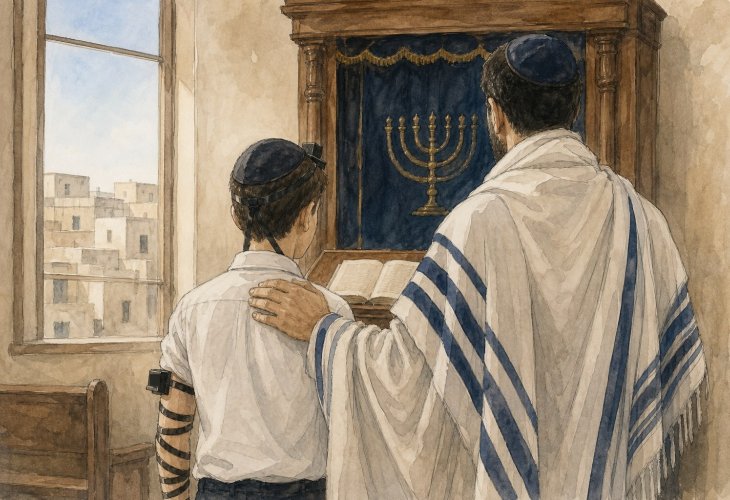 Illustrative image: a father and his bar mitzvah son wearing tefillin in the synagogue
For many Jewish children, the approach of a bar or bat mitzvah means one thing above all: a party. There may be a hall to book, a guest list to compile, clothes to buy, and, for the boy, a Torah portion to learn. But the party, however elaborate, is not what makes someone a bar or bat mitzvah.
In Orthodox Judaism, the change happens automatically. When a boy reaches thirteen and a girl twelve, each becomes obligated to observe the commandments. No ceremony, rabbi, or birthday cake is required.
The Hebrew-Aramaic terms bar mitzvah and bat mitzvah mean “son of the commandment” and “daughter of the commandment.” They do not mean that the child has completed a course in Judaism, passed an examination, or demonstrated sufficient maturity to be trusted with adult responsibilities. The birthday itself changes the child’s legal status.
What happens around that birthday, however, is another matter. Over the centuries, Jewish communities developed a rich assortment of customs to mark the transition: a blessing from the father, tefillin, a Torah reading, a scholarly speech, a festive meal, and, eventually, celebrations for girls as well. The result is a ceremony that feels ancient and indispensable but whose familiar form is considerably younger than the underlying religious obligation.
Growing up, Jewish-style
The rabbis of the Talmud established thirteen as the age at which boys become obligated in the commandments, and twelve as the corresponding age for girls. The Mishnah also uses these ages in discussing the validity of vows. The Talmud explains the difference in terms of the earlier physical maturation of girls.
The ages are not a judgment about intellectual ability. The medieval Spanish scholar Ritva explicitly cautions against interpreting the distinction as a claim that women are more intelligent than men. Jewish law is establishing a threshold of responsibility, not awarding a prize for maturity.
A famous rabbinic saying offers a more psychological explanation. According to the Midrash, the bad inclination, which encourages a person to do wrong, enters the picture at birth, while the good inclination joins it later. The thirteenth birthday marks the point at which the good inclination can begin to contend with its rival.
The Midrash makes the point through the biblical twins Jacob and Esau. As children, they were difficult to distinguish, but at thirteen their paths diverged: Jacob turned toward the study hall, while Esau turned toward idolatry. The story is not a clinical account of adolescent development. It is a rabbinic reflection on the moment when differences of character begin to manifest themselves in choices for which a person can be held accountable.
And yet, for much of Jewish history, there was no elaborate ceremony to mark that moment. The child simply became obligated in the commandments. The public celebration developed later, as communities came to give greater ceremonial expression to the new status.
The father gets a blessing, too
One of the oldest customs associated with a boy's bar mitzvah is a blessing pronounced by his father: Barukh she-petarani me-onsho shel zeh, roughly, “Blessed is He who has freed me from responsibility for this one's punishment.”
It is an unusual blessing, to say the least. Most parents would hesitate to describe their child's coming of age as a welcome release from responsibility. But the blessing is not a declaration that the father no longer has to care about his son. It marks a shift in accountability. Until now, the father has borne responsibility for his son's religious education and conduct; from this point on, the boy himself is accountable for his actions.
The Rema records the custom, recommending that it be said without God’s name. The Lechem Chamudot connects it with the father's obligation to educate his son, explaining that a father who neglected that responsibility could himself be held accountable.
The blessing also has a practical history. It is commonly recited when the boy is called to the Torah, though some communities say it when he first puts on tefillin as a bar mitzvah or at the festive meal. Others wait until the following Shabbat.
There is something appealing about the ceremony's double perspective. The boy is acquiring new responsibilities, while his father is acknowledging that he can no longer be held responsible for everything his son does. Jewish tradition recognizes that growing up involves a change not only in the child but also in the relationship between parent and child.
From an ordinary birthday to a festive meal
The modern bar mitzvah party is not a direct survival from biblical times. The custom of celebrating the occasion developed gradually, with the familiar synagogue ceremony taking shape in the medieval period and the festive meal becoming established later.
Rabbinic tradition nevertheless found ways to connect the celebration to much older sources. The Zohar, for example, describes Rabbi Shimon bar Yochai making a wedding-like feast for his son's bar mitzvah.
A particularly charming Talmudic story provides another possible foundation for the celebration.
Rav Yosef, a great sage who was blind, was uncertain whether a blind person was obligated in the commandments. He initially said that he would make a feast for the scholars if the law followed the opinion that exempted blind people, since he would then be performing commandments voluntarily. When he learned that the law followed the view that a person who is commanded has greater merit than one who acts voluntarily, he changed his position: he would make a feast for the scholars precisely because he was commanded.
The story is about the value of obligation. Being commanded is not a burden to be escaped but a source of religious merit. Later authorities, including the Magen Avraham and the Mishnah Berurah, give the bar mitzvah feast an important place in the tradition, while the Maharshal discusses the status of such celebrations.
The meal is often accompanied by a d'var Torah, a discourse on a Torah topic delivered by the boy himself. This gives the celebration a distinctly Jewish character: the young man is not merely the object of congratulations but is expected to contribute something of his own learning.
Traditionally, some authorities prefer the meal to take place on the Hebrew date of the birthday itself. In practice, families often arrange the main celebration for a convenient day, especially when guests are travelling or the birthday falls on Shabbat.
Tefillin, Torah, and the first public appearance
For boys, the most visible sign of the new stage of life is often tefillin: the small black leather boxes containing Torah passages, bound to the arm and head during weekday morning prayer.
The precise age at which a boy begins wearing tefillin has long varied among Orthodox communities. In many Ashkenazi communities, he begins about a month before his bar mitzvah, giving him time to practise before the obligation becomes binding. The Aruch HaShulchan describes this practice among Lithuanian Jews.
Many Sephardic authorities, following the approach of the Shulchan Aruch, favour beginning earlier, once the boy is sufficiently prepared to handle tefillin properly. Chabad has its own practice, beginning two months before the birthday, initially without a blessing.
Rabbi Shlomo Zalman Auerbach followed a custom of having his sons begin a month early, while telling them that their own tefillin would be given to them on the day of their bar mitzvah. The distinction neatly captures the difference between preparing for a responsibility and actually assuming it.
The synagogue service offers another public marker. A boy may be called to the Torah before his bar mitzvah, but the occasion of his coming of age gives the aliyah special significance. In many communities, he reads the weekly Torah portion, the haftarah from the Prophets, or both. The exact arrangement varies.
In some families, the speech is the most eagerly anticipated part of the celebration. In others, the emphasis falls on the Torah reading, or on the moment the boy is called up for his aliyah. He may also begin leading communal prayer and, under the relevant rules, count toward a minyan, the quorum required for certain prayers.
The familiar bar mitzvah ceremony thus brings together several elements that developed over time: religious obligation, public recognition, study, and celebration. None is needed to create the legal status, but together they give the milestone its social and educational force.
And what about the girls?
The bat mitzvah raises a different historical question. Girls have been obligated in the commandments from the age of twelve for centuries, but the familiar public celebration of a girl's coming of age is a much more recent development.
That does not mean Orthodox Judaism has no tradition of marking the occasion. Sephardic rabbinic authorities were discussing celebrations for girls well before the bat mitzvah became a familiar feature of modern Jewish life.
One early advocate was Rabbi Yosef Hayyim of Baghdad, known as the Ben Ish Hai. He recommended that a girl rejoice on the day she became obligated in the commandments, wear Shabbat clothes, and, if possible, wear a new garment and recite Shehecheyanu, the blessing said on certain joyous occasions. His approach treated the milestone as worthy of recognition in its own right.
Rabbi Ovadia Hedaya subsequently supported a festive meal, while Rabbi Ovadia Yosef argued that a bat mitzvah celebration was a legitimate Jewish custom, not something that needed to be dismissed as an import from non-Orthodox Judaism. He also made an educational argument: celebrating a girl's new responsibilities could encourage her to take them seriously.
His reasoning is straightforward. If becoming obligated in the commandments is a significant moment, why should it not be marked with joy?
Not all Orthodox authorities agreed about the appropriate form of the celebration.
In the United States, Rabbi Moshe Feinstein approached the question against the background of the twentieth-century debate over religious reform. He objected to turning a bat mitzvah into a synagogue ceremony that might imitate the practices of non-Orthodox movements. A private party at home, however, was permissible, much like an ordinary birthday celebration.
He was also reluctant to classify the event as a seudat mitzvah, a meal with the religious status of a mitzvah feast. In his view, a boy's celebration had a different basis because the boy's new status brought changes in public religious participation. In a later discussion, he expressed little enthusiasm even for extravagant bar mitzvah celebrations, particularly when they led to Shabbat desecration.
Rabbi Yechiel Yaakov Weinberg, writing from the perspective of a European Orthodox tradition that had long struggled with Reform, proposed a more accommodating approach. He was wary of imitating non-Orthodox ceremonies, but saw value in a private celebration that included a rabbi's address encouraging the girl to observe such commandments as kashrut, Shabbat, and family purity. Rather than simply copying a secular birthday party, the family could use the occasion to give it religious meaning.
Rabbi Mordechai Willig, meanwhile, argued that the reasoning used by the Maharshal to support a boy's bar mitzvah feast could also support a girl's celebration.
The disagreement was not simply over whether a party was permitted. It concerned what the party should signify, where it should take place, and how a community could acknowledge a girl's religious adulthood without adopting practices that its authorities considered inappropriate.
The real milestone
It is tempting to think of a bar or bat mitzvah as a graduation: a child studies, prepares, performs in public, and emerges with a new status. But that analogy is only partly accurate. A bar or bat mitzvah is not a certificate of religious knowledge, and a child does not have to master a Torah portion or deliver an impressive speech to become obligated in the commandments.
The more important question is what the child will do with the new responsibility.
Many contemporary Orthodox rabbis and educators encourage parents to use the months leading up to the occasion for study and experiences that connect the child with family and Jewish heritage. The idea is that the celebration should be the culmination of a process, not an isolated performance.
That also explains why the traditional customs have endured despite changing fashions. Tefillin, the Torah reading, the father's blessing, the d'var Torah, and the festive meal each give a different expression to the same transition. Some emphasize the new obligations; others recognize the parents' changing role, the child's place in the community, or the joy of becoming part of a tradition that stretches far beyond the family.
A bar or bat mitzvah may involve a lavish party or a modest gathering. There may be a long speech or no speech at all. The precise customs will depend on the family's community and rabbinic guidance.
But the underlying moment is the same: a young person has reached the age at which Jewish tradition begins to hold him or her personally responsible for observing the commandments. The celebration is the community's way of saying that this responsibility matters, and that the young person does not have to shoulder it alone.

