

Jewish Law
Sweet Bread Rolls: What Blessing Should You Say? Plus a Lesson on Trusting Hashem
Discover the halachic differences between Sephardic and Ashkenazic customs regarding sweet bread rolls, when to recite Hamotzi or Mezonot, and a powerful teaching from the Pele Yoetz on bitachon and Divine Providence
- Hidabroot
- | Updated
Two daily halachot from B'Halacha U'V'Aggadah, based on the rulings of Rabbi Ovadia Yosef, of blessed memory.
What Blessing Is Recited Over Sweet Bread Rolls?
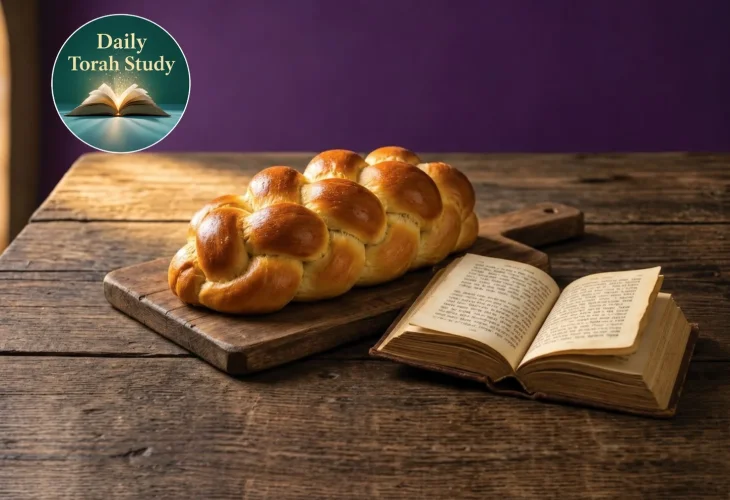
For Sephardic Jews, sweet bread rolls with a noticeable degree of sweetness require the blessing Mezonot. For Ashkenazic Jews, however, the blessing is Hamotzi, unless the sweetness is pronounced enough for the rolls to resemble pastries or other sweet baked goods.
A Sephardic Jew who is a guest at an Ashkenazic friend's home on Shabbat and knows that the host will be reciting Hamotzi over sweet challah should inform the host in advance and ask for challah that is not sweet at all. Alternatively, the guest may bring his own unsweetened challah and recite the blessing over it.
For the mitzvah of lechem mishneh, the requirement to use two loaves at Shabbat meals, a sweet challah may be included alongside the unsweetened one. However, the blessing should be recited over the unsweetened challah, from which the guest should eat an egg-sized portion (54 grams). He may then enjoy the sweet challah without reciting another blessing.
Someone who eats 216 grams of sweet bread rolls must wash their hands, recite Hamotzi before eating, and say Birkat Hamazon afterward. In this case, the rolls have the halachic status of regular bread in every respect. Consequently, separate blessings are not recited over other foods served during the meal, such as chicken or rice, or over beverages consumed with the meal.
Which Bread Rolls Should Be Served at a Seudat Mitzvah?
Someone who eats less than 216 grams of sweet bread rolls recites Mezonot beforehand and Al Hamichya afterward, even if other foods bring the total amount consumed to 216 grams.
In this situation, separate blessings must be recited over the other foods, such as potatoes, chicken, and similar dishes. An exception applies to foods eaten directly as accompaniments to the bread, such as salads spread on or eaten together with the roll, which do not require separate blessings.
A practical recommendation for anyone hosting a seudat mitzvah (a meal celebrating a mitzvah) is to consider the guests' level of religious observance. If the host knows that some guests are unlikely to wash their hands ritually or recite Birkat Hamazon, it is preferable to serve genuinely sweet rolls requiring Mezonot rather than ordinary bread requiring Hamotzi. This can help prevent guests from inadvertently neglecting these halachic obligations.
The host should also encourage guests to recite the appropriate blessings before and after eating. Alternatively, one person may recite the blessings aloud with the intention of fulfilling the obligation on behalf of those listening, provided the relevant halachic requirements are met.
Unfortunately, a serious problem sometimes occurs at memorial gatherings where supposedly sweet Mezonot rolls are served, but the rolls are not actually sweet. As a result, many people unknowingly consume bread that requires ritual handwashing and Birkat Hamazon without fulfilling these obligations.
Daily Quote
“The perfection of the quality of trust is not to place one's trust in any person whatsoever, nor to become upset with anyone, for one should believe with complete faith that everyone is a messenger of the Merciful One. The Almighty has many messengers, whether for good or otherwise. Merit is brought about through a meritorious person, and wrongdoing through a person who is culpable. Even if the entire world stood on one side of the scales, seeking to harm or benefit a person by so much as a hair's breadth, and the decree of the Almighty stood on the other side, His decree would outweigh them all.”
— Pele Yoetz, entry “Havtachah” (Promise)
Meaning of the Quote
The Pele Yoetz explains that the perfection of bitachon, trust in Hashem, is expressed through complete faith in Divine Providence. A person who possesses genuine trust in Hashem does not believe that success or failure ultimately depends on other people. Rather, such a person recognizes that everything comes from Hashem.
Real trust means believing that everything that happens in the world unfolds through Hashem's messengers and under His supervision. Whether an experience appears positive or negative, nothing takes place outside His providence.
Hashem has countless messengers, including people and circumstances, through whom His will is carried out. Even if the entire world were to unite in an effort to help or harm someone, the ultimate outcome would still be determined by Hashem's decree.
This teaching expresses the principle of complete trust in Divine Providence. Instead of attributing ultimate credit or blame to other people, we recognize that they are instruments through which events unfold. This does not eliminate personal responsibility for one's actions, but it reminds us that no individual has independent control over another person's destiny.
A person who has developed this level of trust does not become overly dependent on others or consumed by resentment toward them. Rather, such a person lives with the awareness that everything ultimately rests in Hashem's hands.

