

Parashat Vayetze
The Hidden Meaning of Yaakov’s Ladder: A Glimpse Into the Divine Order of Creation
Discover the deeper meaning of Yaakov’s dream in Parashat Vayeitzei, as Rabbeinu Bachya explains the three realms of creation, the role of angels, and how Divine Providence connects heaven and earth
- Amitai Chanaya
- | Updated
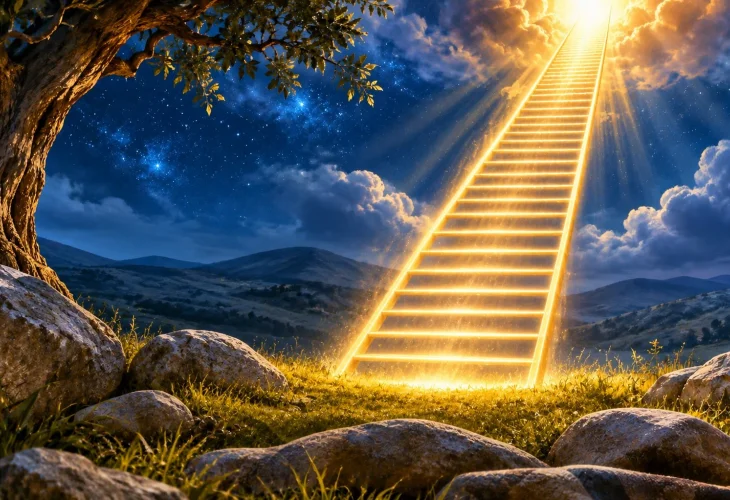
“And he dreamed, and behold, a ladder was standing on the earth, with its top reaching toward heaven, and behold, angels of G-d were ascending and descending upon it” (Bereishit 28:12).
Yaakov Avinu’s extraordinary dream of a ladder connecting heaven and earth is one of the Torah’s most fascinating visions. While the image of angels ascending and descending a heavenly ladder is familiar, Rabbeinu Bachya offers a deeper interpretation: The dream represents the structure of creation and the relationship between its physical and spiritual realms.
According to Rabbeinu Bachya, the ladder symbolizes three distinct levels of existence—the physical world, the celestial spheres, and the world of angels. Each element of Yaakov’s vision corresponds to one of these realms, revealing an ordered universe ultimately governed by Hashem.
The Three Realms of Creation
Rabbeinu Bachya explains that the ladder “standing on the earth” represents the lowest realm, the physical world in which human beings live. Its top, “reaching toward heaven,” symbolizes the celestial spheres, which, according to the traditional cosmological understanding reflected in his commentary, encompass the movements of the heavenly bodies. This corresponds to the verse in Tehillim (19:2): “The heavens declare the glory of G-d.” The movement and order of the celestial bodies testify to the wisdom and majesty of their Creator.
The angels ascending and descending the ladder represent the third realm—the spiritual world of angels, which exists beyond the physical and celestial domains. Rabbeinu Bachya notes that the Torah begins with the earthly world, the realm closest to Yaakov, and gradually ascends through the different levels of creation. The dream thus presents a symbolic picture of the universe, in which each realm occupies a distinct place within a larger, interconnected system.
Why Were the Angels Ascending and Descending?
Rabbeinu Bachya offers an intriguing explanation for the movement of the angels. Their ascent and descent symbolize the existence and disappearance of different categories of angels. He cites the teaching of our Sages that an angel constitutes “one-third of the world.” This does not refer to an angel’s physical dimensions, but rather to the angelic realm as one of the three levels of creation represented by Yaakov’s ladder.
According to this interpretation, some angels exist eternally, while others are created for a particular purpose and cease to exist after fulfilling their mission. Rabbeinu Bachya explains that the enduring angels were created on the second day of creation, while other angels, associated in his commentary with the fifth day, are temporary.
This reflects the teaching of our Sages that Hashem creates groups of angels each day who sing His praises and then depart. The angels’ ascent therefore represents their existence, while their descent symbolizes their disappearance. Through this imagery, the Torah alludes to the different forms of angelic existence and their roles within creation.
Hashem Stands Above Everything
The final element of Yaakov’s vision appears in the following verse: “And behold, Hashem was standing above it” (Bereishit 28:13). Rabbeinu Bachya explains that the word “it” refers to the ladder, which represents the entire structure of existence. Hashem stands above it because He is the ultimate source of power sustaining every realm.
In the framework described by Rabbeinu Bachya, Divine influence flows through an ordered hierarchy. Hashem grants power to the angels, the angels influence the celestial spheres, and the movement of those spheres affects the physical world. As he explains, the celestial spheres are the immediate causes of events in the lower world, the angels are the causes of the movements of the spheres, and Hashem is the ultimate cause of all.
This interpretation reflects the medieval understanding of the cosmos, in which the heavenly spheres were believed to influence earthly events. Rabbeinu Bachya uses this framework to illustrate a central theological principle: Although creation contains different levels and forces, none possesses independent power.
The Deeper Message of Yaakov’s Dream
According to Rabbeinu Bachya, Yaakov’s ladder is more than a remarkable dream. It offers a symbolic representation of the universe, beginning with the physical world and ascending through the celestial and angelic realms. Each level has its own function, yet all are connected within a single Divine order.
For Yaakov, who was leaving his homeland and preparing to face an uncertain future, this vision carried a powerful message of reassurance. Although he could not know what awaited him, he could trust that his journey unfolded within a world governed by a higher purpose.
Yaakov’s dream reminds us that even when the workings of the world remain beyond our understanding, there is an underlying order connecting heaven and earth.
 Parashat VayetzeHaftorah of Parashat Vayeitzei: From Divine Judgment to Mercy and Redemption
 Parashat VayetzeRachel and Leah: Finding Hidden Blessings in Life's Unexpected Challenges
 Parashat VayetzeYaakov at the Well: A Hidden Lesson About Faith and the Beit HaMikdash
 Parashat VayetzeYaakov and the Shepherds: A Lesson in Honesty, Integrity, and Work Ethics

