Jewish Law
Are Marshmallows Kosher? The Surprising Truth About Gelatin and Jewish Law
From animal bones and fish skins to modern food processing, discover why gelatin raises complex kashrut questions and how kosher marshmallows can be made pareve
- Yosef Yaavetz
- | Updated
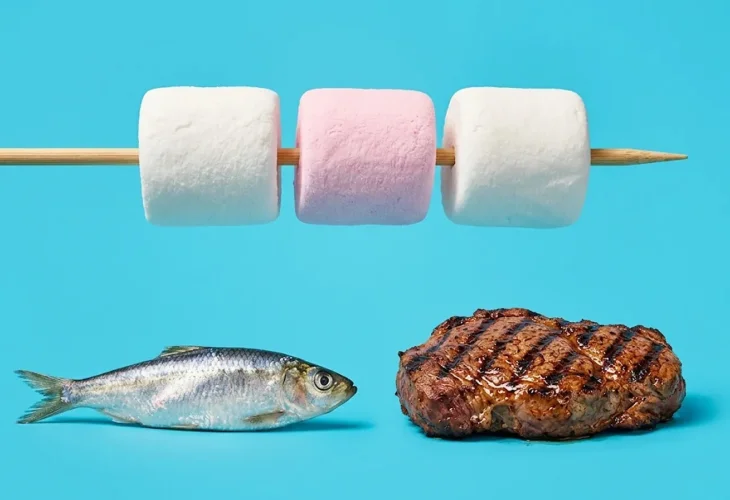
Marshmallows are made mostly of sugar and air. Press one between your fingers and it compresses; release it and it springs back into shape. Hold it near a flame and it softens, browns, and begins to melt. These familiar characteristics come largely from an ingredient that contributes almost nothing to the candy's flavor: gelatin. Just a small amount helps stabilize the foam, maintain its delicate structure, and transform sugar syrup into a soft, springy treat.
Yet the journey of gelatin begins far from the candy aisle. Its production involves slaughterhouses, leather-processing facilities, fish-processing plants, and factories that handle animal bones. Materials derived from animal tissues undergo soaking, chemical treatment, heating, filtration, and drying before eventually reaching food manufacturers as a pale powder. For kosher consumers, this process raises a complicated question: Can an ingredient originally derived from a non-kosher animal become permissible after undergoing extensive industrial processing?
The question has occupied prominent halachic authorities, including Rabbi Chaim Ozer Grodzinski, Rabbi Aharon Kotler, and Rabbi Moshe Feinstein. Their discussions examine the details that determine gelatin's halachic status, including whether it comes from hard or soft bones, dried bones, or animal hides, how it is processed, and what purpose it serves in the finished food.
How Gelatin Is Made and Why Marshmallows Need It
Gelatin is produced from collagen, a protein found in the skin, bones, and connective tissues of animals and fish. During manufacturing, the structure of collagen is altered to create a substance capable of thickening liquids and forming gels. Depending on the raw materials and the desired properties of the finished product, manufacturers use acidic or alkaline treatments, followed by extraction in hot water, filtration, concentration, and drying.
These properties make gelatin especially valuable in food production. It provides structure to gummy candies, stabilizes mousses and whipped desserts, and is used in various dairy products and confections. In traditional gelatin-based marshmallows, it helps hold countless tiny air bubbles within the sweet mixture, allowing the candy to retain its soft, elastic texture after cooling. Manufacturers also pay close attention to gelatin's setting strength, measured using a scale known as the Bloom value. Gelatin from different sources can have different properties, making certain varieties better suited to particular products. Replacing one type with another may require adjustments to the recipe or manufacturing process to achieve the desired consistency.
The Halachic Debate: Can Processing Change an Ingredient's Status?
The foundations of this discussion predate modern food manufacturing. In Mishneh Torah, Hilchot Maachalot Asurot (4:18), the Rambam discusses the consumption of various parts of non-kosher animals, including bones and hides. He distinguishes between edible meat and parts that are not ordinarily considered fit for consumption, stating regarding the latter that although they remain prohibited, one who consumes them is exempt from the prescribed punishment.
The Mishnah in Chullin (9:2) further distinguishes between different types of animal hides, identifying certain skins whose halachic status is comparable to that of meat. Among them is pigskin, a particularly relevant example because it is widely used as a raw material in the gelatin industry. Pigskin is relatively soft, and its halachic status cannot simply be equated with that of hard bones.
Rabbi Chaim Ozer Grodzinski addressed the kashrut of gelatin derived from dried bones in his responsa Achiezer (Vol. 3, Section 33). A central element of his discussion is the distinction between soft and hard bones, particularly bones that have become completely dry. His analysis presents significant grounds for permitting certain forms of gelatin, depending on the circumstances of production.
Rabbi Aharon Kotler examined the issue in Mishnat Rabbi Aharon (Vol. 1, Section 17), focusing in part on the halachic principle of achshevei. This principle concerns the significance a person assigns to a substance by deliberately using it as food. Even when an animal-derived ingredient has become unfit for ordinary consumption, intentionally incorporating it into a food product may raise a question about whether its prohibited status remains relevant.
Rabbi Moshe Feinstein addressed another important consideration in Igrot Moshe (Yoreh De'ah, Vol. 2, Section 23): Does chemical processing render gelatin permissible if the original material temporarily becomes unfit for consumption? His discussion highlights the fact that this temporary transformation is a planned stage in the production of an edible ingredient. Manufacturers process bones and hides specifically to produce a substance that will eventually be used in food. It is therefore difficult to assume that an intermediate stage of inedibility automatically removes the ingredient's original halachic status when the entire process is designed to restore its usefulness in food production.
These differing approaches demonstrate why the kashrut of gelatin cannot be determined solely by its appearance or by the fact that it has undergone chemical processing. The original source, manufacturing methods, and intended use all matter.
From Marshmallow Plants to Modern Gelatin
For many years, despite the halachic arguments permitting certain forms of gelatin, kosher certification agencies were reluctant to approve products containing conventional animal-derived gelatin. As a result, marshmallows were often absent from the homes of observant Jewish families. Interestingly, however, marshmallows originally had no such gelatin-related kashrut problem.
During the nineteenth century, French confectioners prepared a whipped sweet using extracts from the marsh mallow plant, along with sugar and egg whites. The candy's name comes from this plant, which played an important role in its earliest preparations. The modern marshmallow developed as manufacturers adopted gelatin and increasingly efficient production techniques. In 1948, Alex Doumak patented a process that involved extruding the marshmallow mixture through tubes and cutting it into uniform pieces. This innovation made it possible to produce the familiar soft, cylindrical candies quickly and on a large scale.
The manufacturing advances that made marshmallows widely available also brought the question of gelatin's kashrut to the forefront.
How Fish Gelatin Made Kosher Marshmallows Possible
An article published by the Orthodox Union (OU) in 2005 describes how growing demand for kosher marshmallows encouraged manufacturers to develop gelatin made from the skins of kosher fish. This offered a practical solution to the problem of gelatin derived from non-kosher animals. By using suitable fish species and maintaining appropriate kosher supervision throughout the production process, manufacturers could produce gelatin acceptable for kosher-certified marshmallows.
Yet solving one kashrut issue introduced another. Fish gelatin can be used in products labeled pareve, meaning they contain neither meat nor dairy ingredients. But Jewish law also addresses the prohibition against eating fish and meat together, which raises questions when a fish-derived ingredient is incorporated into a food served alongside meat.
Consider a familiar scene: a family roasting marshmallows over a fire while preparing meat on a barbecue. If the marshmallows contain fish gelatin, does their consumption alongside meat raise a halachic concern? The answer requires examining the gelatin's status after processing, the proportion of gelatin in the finished product, and whether the principle of bitul beshishim—nullification in a mixture at a ratio of sixty to one—can apply to the concern about combining fish and meat. These questions have also been addressed by halachic authorities.
What About Gelatin Made From Kosher Animals?
Another type of kosher gelatin is produced from the hides of kosher animals that have been slaughtered according to Jewish law. Although this avoids the problem of using material from non-kosher animals, it raises a different concern: Can gelatin derived from an animal be used in dairy desserts?
If the gelatin retains the halachic status of meat, combining it with dairy ingredients would present a serious problem. But if the processing has changed its status, the resulting ingredient may be considered pareve. Many halachic authorities have ruled that certain forms of properly produced kosher gelatin can be classified as pareve, even when they originate from animal material. This is why gelatin manufactured under stringent kosher supervision may carry an explicit pareve designation.
The ruling depends on the source and production process, and consumers should not assume that every gelatin product is pareve simply because it is derived from an otherwise kosher animal.
The Hidden Complexity Behind a Simple Candy
The humble marshmallow illustrates how much halachic analysis can be concealed behind a single word on a food package: pareve. Determining whether that designation is appropriate requires tracing the ingredient back to its original source, understanding what happens to it at each stage of production, and evaluating the halachic significance of those transformations. Even when gelatin comes from a kosher source, additional questions may arise concerning its use alongside meat or dairy products.
This is where industrial food science and halachic scholarship meet. Details that seem far removed from the candy in a consumer's hand can ultimately determine whether that candy is kosher and how it may be eaten. The next time you enjoy a soft, fluffy marshmallow, remember that behind its familiar texture lies a remarkable story—one that begins with animal bones and hides, passes through modern manufacturing technology, and ends with centuries-old principles of Jewish law.