

Jewish Law
Is Sturgeon Kosher? The 250-Year-Old Halachic Controversy
Discover how a fish mailed to the Noda B’Yehuda sparked a centuries-old debate over kosher scales, rabbinic rulings, and whether sturgeon is permitted under Jewish law
- Yosef Yaavetz
- | Updated
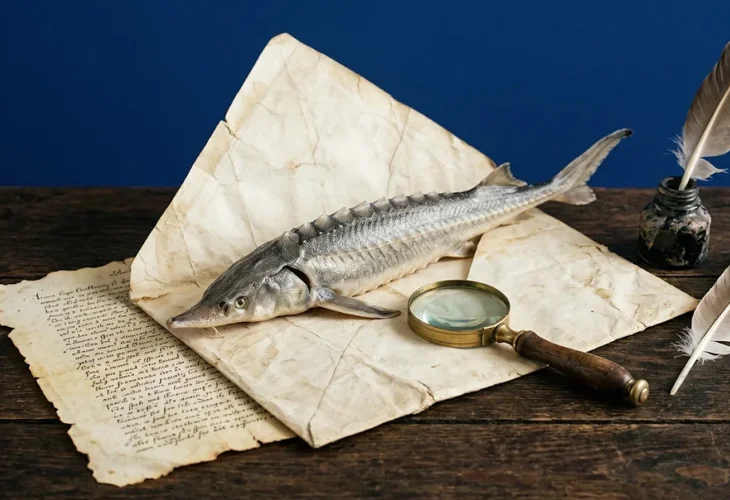
The day after Yom Kippur, approximately 250 years ago, Rabbi Yechezkel Landau, the Chief Rabbi of Prague and author of the Noda B'Yehuda, received an unusual letter. Inside the envelope was a fish.
The sender, Rabbi Tzvi Hirsch Segal, was seeking a halachic ruling on a fish whose kosher status had become a matter of dispute in his community. Some maintained that the species was eaten in other regions, while his own community had a longstanding custom of avoiding it. Rabbi Landau's response began with a brief statement: "Your letter reached me the day after Yom Kippur, together with the fish." He proceeded to examine the specimen, setting in motion a halachic controversy that would continue long after his death.
At the heart of the dispute were several questions: What qualifies as a kosher scale? How should it be tested? Could the fish be identified with a species discussed by earlier halachic authorities? And how much weight should be given to the fact that it was eaten in other communities?
What Makes a Fish Kosher?
The Torah identifies two signs of kosher fish: fins and scales. However, not every hard covering on a fish's body qualifies as a scale under Jewish law. In his commentary on Leviticus 11:9, the Ramban explains that kosher scales must be removable from the skin by hand or with a knife. He illustrates the concept through the biblical description of Goliath's armor, suggesting that scales, like armor, form a separate covering over the body.
The Rema codifies this requirement in Yoreh De'ah 83:1. The same section addresses additional complications, including fish that develop their scales later in life or shed them when removed from the water. Identifying a kosher fish therefore sometimes requires more than examining its appearance.
The Noda B'Yehuda's Unusual Experiment
Rabbi Landau reported finding two rows of scales, one along each side of the specimen. Although he could remove them with an instrument, he conducted an additional test by soaking the fish for approximately three hours in a solution of water and ash, commonly used as a cleaning agent at the time. The soaking softened the outer covering, allowing him to peel it away with his fingers.
Rabbi Landau concluded that this satisfied the halachic requirement and permitted the fish. He added that the status of another species mentioned in the inquiry would depend on whether it possessed the same characteristics. His conclusion became a major point of disagreement among later authorities, some of whom questioned whether soaking was a valid means of establishing the fish's kosher status. Others distinguished between scales that detached on their own during soaking and those that still required peeling afterward.
A Debate Over an Ancient Fish
The controversy was further complicated by references to a fish known as ashturyan, mentioned in earlier halachic literature. The Ohel Moed records a tradition concerning a test attributed to the Ramban, in which a fish was immersed in boiling water, causing its scales to fall away. Rabbi Landau's son, Rabbi Shmuel, argued that this historical account referred to the same species his father had examined and supported his ruling.
However, identifying fish through historical or regional names presents considerable difficulties. Different species may share a commercial name, while the meaning of a particular name can vary between countries and generations. The fish at the center of the controversy is now generally believed to have been a sturgeon.
Did the Noda B'Yehuda Reverse His Ruling?
The relevant responsa were published in the second edition of Noda B'Yehuda, Yoreh De'ah, sections 28–30. Section 28 contains Rabbi Yechezkel Landau's original ruling, while sections 29 and 30 were written by his son, Rabbi Shmuel, in defense of his father's position.
In a letter to Rabbi Yitzchak, the rabbi of Paks, Rabbi Shmuel addressed claims that his father had subsequently withdrawn his permission to eat the fish. He strongly rejected the allegation, pointing out that the original ruling had been preserved among his father's writings without any accompanying retraction. He also questioned why, if his father had changed his position, he would not have informed the rabbi who had originally received the ruling.
The Controversy Reaches the Printing Press
By the end of the 18th century, the dispute had expanded into a public exchange of halachic publications. In 1798, Aharon Chorin published Imrei Noam, relying on the Noda B'Yehuda's ruling to support permitting the fish. The following year, Rabbi Yitzchak Grishaber of Paks published Makel Noam, challenging that position.
Rabbi Mordechai Banet's endorsement became an important source of support for those who prohibited the species, and the controversy continued to be discussed in later halachic works. The Pitchei Teshuvah on Yoreh De'ah 83 presents the Noda B'Yehuda's ruling and his son's defense alongside the objections of the Bigdei Kehunah, who questioned the examination method and emphasized the longstanding custom of avoiding the fish.
Despite the Noda B'Yehuda's permissive ruling, major kosher certification organizations around the world today generally regard sturgeon as non-kosher. What began with an unusual envelope delivered to the Chief Rabbi of Prague became a lasting halachic debate, illustrating the complexities of applying traditional Jewish law to the identification of unfamiliar species.
 Jewish LawWhat Is Kosher? A Complete Guide to Kashrut Laws and Meaning
 Jewish LawThe Science of Kosher Fish: How the Torah Predicted a Biological Truth Thousands of Years Ago
 Jewish LawWhat Blessing Do You Say on Sfenj and Fried Bread? A Halachic Guide
 Jewish LawFish and Meat at the Same Table? Halachic Rules and Health Concerns Explained

