Jewish Law
Must You Walk Backward When Leaving the Western Wall? The Halachic Ruling
Discover what Jewish law says about leaving the Kotel, why some people walk backward, and whether the practice is required or customary
- Rabbi Yaron Ashkenazi
- | Updated
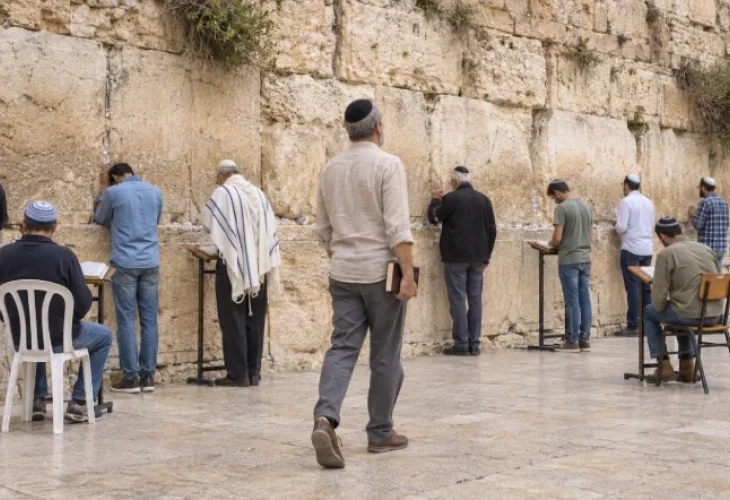
When leaving the Western Wall prayer plaza, is it necessary to avoid turning one's back toward the Wall and instead walk backward while facing it?
According to the strict letter of Jewish law, it is permissible to turn one's back toward the Western Wall when leaving, since the prayer plaza is not part of the Holy Temple itself. Nevertheless, walking backward while facing the Wall until leaving the prayer area is considered a commendable practice that expresses reverence for the holy site.
The Halachic Obligation to Show Reverence for the Temple
The Rambam writes in Hilchot Beit HaBechirah (7:4) that anyone who has completed his service in the Beit HaMikdash should not leave with his back toward the Sanctuary. Instead, he must walk backward slowly and respectfully until he exits the Temple courtyard. This requirement reflects the reverence owed to the Temple and its sanctity.
The Rambam further explains (7:7) that the obligation to revere the Temple remains in force even after its destruction. Citing the verse, "You shall keep My Sabbaths and revere My Sanctuary," he teaches that just as the obligation to observe Shabbat is eternal, so too is the obligation to show reverence for the Temple. Its physical destruction did not diminish its inherent holiness.
However, the book Asher Heshiv (p. 104) clarifies that the requirement to walk backward applies specifically to someone leaving the Beit HaMikdash. Since the Western Wall prayer plaza is not part of the Temple itself, a person leaving the Wall is not strictly obligated to follow this practice.
Why Some People Walk Backward When Leaving the Western Wall
Despite the absence of a strict obligation, walking backward while facing the Western Wall is regarded as a respectful and praiseworthy custom. In Sovu Tzion (p. 17, sections 31–32), Rabbi Avigdor Nebenzahl was asked whether this practice is halachically required or simply recommended. He replied, "I do not know, but it is certainly customary to do so."
When further asked whether one should avoid turning one's back toward the Wall only near the exit or throughout the entire prayer plaza, Rabbi Nebenzahl explained that the practice applies to the entire prayer area. He added that he personally continues walking while facing the Wall until reaching the end of the plaza.
A similar custom applies when leaving a synagogue. Based on the Rambam's ruling concerning reverence for the Temple, the Maharil (Minhagim, Hilchot Tefillah 3) writes that a person departing from a synagogue should turn toward the Aron Kodesh and leave respectfully. The Rema cites this practice in Shulchan Aruch (Orach Chaim 132), while the Mishnah Berurah (132:18) explains that it is derived from the conduct required when leaving the Beit HaMikdash. See also Magen Avraham (132:6).
Conclusion: Is Walking Backward Required?
Although Jewish law does not strictly require visitors to walk backward when leaving the Western Wall, maintaining one's face toward the Wall until exiting the prayer plaza is a respected custom that demonstrates reverence for the holiness of the site. Those who wish to observe this practice may walk backward or move sideways while facing the Wall, taking care to do so safely and without disturbing other worshippers.
Source: Rabbi Yaron Ashkenazi, Halachah LeMaaseh, Chapter 8, Section 132, Paragraph 2.