עברית
עברית

Why Didn’t Hashem Use Fire Against Egypt?
Fire marks the Divine throughout the Exodus story—Sinai blazes, a pillar leads the way—but the plagues and the grand finale at the sea unfolded in water. Here’s why that matters.
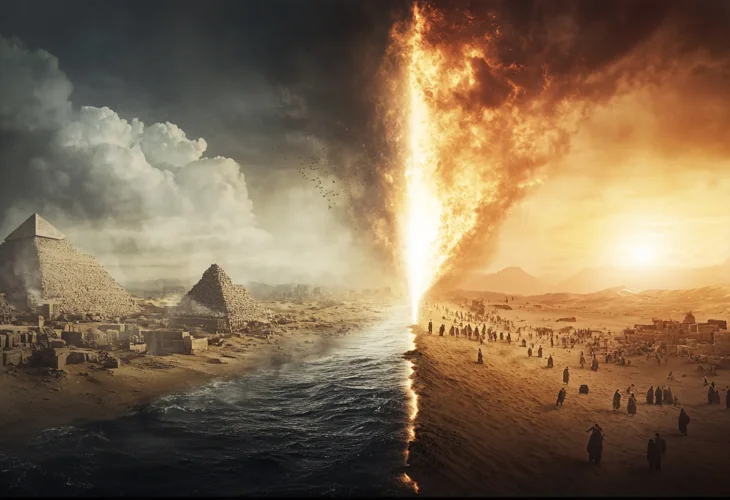
During the Exodus, Egypt was struck by every disease and every plague, but not by fire.
Yes, the pillar of fire was a constant sign of Hashem’s presence, but none of the plagues were with fire, and none of the wonders were with fire. True, there was fire blazing within the hail, but it is not stated that it ignited and caused harm; it was only a sign of the Creator’s presence and that the hail was not natural. Egypt’s great blow came, as is known, at the sea, and therefore years later, in the time of Titus, idol worshipers could still think that Hashem was a god of water.
Fire distinguishes between Egypt and Israel, just as the pillar of fire stood at the head of Israel’s camp and shot arrows at the Egyptian camp. Hashem revealed Himself in fire, \"Hashem your God is a consuming fire\", He descended upon Mount Sinai in fire, and everywhere He appeared in fire—but He struck Egypt only with water.
Why?
The Egyptians worshiped the sun. The name \"Ra,\" which makes up most of their names, is what they called the sun god, and when Pharaoh said, \"See, ra’ah is before you,\" that is whom he meant. Egypt is a kingdom of water, the kingdom of the Nile and the sea; their whole worldview ran through water. They buried Pharaoh with ships so that he could, as it were, sail them in the world of the dead. But their outlook was idolatrous. They did not seek the single cause behind everything; on the contrary—they sought plurality behind unity. Pharaoh was the local god, ruling over the waters, and the sun was the distant god, ruling the opposite force, the sun.
The Nile is a mighty, enduring river. Its waters do not cease and do not disappoint, and so Pharaoh could feel that he controlled it and could ascribe the forces of the Nile to himself and his own power. But the sun did not depend on him. Sometimes the sun was too strong or too weak, and years of famine came. That they attributed to the distant god—the sun—and therefore, striking Egypt by means of the sun and fire would only have strengthened Pharaoh’s claim: \"My sun-god is angry with me because I thought to send the Jews out. I must harden myself, follow his way, and keep the Jews in the iron furnace.\"
The purpose of the plagues of Egypt was to show Pharaoh that he did not control the forces of water—\"The Nile is mine, and I made myself\"—and so the Nile was struck again and again, and in the end the great sea was struck as well. The sun-god, too, was struck in the plague of darkness. The plagues of Egypt were blows of cold and damp. Sun-drenched Egypt turned dark, moist, wet, ill. The sun-god could not warm it; on the contrary, the Israelites gathered around the fire, which warmed the world for them. The waters rose and rose in Egypt until they closed over the Egyptians’ heads—waters came up to the very soul.
Therefore the month of spring is the first of the months—the rising sun of Israel and a departure from the land of winter and last year’s rains—taking the awakening of growing warmth to gather around the pillar of fire. All the remaining chametz from last year is burned in fire, and one begins to count for the new grain. The renewal of Pesach is also a beginning of the year: may a year and its curses come to an end; food is not kept from year to year. And about the Pesach offering came the warning, \"Do not eat it raw\"; light must rule over it and drive out all dampness and every trace of the previous life.
Water, when it comes for punishment, means annihilation and burial; it covers, blocks, and seals. But fire burns, cooks, and repairs. Hashem brought the Israelites into Egypt because it is the iron furnace. For the Egyptians it became a grave beneath the waters, and for the Israelites it became a crucible that refines and purifies. From the people of Israel, Hashem exacted by fire—as with Nadav and Avihu, Korach and his assembly, the complainers, and others. Water is the simplest state of matter; most matter in the world is water (and therefore water is the force of life. Only when the balance is disturbed do waters stifle life. Even within the body, when water penetrates a vital organ—one cannot live), whereas fire is the rarest state; it is a process that needs energy constantly, and it is a process of clarification and repair.