

History and Archaeology
The Strange Archaeological Mystery Surrounding King Uzziah
Empty royal tombs, an ancient inscription, and a mysterious palace near Jerusalem may reveal the final chapter of King Uzziah’s life.
- Yehosef Yavetz
- | Updated
King Uzziah of Judah is remembered as one of the most successful and powerful rulers of the First Temple era. The Tanach describes him as a strong military leader, builder, and agricultural innovator whose fame spread throughout the region. But despite his greatness, his life ended in tragedy and isolation.
According to the Book of Chronicles, Uzziah became proud of his success and entered the Temple to offer incense, a role reserved only for the priests. When the priests warned him that this was forbidden, he refused to stop. At that very moment, tzara’at suddenly appeared on his forehead.
Because someone afflicted with tzara’at was considered ritually impure and required to live separately from others, Uzziah was removed not only from the Temple, but effectively from public life altogether. His son Jotham began ruling in his place during his lifetime.
“He Dwelt in the House of Separation”
The Book of Chronicles states: “And King Uzziah was a metzora until the day of his death, and he dwelled in the House of Separation, a metzora, for he was cut off from the House of Hashem.”
The Sages explained that this “House of Separation” was a special place designated for someone suffering from tzara’at, who was required to live in isolation. But what exactly was this place? Was it a small and miserable dwelling meant for banishment, or was it something far more significant?
The Ancient Royal Complex at Ramat Rachel
South of Jerusalem, near Bethlehem and the Talpiot area, lies Ramat Rachel, a site that has fascinated archaeologists for decades.
Excavations there uncovered the remains of a large royal fortress and agricultural estate dating back to the era of the kings of Judah. Researchers discovered massive stone structures, defensive walls and gates, gardens and orchards, sophisticated water systems, pools, decorative waterways, fertile imported soil, and even what appears to have been an etrog orchard.
Some archaeologists described the site as almost a royal “palace and paradise” because of how sophisticated and luxurious it appeared compared to other Judean sites from the same period.
Was This Uzziah’s “House of Separation”?
The fortress appears to have been built around the time of King Uzziah himself. And remarkably, the Tanach describes Uzziah as exactly the type of king who would have developed such a place: “He built towers in the wilderness and hewed many cisterns… for he loved the soil.”
Researchers therefore began wondering whether this royal estate may have served as Uzziah’s isolated residence after he was stricken with tzara’at. The theory became even more intriguing after archaeologists discovered an elaborate tomb system at the site.
The Empty Royal Tombs
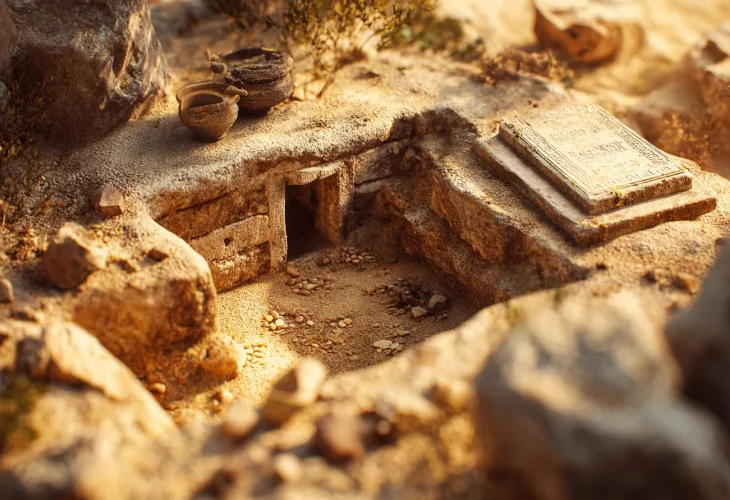
The burial caves found at Ramat Rachel were impressive and clearly connected to royalty. Yet they contained something deeply puzzling: nothing.
No bones were discovered, and no evidence suggested the tombs had ever actually been used. Researchers proposed that the remains may have been removed and transferred elsewhere in later periods. But the question remained: whose tombs were these originally meant for?
Some scholars believe they may have been connected to King Uzziah himself.
The Ancient Inscription About Uzziah’s Bones
About eighty years ago, Israeli archaeologist Eleazar Lipa Sukenik made a surprising discovery in a Russian monastery on the Mount of Olives.
He found an ancient Hebrew inscription reading: “Here were brought the bones of Uzziah king of Judah — do not open.”
The inscription appears to have once marked a burial cave or grave containing Uzziah’s transferred remains.
Interestingly, the famous Jewish traveler Benjamin of Tudela had already written centuries earlier that Uzziah’s grave was located near Absalom’s Pillar in the Kidron Valley. This has led some researchers to believe that Uzziah may first have been buried elsewhere, possibly in isolation because of his tzara’at, and only later reburied in a more permanent location.
The Final Chapter of a Powerful King
The prophet records that Uzziah was buried “in the burial field that belonged to the kings,” but not inside the regular royal tombs, because “he was a metzora.”
Some researchers believe this may explain the mysterious empty tombs discovered at Ramat Rachel. If the theory is correct, the royal estate may have become both Uzziah’s place of isolation and his original burial site before his bones were later transferred elsewhere.
It is a striking and tragic ending for one of Judah’s greatest kings: a ruler whose fame spread far and wide, but whose pride ultimately led to isolation, illness, and removal from the center of power.

