

Raising Children
“No One Notices the Quiet Child”: The Hidden Pain of Exclusion
A veteran educator explains how social exclusion often happens silently inside classrooms, and why many parents completely miss the signs.
- Michal Arieli
- | Updated
 Avinoam Hersh
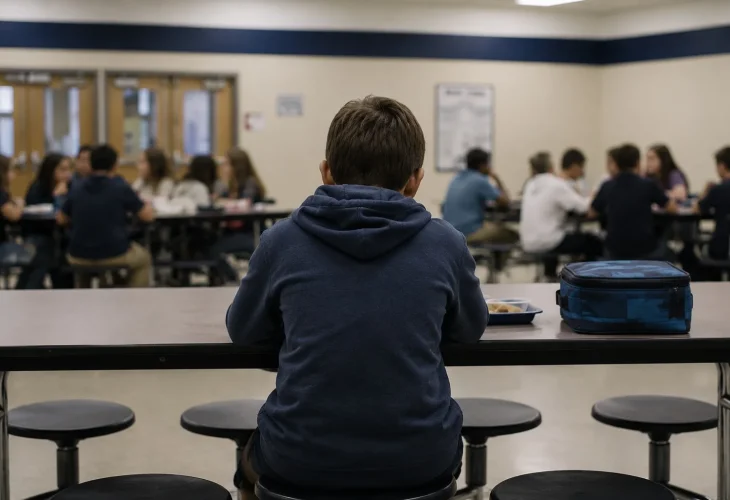
Imagine your child walking into school in the morning. On the outside, he seems calm. The teacher may even describe him as “quiet” or “easygoing.” But inside, in the place that is supposed to feel safest for him, he feels invisible. No one greets him warmly, no one asks him to sit nearby, and during recess he quietly remains outside the social circle.
Today, educators and parents are becoming increasingly aware that social exclusion does not always look like open bullying or cruel verbal attacks. Sometimes the deepest pain comes from something much quieter: being ignored.
And according to veteran educator Avinoam Hersh, this painful phenomenon has become impossible to ignore.
“Exclusion Has Always Existed, But Today It’s Worse”
Avinoam Hersh, a seventh grade homeroom teacher and longtime educator, has spent 25 years working with students, parents, and teaching staff. Over the years, he has become one of the better known voices speaking publicly about the hidden social struggles taking place inside classrooms.
Now, after years of observing the issue closely, he says the situation has grown significantly worse.
“Exclusion has always existed,” Hersh explains. “But in the past, people were ashamed to talk about it. Sometimes educational staff avoided addressing it because they lacked awareness, and sometimes because they feared that speaking about it would only give children more ideas.”
According to Hersh, the situation intensified dramatically in recent years, especially during periods of national stress and instability.
“In times of war and tension, cases of exclusion become much more severe,” he says. “Parents are often emotionally exhausted themselves and less available to notice what is happening with their children socially.”
As a result, many struggling children quietly slip beneath the radar.
The Child Who Suffers Silently
One of the most painful aspects of exclusion, Hersh says, is that many children never openly tell anyone what they are experiencing.
“There are very clear warning signs,” he explains. “A child may become withdrawn, quieter than usual, avoid activities, or stop going to social events.”
Among older children, the signs may become especially noticeable around birthdays and celebrations.
“When boys or girls stop receiving invitations to bar mitzvahs or bat mitzvahs, when nobody calls them or includes them socially, parents need to stop and ask difficult questions.”
Of course, some children are naturally quieter and more independent. But Hersh stresses that complete social isolation should never be dismissed casually.
“Most children are social by nature,” he says. “Even quieter children usually maintain at least one or two close friendships. If a child truly has no friends at all, that should absolutely concern us.”
“Exclusion Is the Top Floor”
Hersh believes many parents misunderstand what exclusion really is.
“People think exclusion begins when a child is fully rejected,” he explains. “But that is already the top floor of the building. There are many earlier stages before things reach that point.”
Some children struggle socially because they lack confidence or social skills. Others may have difficulty initiating friendships, reading social situations, or connecting naturally with peers.
Without guidance and support, these smaller struggles can slowly grow into much deeper isolation.
Why Do Children Hurt Other Children?
One of the most difficult questions parents ask is how children from loving, educated homes can still participate in excluding others.
Hersh believes the answer often lies beneath the surface.
“A child who truly feels secure and good about himself usually does not need to exclude anyone else,” he explains. “Very often, exclusion grows out of insecurity and inner struggle.”
Over years of working with students, he says he has repeatedly seen children from excellent homes participate in painful social behavior because they themselves were struggling emotionally.
“They may hurt another child terribly,” he says, “but sometimes they are suffering deeply too.”
A New Educational Approach
In response to the growing problem, Hersh is now launching a special pilot program aimed at helping schools identify and prevent social exclusion before it becomes severe.
The program is currently being introduced at the “Moreshet Neria” school in Givat Shmuel and focuses on giving homeroom teachers practical tools to recognize exclusion early, respond appropriately, and create long term solutions inside the classroom.
Importantly, the program also involves parents.
“Teachers cannot solve this alone,” Hersh emphasizes. “Parents and educators must work together. If parents are not paying attention at home, and schools are not addressing things properly in class, real change cannot happen.”
“And How Was It for Your Friend?”
Despite the painful stories he encounters, Hersh remains deeply optimistic.
“Otherwise,” he says, “I could never stay in education.”
To illustrate the kind of sensitivity he believes children can develop, he shares one especially moving story.
On the first day of school, Hersh noticed one of his students standing quietly instead of choosing a seat.
“I asked him what he was looking for,” Hersh recalls. “And he answered: ‘I’m checking who doesn’t have a place to sit yet, so I can sit next to him and he won’t be alone.’”
The response stunned him.
That evening, Hersh called the boy’s father and asked how he had raised a child with such unusual sensitivity.
The father answered with one simple habit.
“Every day when my children come home and tell me how their day was,” he explained, “I ask them one extra question: ‘And how was it for your friend?’”
For Hersh, that small question contains an enormous lesson.
The moment parents begin teaching children to notice not only themselves, but also the lonely child standing quietly on the side, the entire social atmosphere of a classroom can begin changing.

