

Behind the News
Israel Captured Beaufort For The First Time Since 2000. Why Is It So Important?
The IDF's advance beyond the Litani was months in the making and reflects a broader effort to remove Hezbollah's direct-fire threat to northern communities
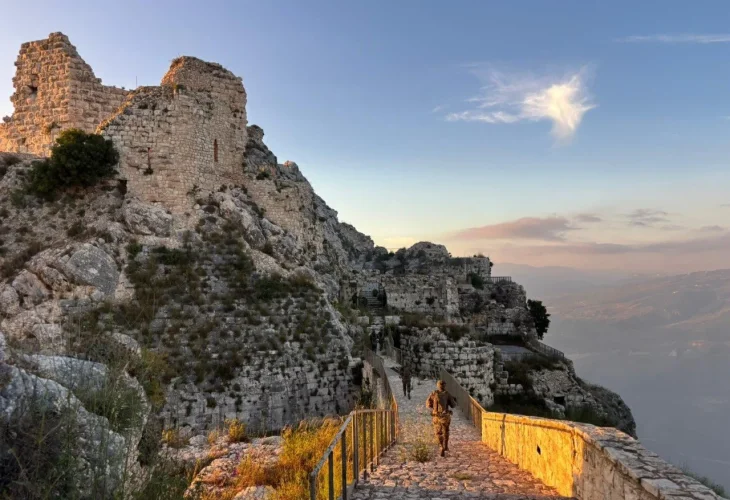 IDF in Beaufort (IDF)
For the first time since Israel’s withdrawal from southern Lebanon in May 2000, IDF forces have returned to the Beaufort ridge, crossing the Litani River and taking control of one of the most strategic positions in southern Lebanon.
The move, led by Division 36, marks a major expansion of Israel’s ground campaign against Hezbollah. It comes after days of intensified rocket and drone fire from Lebanon, including attacks toward Nahariya, Carmiel, Tzfat, Meron and Kiryat Shmona.
The Beaufort operation is not only about one historic fortress. It is about the high ground overlooking Metula, the Galilee Panhandle and the northern border communities that have faced Hezbollah fire throughout the war. According to the IDF, Hezbollah built fortified infrastructure in the area with Iranian guidance and funding, using the terrain to direct attacks and launch rockets toward Israel.
Prime Minister Benjamin Netanyahu said Friday that the operation had already moved beyond the Litani. “Our forces crossed the Litani, and they’ve advanced to the dominating terrain,” he said during a visit to the northern border.
Over Shabbat, Hezbollah expanded its fire toward northern Israel. Around 25 to 30 launches were reported from Lebanon, with rockets fired toward areas including Nahariya, Carmiel, Tzfat and Meron, in addition to frequent drone alerts across the border. A rocket also struck a commercial center in Kiryat Shmona, while an explosive drone hit a military area near Shomera.
Following the escalation, Home Front Command tightened restrictions across parts of the north. Schools were canceled in confrontation-line communities and around Meron, gatherings were limited, workplaces were restricted to places with proper protected spaces, and beaches were closed to the public.
Israeli reporting said officials in Israel and the United States believe Hezbollah intensified its fire in an effort to disrupt diplomatic talks expected to resume this week. The discussions have focused on security arrangements and moves to dismantle Hezbollah’s military presence.
The current operation was carried out by large ground forces under Division 36, including Golani, Givati, the 7th Armored Brigade, the Fire Brigade and the Multidimensional Unit, with intelligence support from the Military Intelligence Directorate. Before the ground entry, the Israeli Air Force carried out heavy strikes on Hezbollah infrastructure, accompanied by artillery and tank fire.
Engineering forces also played a central role. According to Israeli reporting, the IDF built at least five bridges over the Litani and opened routes through thick vegetation and rocky terrain to allow large forces to move north of the river. One IDF source quoted in Hebrew media said, “After we captured and cleared the area, we created crossings over the Litani with a very significant engineering effort.”
The operation had reportedly been planned for more than a year. An earlier attempt two months ago with Division 98 was canceled after Hezbollah ambushes and operational difficulties. The plan was then transferred to Division 36, which rebuilt it before the current push.
The military significance of Beaufort lies in its commanding position above the Litani River, overlooking Metula, the Galilee Panhandle and the Iyyon Valley. According to the IDF, Hezbollah used the area to observe Israeli communities, direct anti-tank fire and operate rocket and drone infrastructure. By taking control of the ridge, Israel hopes not only to destroy launch sites after attacks occur, but to deny Hezbollah the terrain from which it threatens northern Israel in the first place.
The Litani crossing also carries wider significance. UN Resolution 1701, passed after the 2006 Second Lebanon War, was meant to keep Hezbollah forces away from the area south of the river. The current operation reflects Israel’s assessment that Hezbollah’s infrastructure on both sides of the Litani has remained a direct threat.
Beaufort also carries deep historical weight in Israel. Golani forces captured the fortress in June 1982 during the First Lebanon War in one of the IDF’s most famous and costly battles. Six soldiers were killed, including Maj. Goni Hernik, commander of the Golani reconnaissance unit.
The site later became one of the symbols of Israel’s 18-year presence in the southern Lebanon security zone. In May 2000, under the Barak government’s decision to withdraw from Lebanon, the IDF demolished its Beaufort outpost before pulling back to the border.
Now, 26 years later, Israeli forces have returned to the same terrain as Hezbollah continues to fire on northern Israel. The operation signals that Israel is no longer relying only on border defenses or diplomatic lines to remove the threat.
The IDF said it is prepared to deepen and expand the operation if needed. “The IDF will continue to operate to remove every threat to the State of Israel,” the military said.

