

Israel News
He Was Looking for Lost Jewelry. Instead, He Found a 2,500-Year-Old Treasure.
A rare Persian-period coin from Cyprus was discovered on a beach in Ashdod and turned over to the Israel Antiquities Authority. Experts say it is the first coin of its kind ever found in Israel and carries major research value.
- Yuval Aviv
- | Updated
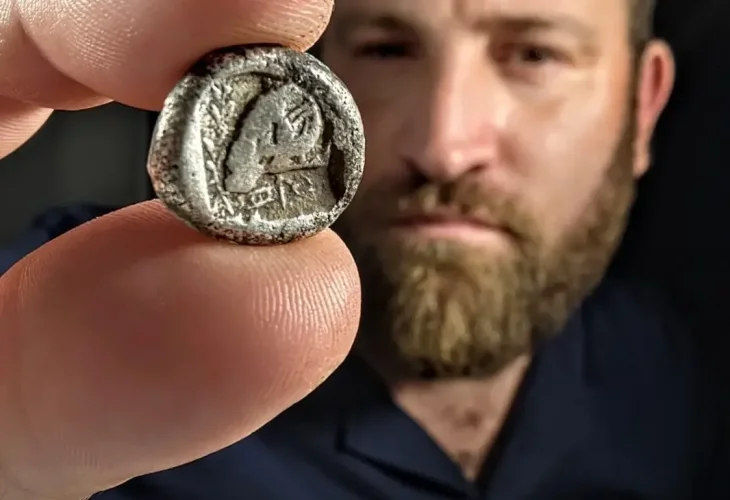 Coin expert Yaniv David Levy with the coin (Photo: Israel Antiquities Authority, Shay Halevi)
A rare coin dating back about 2,500 years, originally from Cyprus, was recently discovered on a beach in Ashdod—and has been identified by the Israel Antiquities Authority as the first of its kind ever found in Israel. The coin was spotted by Avi Tzafrak, deputy director of the Beaches Department at the Ashdod Municipality, during a routine scan that was actually meant to help locate items lost by beachgoers.
Tzafrak regularly helps residents and visitors search for jewelry, keys, and personal belongings that disappear into the sand. About a month ago, during one of those searches, he noticed something unusual: an ancient coin. In accordance with the law, he transferred the find to the Israel Antiquities Authority for examination, where it became clear that this was an exceptional discovery with archaeological significance.
After a professional examination, experts determined that the coin was minted in the city of Salamis in Cyprus, around the middle of the 5th century BCE. It is a coin from the Persian period, in the denomination of a “siglos,” weighing about 11 grams.
According to Yaniv David Levy, a researcher and curator in the Coin Department of the Israel Antiquities Authority, the coin has distinctive features: "A closer examination of the coin shows that it is not made of silver, but rather of metal coated in silver, a phenomenon known from Cypriot silver coins of this period, against the backdrop of a silver shortage on the island."
According to the researcher, the fact that the coin survived intact makes the find especially unusual: "Coins of this size and value from the Persian period are rare in the archaeological record. In most cases, silver coins of this size were not preserved whole; they were cut into small pieces, which were used as ‘silver fragments’ in local trade. Evidence of this kind of use is known mainly from inland sites. That is why the discovery of a complete coin דווקא in the coastal region is exceptional and of special importance."
The Israel Antiquities Authority said: "Coins from Salamis dating to the 5th century BCE are known to have circulated throughout the eastern Mediterranean, but finds whose discovery site is known and verified may provide significant information about trade ties and movement between Cyprus and the Land of Israel during the Persian period. The circumstances of the discovery and the precise reporting allow us, as researchers, not only to identify the coin itself, but also to use it as a source of information about the economic and maritime connections that existed in the region some 2,500 years ago."
Following the report and the transfer of the coin to the state collections, Tzafrak was awarded a certificate of appreciation by the Israel Antiquities Authority: "I’m happy to have had the privilege of being part of a discovery with historical value. As far as I was concerned, it was obvious that the coin belongs to the heritage of all of us, and that is why I immediately transferred it to the Israel Antiquities Authority. If, through this act, I contributed one more small piece to the research and history of the Land of Israel, that is a great privilege for me."

