

Behind the News
Trump Stops Israel’s Beirut Strike After Iran Threatens Ceasefire Collapse Over Lebanon
Netanyahu says the IDF will keep operating in southern Lebanon, but Trump’s announcement raised questions over who controls Israel’s next move against Hezbollah
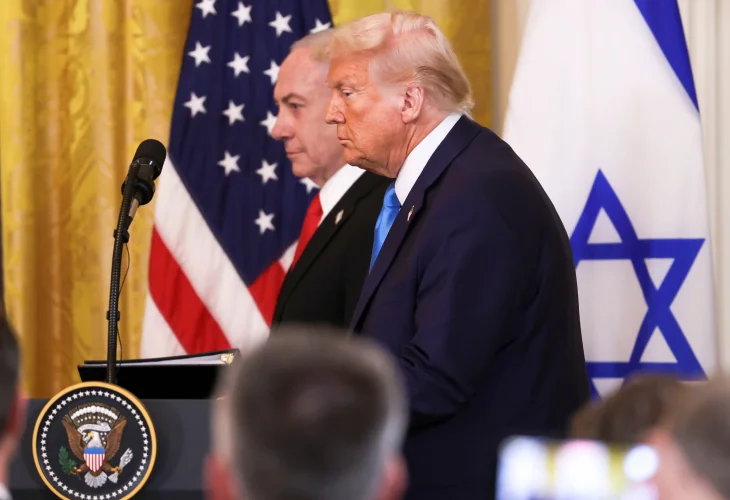 Shutterstock
President Donald Trump appeared to stop Israel’s planned strike on Hezbollah targets in Beirut on Monday night, stepping in after a day of escalating Israeli threats, Iranian pressure, and U.S. concern that the Lebanon front could disrupt talks with Tehran.
“I had a very productive call with Prime Minister Bibi Netanyahu, and there will be no Troops going to Beirut, and any Troops that are on their way, have already been turned back. Likewise, I had a very good call with Hezbollah, and they agreed that all shooting will stop — That Israel will not attack them, and they will not attack Israel.”
The sequence began earlier Monday, when Prime Minister Benjamin Netanyahu and Defense Minister Israel Katz said they had instructed the IDF to strike Hezbollah terror targets in Dahiyeh after repeated Hezbollah violations. “The rule for Dahiyeh in Beirut is the same as the rule for communities in northern Israel,” Katz said. “If there is no quiet in the north, there will be no quiet in Beirut.”
Later in the day, Iran’s IRGC-linked Tasnim reported that Iran was suspending mediated exchanges with the U.S., arguing that Israel’s operations in Lebanon had violated the broader ceasefire understandings. In effect, Iran was signaling that continued Israeli escalation in Lebanon could jeopardize the U.S.-Iran diplomatic track itself.
Trump’s second post reinforced that connection. Just minutes after announcing the Hezbollah understanding, he wrote that “talks are continuing, at a rapid pace, with the Islamic Republic of Iran.” In other words, Lebanon and the Iran talks had become part of the same conversation.
The immediate result was limited but significant. Israel is not withdrawing from the line where its forces are currently positioned in southern Lebanon. Netanyahu also said the IDF would continue operating there as planned, but Israel did not carry out the planned Dahiyeh strike.
Netanyahu later tried to preserve Israel’s red line. “I spoke this evening with President Trump and told him that if Hezbollah does not stop attacking our cities and civilians, Israel will strike terror targets in Beirut,” he said. “This position remains in place. At the same time, the IDF will continue operating as planned in southern Lebanon.”
Katz also sought to turn Trump’s announcement into an Israeli achievement. “Trump adopted the equation we set, under which fire on our communities means bombings in Beirut. That is the meaning of his statement,” he said.
But the political backlash was immediate. Opposition leader Yair Lapid called Israel “a full protectorate state.” Naftali Bennett said, “Jerusalem. Beit Shemesh. Lebanon. Gaza. The location is different, the story is the same: a government that has lost control over Israeli sovereignty.”
Avigdor Lieberman said it was unacceptable that northern Israel was under fire while “Israel’s prime minister waits for approval from Trump to bomb Dahiyeh,” adding, “We are not a banana republic.”
National Security Minister Itamar Ben Gvir said, “Mr. Prime Minister, you said a strong prime minister says ‘yes’ to a U.S. president when possible, and ‘no’ when necessary. This is the time to say to our friend, President Trump: ‘No.’”
Former IDF chief Gadi Eisenkot said, “There has never been an Israeli prime minister who accepted such an unreasonable demand with such surrender.”
According to the Lebanese presidency, the emerging arrangement means Israel will not strike Dahiyeh and Hezbollah will not attack Israel, with the ceasefire later expected to expand to all of Lebanon. Hezbollah reportedly conveyed its position through Lebanese Parliament Speaker Nabih Berri, a key Hezbollah ally.
Israel’s Home Front Command, however, did not treat the announcement as the end of the security threat. It said defensive guidelines would remain unchanged until Tuesday evening, while continuing ongoing assessments.
Israeli and Lebanese officials are expected to meet in Washington on Tuesday and Wednesday for U.S.-mediated talks on the ceasefire proposal. The central question is no longer only whether Hezbollah fires again, but what Israel is allowed to do if Hezbollah stops firing while continuing to rebuild.
If Trump’s intervention only blocked a strike in Dahiyeh, Israel may still preserve most of its freedom of action in southern Lebanon. If it also limits Israeli strikes on Hezbollah, then the U.S. has imposed a much wider restraint on Israel’s campaign, potentially allowing Hezbollah to continue attacking Israeli troops and communities along the border while Israel’s hands remain tied.

