

In Search of God
Can Scientists Really Bring Extinct Animals Back to Life?
Genetic engineering and cloning have advanced dramatically in recent years, but can humans actually create life or resurrect extinct animals?
- Yosef Yaavetz
- | Updated
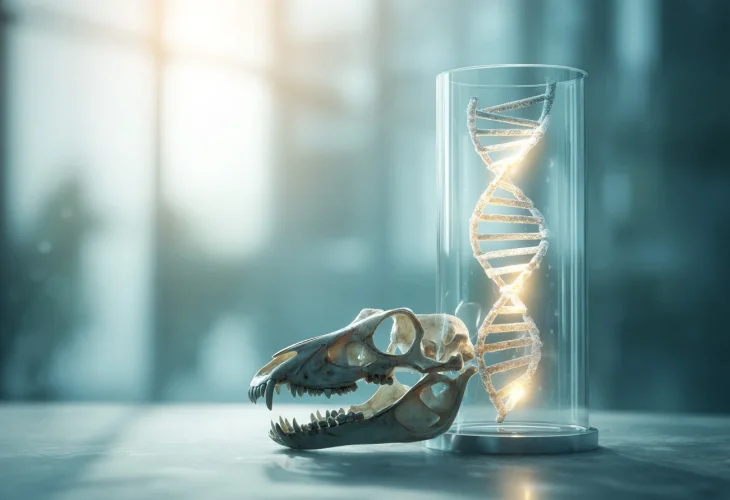
Every so often, headlines announce that scientists have "brought back" an extinct animal or created a new life form in a laboratory. Images spread across the internet, excitement grows, and it can seem as though science has crossed a line once thought impossible.
But what is really happening? Are scientists actually creating life? And can extinct species truly be resurrected?
The reality is both fascinating and more complex than many headlines suggest.
Can Humans Create Life?
Science has achieved remarkable things, but it still cannot create life from nothing.
What scientists can do is manipulate and work within the biological systems that already exist in nature. They can clone, modify, and combine genetic material, but the fundamental process of life remains the one built into creation by the Creator.
In many ways, this resembles the Torah's prohibition of kilayim, mixing different species. Just as breeding a horse and a donkey produces a mule, modern genetic engineering attempts to combine characteristics from different organisms. The technology is far more sophisticated today, but the principle is similar: scientists are working with existing life rather than creating new life from scratch.
The Two Main Approaches
Researchers generally use two methods when attempting to recreate extinct species.
The first involves recovering an intact cell from an extinct animal. This is extremely rare but has been attempted with the woolly mammoth. Because some mammoths were preserved in Siberian permafrost, scientists were able to recover remarkably well-preserved biological material. Companies such as Colossal Biosciences hope to use this material alongside Asian elephant embryos in an effort to create an animal closely resembling a woolly mammoth.
The second method is more common. Instead of using a complete cell, scientists work with fragments of ancient DNA. They identify genetic traits from extinct animals and attempt to insert those traits into living relatives through genetic engineering. This does not recreate the original species but rather produces an animal that shares some of its characteristics.
The Animal That Went Extinct Twice
One of the most striking examples involved the Pyrenean ibex, a wild mountain goat that became extinct in 2000.
Scientists successfully extracted DNA from the final surviving animal and, in 2003, managed to clone a new ibex. For a brief moment, the species had returned.
However, the cloned animal survived only a short time before dying, causing the species to become extinct once again. The experiment demonstrated both the promise and the tremendous challenges involved in de-extinction efforts.
What About the Dire Wolf?
One of the biggest recent headlines involved claims that scientists had brought back the dire wolf, a large predator known from fossils and popularized by television and movies.
According to critics, that claim was exaggerated.
Rather than reviving a genuine dire wolf, researchers genetically modified modern wolves to emphasize certain traits associated with the extinct species. The resulting animals may resemble dire wolves in appearance, but they are not actually dire wolves. In other words, this was genetic engineering, not true resurrection of an extinct species.
Other Species Scientists Hope to Revive
The woolly mammoth is not the only animal researchers hope to bring back.
Several teams around the world are working on projects involving:
- The Tasmanian tiger
- The dodo
- The giant moa of New Zealand
- The gastric-brooding frog of Australia
So far, however, none of these efforts has successfully restored a self-sustaining population of an extinct species. In some cases, embryos have been created but failed to survive. In others, the genetic material available remains incomplete.
What Science Can Do Today
While true de-extinction remains elusive, scientists have achieved success in other areas.
Cloning existing animals has become a reality. Researchers have used cloning techniques to help increase populations of endangered species, including the black-footed ferret in North America. Genetic modification has also become increasingly sophisticated, allowing scientists to alter traits within living species.
These advances demonstrate the growing power of biotechnology, even if they fall short of bringing extinct animals fully back to life.
The Bottom Line
Despite dramatic headlines, scientists have not yet learned how to create life in a laboratory or truly resurrect an extinct species.
What they can do is manipulate existing genetic material, clone living organisms, and attempt to restore traits from long-lost animals. Some projects have produced promising results, while others have fallen short.
Whether extinct species will one day walk the earth again remains an open question. For now, science continues to push the boundaries of what is possible, but the creation of life itself remains beyond human reach.

