

Israel News
A Rare Manuscript Found at Oxford Appears to Reveal Where Rashi Is Buried
The exact burial place of Rashi in France has come to light: the great commentator was laid to rest in the city where he founded a yeshiva, taught Torah, and wrote his landmark commentaries on the Torah and Talmud.
- Yonatan HaLevi
- | Updated
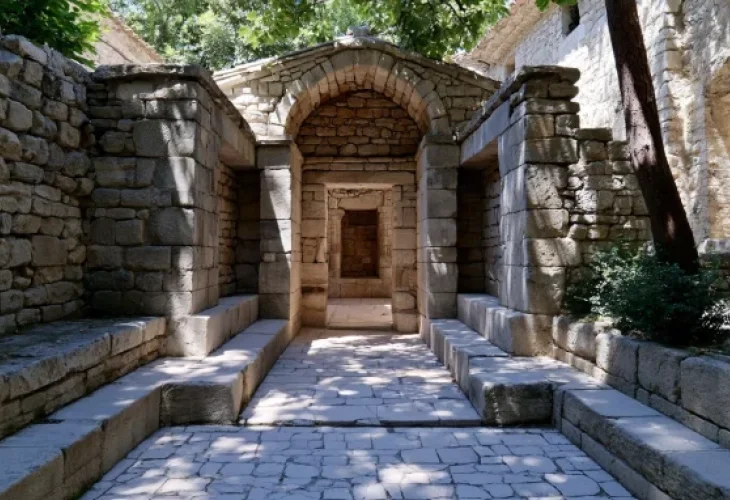 Rashi’s synagogue in Troyes (illustration)
A long-running mystery surrounding the burial place of Rashi has apparently been solved, in light of an ancient manuscript uncovered in Oxford’s library, along with old manuscripts and maps discovered recently. The findings indicate that Rashi was buried in his hometown of Troish, that is, Troyes in France, near the cemetery where his ancestors were buried.
Rashi was born in Troish in the year 4800 (1040 by the secular calendar), studied in his youth in the yeshivot of Ashkenaz, and later returned to his city, where he founded a yeshiva, taught Torah, and wrote his celebrated commentaries on the Torah and Talmud. He passed away on Thursday, the 29th of Tammuz, 4865, at the age of 65.
Over the generations, a tradition persisted that his burial place was in Troish. At the end of the era of the *Rishonim*, the Jews were expelled from France, and the gravestones were then uprooted from the cemetery in Troish. For several centuries, no Jews lived in Troish. Although French Jewish descendants preserved a tradition that Rashi was buried in Troish, over time various rumors began to circulate claiming that Rashi was buried in Prague, in the Czech Republic, or in Worms, in Germany.
Even though it was understood that it made little sense that he would have been taken to such distant places—and all the more so since those communities always had Jewish populations and no one there knew of any such thing, that the teacher of Israel was buried among them—and although the rumors did not come from authoritative sources, they still created doubt as to whether he was in fact buried in his city of Troish. As a result, scholars became accustomed to writing that the location of Rashi’s grave was unknown.
In recent months, during preparations for a trip by students of the Beit Yisrael Vizhnitz yeshiva gedolah in London to the graves of early rabbinic sages in France, a turning point emerged. As part of the research carried out ahead of the trip, a manuscript of “Seder HaYachas” on the sages of France was located in Oxford’s library. It was written toward the end of the fifth millennium, not long after the period of Rashi.
In that manuscript, researchers found a line that had not previously received scholarly attention: “In the year 4865, the lamp of Israel was extinguished, and the crown of splendor fell, and he lay with his fathers in Troish.” Researchers note that this wording also fits with the words of Rashi’s grandson, Rabbeinu Tam, who in *Sefer HaYashar* refers to Troish as “the city of my ancestors’ graves.” Still, that wording alone does not explicitly state that Rashi is the one being discussed. But in the manuscript of “Seder HaYachas,” written in France a few generations after Rashi, when the Jewish community and cemetery there still existed, it is explicitly stated that Rashi was indeed buried near the graves of his ancestors in Troish.
Alongside the manuscript, additional evidence has also been uncovered. Researchers studying the history of the city of Troish, working within a joint framework of the French government, regional authorities, and the municipality, identified other historical sources from the period, including documents written by people of that time, old maps marking the Jewish cemetery, and archival information documenting its location at the foot of the old city wall, near the Corde stream. In 2021, ancient graves were even found at the site, confirming the location of the historic cemetery. The researchers are expected to publish their official conclusions after the *Tishrei* holidays.

