

History and Archaeology
The Sea of Galilee Massacre: When Paradise Became a Battlefield
The fertile Plain of Ginosar became the setting for one of the most tragic battles of the Great Jewish Revolt.
- Yehosef Yavetz
- | Updated
Today, when people think of the Kinneret region, they often think first of Tiberias. Yet in ancient times, the area was known by a different and far more celebrated name: the Plain of Ginosar.
The city of Tiberias, founded during the reign of King Herod and mentioned frequently by Chazal, was home to great Torah sages such as Rabbi Meir and Rabbi Yehuda HaNasi. But the region itself gained fame because of the extraordinary Plain of Ginosar, whose beauty, fertility, and abundance became legendary throughout the ancient world.
The Valley of Extraordinary Fruit
The praise Chazal bestowed upon the Plain of Ginosar is remarkable.
The sages described its fruit as so delicious that people could hardly stop eating it. Some accounts even suggest its sweetness was so intense that it could leave a person feeling weak or faint. Chazal saw an allusion to this unique blessing in Yaakov Avinu's blessing to the tribe of Naftali, comparing the region's productivity to the speed and energy of a running deer.
The first century Jewish historian Josephus also wrote about the valley in glowing terms, describing it as a place of exceptional beauty, abundant water, and extraordinary produce, unlike almost anywhere else in the world.
Why Was Ginosar So Fertile?
The Plain of Ginosar benefited from a rare combination of natural advantages that few places possess.
First, there was an abundant water supply. In addition to the Kinneret itself, numerous springs and streams once flowed through the region, providing reliable irrigation and supporting thriving agriculture. Many of these water sources have diminished in modern times due to extensive water pumping.
Second, the valley was blessed with exceptionally fertile soil. Rich deposits of alluvial sediment, combined with mineral materials carried from surrounding mountains and volcanic terrain, created deep soil that retained moisture and nourished plant roots.
Finally, the basin surrounding the Kinneret trapped warmth throughout much of the year. This consistent heat accelerated ripening and concentrated natural sugars in the fruit.
Together, these factors produced harvests so impressive that the region became famous throughout the Land of Israel and beyond.
A Thriving Center of Agriculture and Fishing
The prosperity of the region extended beyond its orchards.
At the southern edge of the valley stood Migdal Nunya, whose name means "Tower of Fish." The city was also known by its Greek name, Tarichaeae, a name associated with the salting and preservation of fish.
Fishing was a major industry in the area. Salted fish could be transported long distances and sold in distant markets, making the city an important commercial center.
Combined with the region's prized fruit production, the area became a symbol of abundance and blessing. Ancient sources often describe it in terms that evoke a garden of paradise overflowing with Hashem's bounty.
When Paradise Became a Battlefield
Yet this beautiful landscape would eventually become the site of one of the most tragic episodes of the Great Jewish Revolt against Rome.
After the fall of Tiberias, many Jewish fighters and refugees fled to Migdal Nunya, which became the final center of Jewish resistance in the Kinneret region.
As Roman forces advanced, thousands of Jews sought refuge on the lake itself. Boarding fishing boats, they attempted to escape Roman control and avoid capture.
What followed was one of the most unusual naval battles in Jewish history.
The Battle on the Kinneret
Hundreds of boats filled the waters of the Kinneret.
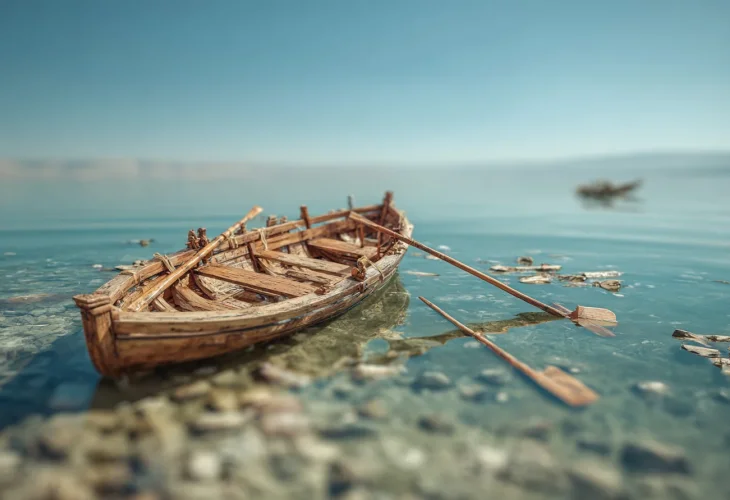
Most were simple fishing vessels, low to the water and designed for casting nets, not for warfare. On board were fishermen, refugees, and fighters who lacked armor, military training, and proper weapons. Yet they were determined not to surrender to Rome.
The Roman army approached with overwhelming force.
From the shoreline, trained soldiers armed with bows, javelins, and shields prepared for battle. Catapults and ballistae were positioned to bombard the crowded vessels.
The Romans first sealed off all escape routes around the lake.
Then the attack began.
Stones and arrows rained down on the boats. Vessels collided with one another, overturned, and broke apart. The water filled with wreckage and bodies. The Jewish fighters attempted to defend themselves using oars, stones, and fishing tools, but they stood little chance against the Roman war machine.
A Massacre on the Water
When Roman forces finally entered the lake, they did so aboard larger and sturdier military vessels.
From their elevated positions, Roman soldiers attacked downward, knocking men into the water and striking those still aboard the smaller boats.
Many drowned. Others were killed by arrows as they attempted to swim to safety.
Josephus describes a horrifying scene in which the waters of the Kinneret became filled with blood, floating debris, and countless bodies.
The tragedy was compounded by the absence of any escape.
Those who tried to reach shore were killed. Those who remained on the water were attacked. Those who attempted to hide among the boats were hunted down.
According to Josephus, Roman soldiers moved methodically from boat to boat to ensure that no survivors remained.
A Silent Witness to Tragedy
After the battle ended, the devastation remained visible for days.
Josephus records that bodies continued washing ashore long afterward. The stench became so severe that parts of the area were nearly impossible to inhabit.
The same lake that had symbolized prosperity, abundance, fishing, and blessing became a witness to one of the darkest moments of the revolt.
The story of the Plain of Ginosar serves as a powerful reminder of the dramatic contrasts that have shaped the history of the Land of Israel. A place once celebrated as a paradise on earth became the setting for unimaginable suffering, leaving behind a legacy remembered in both the words of Chazal and the historical accounts of Josephus.

