

Magazine
Lessons in Leadership from Moses
The Torah’s greatest leader teaches that true leadership is not about having all the answers—it is about humility, empowering others, and cultivating a nation of leaders.
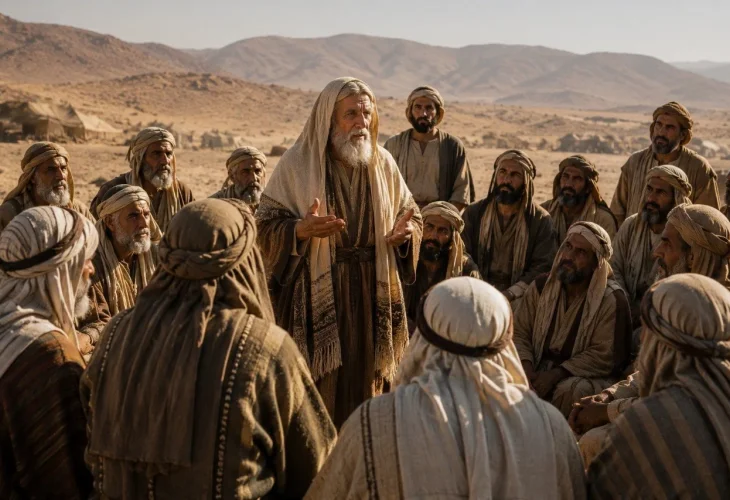
It was less than a year after leaving Egypt. The Israelites had just finished consecrating the newly built Tabernacle when God commanded Moses to instruct the people that, in commemoration of their miraculous exodus from Egypt, they were to bring a pascal offering similar to the one they had brought the year before, the night before they had left. In fact, this would be the charge every year: On the fourteenth day of the month of Nissan, the Jewish people are to sacrifice a lamb and, that night, join in a festive meal to eat the lamb while retelling the story of the Exodus.
The Jewish people busied themselves getting ready for the celebration. They all remembered the events of the previous year, and one can only imagine the excitement that must have permeated the camp as they prepared to commemorate the event. Yet, there was one group of people who were ritually impure and could not complete their purity in time to bring the offering. That, of course, was highly problematic: Those who are ritually impure cannot partake in the Passover offering, and it was a one-day-a-year event.
This group was not satisfied with simply being left out. Their unhappiness did not come from petulance or jealousy; they felt genuine sorrow at the thought of missing out. In fact, Rabbi Obadiah Sforno, an Italian commentator who lived around the turn of the sixteenth century, points out that their impurity came from handling the dead, and they were upset that their having engaged in a mitzvah would cause them to lose out.
That, indeed, was the crux of their complaint when they came to Moses. The verse does not elaborate on the conversation that took place, but it does give us the question they posed: “Why should we lose out?” (Numbers 9:7). They could not fathom that they would be excluded from the celebration, that they would be unable to partake in this national event, that they would miss an opportunity to fulfill such a beautiful commandment and ritual. Their question speaks volumes about their priorities.
In response to their request, God commanded Moses to instruct the people that, for all time, if someone misses the Passover offering due to circumstances out of his control, he can make it up one month later, on the fourteenth day of Iyar. In fact, Rashi notes that this commandment is taught only as a result of the question asked, and he comments that these people merited that it should be taught precisely because of them, because of their virtue.
Not to be overlooked is Moses’ response when the petitioners posed their question: “Stand here and I’ll listen to what God will command you” ( 9:8). Or, in other words: “I don’t know, let me go find out.” What a man. What a leader, to be the man who spoke to God face to face, the man who spent forty days and nights on top of the mountain receiving the Torah directly from God, who at the same time has the courage to be able to say that he does not know.
Moses was the consummate leader. It’s clear, from reading the Torah, that he is the model of what a leader should be. Brave enough to stand up to kings and to God for the sake of his people, ready to fight and die for them, yet also not afraid to rebuke the Jewish people and, when necessary, order their deaths. With all that, he was also humble enough to remember that he was a man, a man who could—and will, in a few weeks’ time—err. And, more importantly, he recognized that leadership does not always mean having the answers.
There’s an intriguing passage towards the end of this week’s portion. Moses asks God for people to help him lead, and God grants him seventy elders, after which all of whom are given the power of prophecy. There were two, however, who did not believe that they had been chosen for the position until they suddenly found themselves prophesying in the middle of the camp. Joshua, the principal student of Moses and the man who would one day lead the Jewish people into the land of Israel, is overcome, and he exclaims to Moses, “My master, Moses, kill them!” (11:28).
Moses’ response is very telling. He gently chides Joshua, “Are you jealous on my behalf? I wish all of God’s nation were prophets, with God giving His spirit to them” (11:29). Moses, the consummate leader, is unbothered by his people achieving greatness. In fact, to him, that seems to be the ultimate achievement. His goal is to lead a nation of leaders, a nation that is not satisfied with the prospect of missing out on a chance for a mitzvah, that is never afraid to say, “I don’t know,” and that can become the leaders who can raise the next generation of leaders.
David Ben Gurion once quipped that his job was harder than the president of the United States, because while the president was the leader of millions of people, Ben Gurion was the leader of a “country of prime ministers.” I’d like to think that Moses would have been proud.
We can’t all be Moses. In fact, none of us can. But as the consummate leader who wished to build a nation of leaders, we can all learn from him, take what he taught us as the man who could both break the tablets and say, “Hang on, let me ask God.” A touch of his humility, and a continued pursuit of truth for the sake of heaven, and we’ll all be on our way to living out his dream of a nation of prophets.

