

History and Archaeology
The Mount Carmel Treasure: Was It Bound for the Beit Hamikdash?
Why were thousands of silver coins buried on Mount Carmel nearly 2,000 years ago? One remarkable discovery may hold the answer.
- Yehosef Yavetz
- | Updated
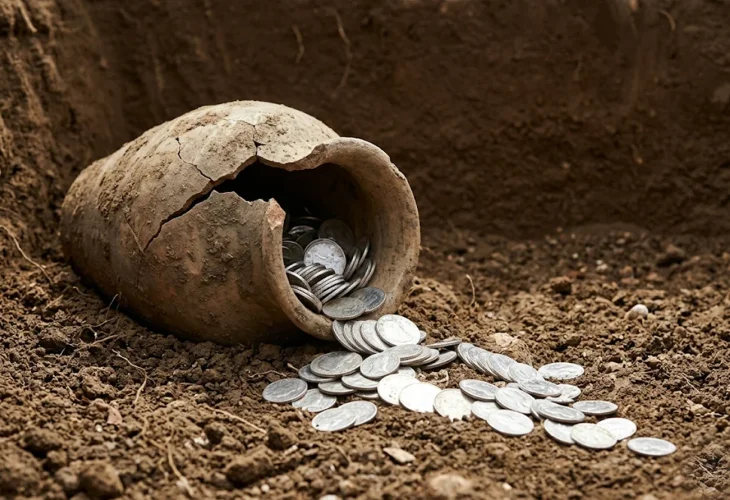
In 1960, an extraordinary discovery was made in the Druze village of Isfiya on Mount Carmel. A local farmer working near the remains of an ancient settlement stumbled upon one of the most remarkable archaeological finds ever uncovered in the Land of Israel: a massive hoard of silver coins hidden inside clay jars.
This was no small personal savings stash. The treasure contained 4,560 silver coins, including thousands of Tyrian shekels, hundreds of Tyrian half shekels, and a smaller number of Roman denarii. Nearly two thousand years after it was buried, the hoard emerged from the soil and opened a fascinating window into Jewish life during the final decades of the Second Temple period.
A Treasure Unlike Any Other
From the moment archaeologists examined the discovery, it was clear that this was no ordinary collection of coins.
The quantity was enormous, the types of coins were highly unusual, and the location raised intriguing questions. Most of the coins were minted between 20 and 53 CE, placing them in the final generation before the destruction of the Second Temple.
Even more significant was where they were found.
The hoard was discovered on the site of ancient Husifa, a Jewish settlement that once stood atop Mount Carmel where modern day Isfiya is located. This immediately raised an important question: why would such a large amount of silver be hidden in a Jewish town on Mount Carmel?
A Jewish Community on Mount Carmel
The discovery site revealed more than just coins.
Near the hoard, archaeologists found the remains of an ancient synagogue, confirming the existence of a thriving Jewish community in the area. The ancient name Husifa appears to have survived in modified form through the modern name Isfiya.
This was not an isolated mountain outpost. It was a living Jewish settlement with communal institutions, religious life, and connections to major travel routes.
From Mount Carmel, residents overlooked the route descending through Wadi Milik, one of the most important passes connecting northern regions of the country with central Israel and Jerusalem. For centuries, armies, merchants, and travelers used this strategic corridor.
The location suggests that Husifa occupied an important position within the Jewish landscape of the Second Temple era.
Why Were Tyrian Shekels So Important?
The true significance of the hoard lies not only in its size, but also in the types of coins it contained.
Most of the coins were Tyrian shekels and Tyrian half shekels minted in the Phoenician city of Tyre. These coins were famous throughout the ancient world for their exceptionally high silver content.
While many Roman coins contained significant amounts of other metals, Tyrian silver maintained a reputation for purity and reliability.
For that reason, Tyrian currency held a unique place in Jewish law.
The Gemara repeatedly identifies Tyrian silver as the standard for fixed Torah monetary values, stating: "Any fixed silver amount mentioned in the Torah is Tyrian silver" (Kiddushin 11b).
This connection may provide the key to understanding the treasure.
A Strong Connection to the Half Shekel Mitzvah
Many researchers believe the hoard was connected to the annual half shekel contribution to the Beit Hamikdash.
The mitzvah, described in Parashat Ki Tisa, required every Jewish male age twenty and older to contribute the same amount: half a shekel.
"The rich shall not give more, and the poor shall not give less than half a shekel."
During the Second Temple period, this mitzvah took on national significance. Jewish communities had spread throughout the ancient world, reaching Babylonia, Egypt, Syria, Asia Minor, Libya, and Rome.
For Jews living far from Jerusalem, sending the half shekel was more than a financial contribution. It was a powerful expression of belonging to the Jewish people and maintaining a connection to the Temple.
Each year, the funds were gathered and sent to Jerusalem, where they supported communal offerings, Temple maintenance, and the needs of the Mikdash.
Josephus himself wrote about the immense wealth of the Temple, much of which came from contributions sent by Jews across the world.
The Theory That Connects the Dots
Numismatist Leo Kadman was among the first scholars to suggest that the Isfiya hoard represented a collection of half shekel funds on their way to Jerusalem.
While some researchers challenged the theory, the evidence remains compelling.
The treasure was far too large to belong to a single individual and exceeded the economic needs of a small mountain settlement.
Its composition is equally striking: approximately 3,400 Tyrian shekels, about 1,000 Tyrian half shekels, and roughly 160 Roman denarii.
The presence of so many full shekels does not necessarily contradict the theory. Ancient sources indicate that two individuals could combine their half shekel obligations into a single full shekel, and messengers may have exchanged smaller coins for larger denominations to simplify transportation.
Why Was the Treasure Hidden?
If the hoard was indeed on its way to Jerusalem, another question emerges: why was it buried?
The answer may lie in the dangers of ancient travel.
A group carrying thousands of valuable silver coins would have attracted attention from robbers and bandits. As the messengers approached the mountain passes near Mount Carmel, they may have received reports of danger along the route.
Some scholars once connected the burial to the Great Revolt against Rome in 67 CE. However, because the newest coin in the hoard dates to 53 CE, many researchers now believe it was hidden earlier, perhaps around 54 CE during the political uncertainty that followed the death of Emperor Claudius.
Periods of instability often led to increased lawlessness, making travel particularly risky.
Whatever the specific threat, the messengers apparently concluded that continuing openly with such a large sum of money was too dangerous.
A Mission Left Unfinished
The solution may have seemed simple.
Rather than remain on the main road, the travelers likely climbed to Husifa, a Jewish settlement where they could temporarily hide the treasure in safety.
There, near the synagogue and among fellow Jews, the silver was buried inside clay jars with the intention of retrieving it later and continuing the journey to Jerusalem.
But they never returned.
Within a few years, the world around them changed forever. Jerusalem was destroyed, the Second Temple was burned, and the hidden silver remained undisturbed beneath Mount Carmel.
For nearly nineteen centuries, the treasure waited in silence.
Its discovery in modern day Isfiya provided a rare glimpse into one of the most unique mitzvot of the Second Temple era and the powerful connection that united Jews throughout the world with the Beit Hamikdash.
More than a collection of coins, the hoard stands as a testimony to Jewish unity, devotion, and the enduring bond between communities scattered across distant lands and the spiritual center of the Jewish people in Jerusalem.
With Hashem's help, may we merit seeing that connection fully restored with the final redemption.

