

Behind the News
Israel Is Preparing for the Iran Fight It May Have to Wage Alone
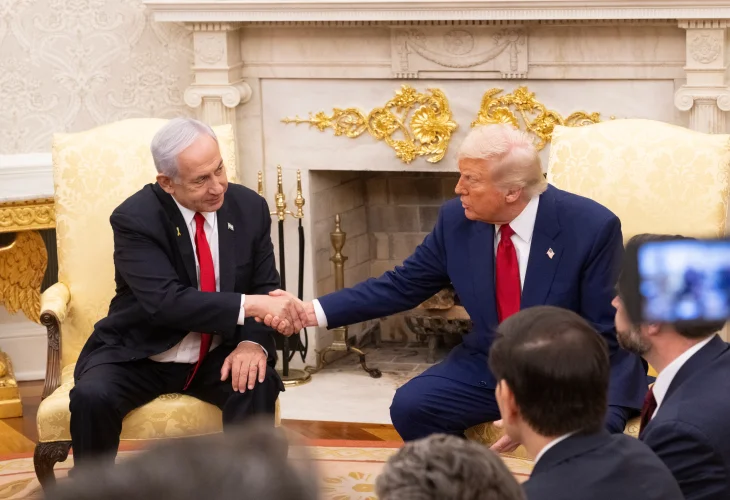
Trump, Vance and Netanyahu are all pointing to the same reality: Israel and the U.S. share enemies, but not always the same war aims
 Shutterstock
Prime Minister Benjamin Netanyahu told ministers in a security cabinet meeting this week that Israel may have to prepare for a scenario in which it confronts Iran without full American backing, according to an i24NEWS report.
“We may reach a situation in which we will have to deal with the Iranians alone, without backing from the United States, with all the costs involved — armaments and global isolation,” Netanyahu reportedly said. “We do not want to get there, but we know we can get there.”
That warning may be the clearest statement yet of where Israel’s Iran strategy is heading after what the past few days and weeks have shown: Israel and the United States are still allies, and they still share major interests. But they do not always have the same war aims, the same red lines or the same sense of urgency.
For the U.S., Iran is first a nuclear issue, a regional stability issue, a Strait of Hormuz issue and a threat to American forces. For Israel, Iran is all of that, but it is also something more immediate and close to home: ballistic missiles and drones launched from Iran, Iranian-backed militias like Hezbollah and Houthis, operating across the region, and the constant effort to turn every front around Israel into one coordinated pressure campaign.
That difference is why the next Iran confrontation may look less like a fully joint U.S.-Israel campaign and more like Operation Am Kelavi, the earlier 2025 round in which Israel carried the main offensive burden while the U.S. helped from the side.
The warning signs began earlier on Sunday, before Iran fired missiles at Israel.
As Hezbollah fire from Lebanon had continued for weeks, many Israelis wanted a stronger response in Beirut, a key Hezbollah stronghold. Then President Donald Trump announced that he had spoken with Netanyahu and that Israeli action in Beirut would not go forward.
“I had a very productive call with Prime Minister Bibi Netanyahu, of Israel, and there will be no Troops going to Beirut, and any Troops that are on their way, have already been turned back,” Trump said.
That message put many Israelis on edge. It suggested that even before Iran got involved, Trump was already trying to draw limits around Israel’s response to Iranian-backed pressure from Lebanon.
Then Iran struck Israel, and the frustration from the Israeli side became sharper.
Trump pressed Netanyahu not to retaliate. “I am going to call Bibi right now and tell him not to retaliate,” Trump told Axios almost immediately. “Each of them had their fun. Israel had its strike and Iran had its strike. We don’t need another one.”
Many Israeli civilians, reporters and politicians reacted angrily, seeing Trump’s pressure as a sign that even a friendly U.S. administration could ask Israel to restrain itself after a direct Iranian attack when American priorities pointed toward de-escalation.
Israel did eventually strike Iran, but only in a limited way, with barely-there American approval. It was less a green light than a grudging allowance for a much narrower strike backed by Marco Rubio. Reports later said Israel had prepared a much larger attack, with aircraft already prepared for takeoff, before Trump intervened and Netanyahu called it off. “They were already on their way. But eventually I had [the Israeli strike] limited,” Trump said.
Trump was trying to prevent a wider regional war. But from an Israeli point of view, Iran had fired directly at Israel, and Israel was being asked to calculate not only what Iran would do next, but what Trump would allow.
Then came the Apache incident near the Strait of Hormuz.
Trump posted that Iran had shot down “one of our highly sophisticated Apache Helicopters” while it was patrolling over the Strait of Hormuz, adding that the two pilots were safe and uninjured. “Nevertheless, the United States must, of necessity, respond to this attack,” he wrote.
It did promptly. Overnight, U.S. forces struck Iranian targets near the Strait of Hormuz, including air-defense systems, ground-control stations and surveillance radar sites, according to CENTCOM. Trump said Israel was not involved in the strikes, making the point even clearer: this was an American response to an American attack.
But from the Israeli side, it sharpened the sense of a double standard. When Hezbollah fired from Lebanon, Israel was told to avoid Beirut. When Iran fired directly at Israel, Israel was urged not to retaliate. But when American forces were hit, the response came quickly, clearly and without the same hesitation.
This whole sequence is the key to understanding the deeper split. The issue is not whether the U.S. is willing to use force against Iran. It clearly is. The issue is when, why and for whose war aims it is willing to do so.
The two countries may strike the same enemy in the same week and still be fighting parallel wars. They can share intelligence, coordinate airspace and intercept missiles, while still having different reasons for acting and different points at which they want the fighting to stop.
That is also why one line from Trump to Netanyahu matters so much. According to Axios, as Trump pressed Netanyahu not to widen the fight with Iran, he warned him: “Bibi, you better be careful, or you will be on your own very soon.”
Trump was warning Israel not to escalate beyond what the U.S. could support. Netanyahu, according to the i24NEWS report, told ministers Israel may have to prepare for exactly that scenario. In other words, both sides are saying the same thing from opposite directions.
That split is also diplomatic. If the U.S. sees a deal with Iran as a way to stop enrichment and calm the region, Israel may see the same deal as leaving its own larger threat intact. IDF Chief of Staff Eyal Zamir captured that concern in the cabinet, warning: “As we see it now, almost any agreement is a bad agreement.”
That is the second half of Israel’s problem. The question is not only whether the U.S. will join a military campaign, but whether it will accept a deal it sees as stabilizing and Israel sees as dangerous. For Israel, a deal that leaves Iran with missiles, proxies and room to rebuild may not solve the threat at all.
That is where Vice President JD Vance matters. He represents the camp on the American right that may agree Iran is a threat, but is much less eager to let every Israeli-Iranian escalation become a broader American war.
“The Israelis and the United States, we have a lot of shared interests, but we also have some situations where our interests diverge,” Vance said. “Israel may like that, they may not like that, but fundamentally, we think this is in the best interest of the United States of America.”
That is the America First doctrine in one sentence. It does not say Israel is an enemy. It does not say the U.S. should abandon Israel. It says American policy will be judged by American interests first. Israel has to listen carefully to that, because as the America First movement grows on the right, Israel cannot assume every future Republican administration will be as instinctively friendly as figures like Trump, Rubio and Hegseth, who come from a more traditional conservative and evangelical pro-Israel world.
That is why the Am Kelavi model may become the future pattern. Israel will coordinate with the U.S. when possible. It will welcome American defensive help, intelligence, interceptors, diplomatic backing and limited military coordination. But when the question is whether Israel can live under Iranian fire and proxy pressure, Israel may have to act even if the U.S. wants to pause.
Netanyahu is not trying to rupture the alliance. He has emphasized close coordination with Trump and does not seek an unnecessary confrontation with a friendly American president. But a friendly president is not the same thing as identical interests.
The lesson of the past few days is not that the U.S.-Israel alliance has collapsed. The lesson is that Israel cannot outsource its Iran policy to the U.S., even when the U.S. is led by a president who is broadly sympathetic to Israel.
The next Iran war may not be a shoulder-to-shoulder American-Israeli campaign. It may be Israel fighting because it has no choice, while the U.S. decides case by case how much help serves American interests.
That is not the collapse of the alliance. It is the return of an older Israeli rule: when the threat is existential, Israel has to be ready to act alone.

