

Evolution
Did Humans Really Evolve from Apes? A Torah Perspective on Human Origins
Explore the debate between evolution and creation through the lens of Jewish thought, examining ape-like fossils, the definition of humanity, the role of the soul, and whether physical similarity can truly prove common ancestry
- Yosef Yaavetz
- | Updated
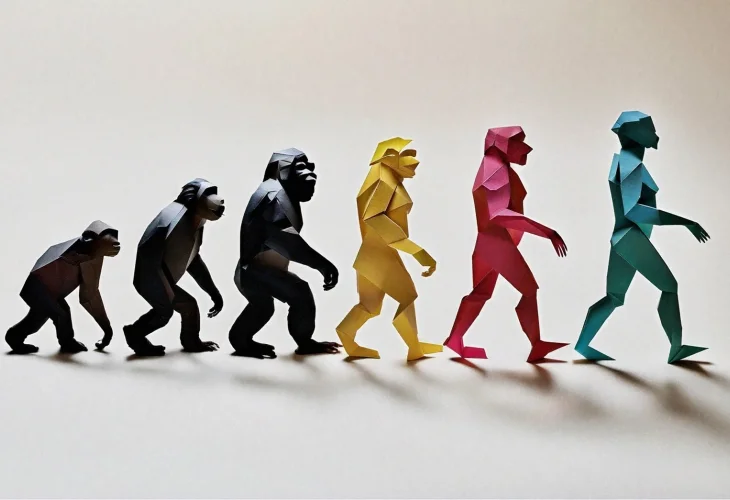 (Photo: shutterstock)
"Hello, Rabbi. Some time ago I heard you say that the idea that humans evolved from apes is a theory people developed in order to deny that humanity occupies a unique place in creation. You said it is not something that can be proven, but rather a scientific hypothesis based on interpretation. In reality, no one can know exactly what happened in the distant past, and the theory reflects a worldview in which humans are simply advanced animals who owe nothing to anyone.
"At the time, that sounded reasonable to me. Recently, however, I read some books on the subject and discovered that many scientists argue the opposite. They claim there is strong evidence that humans evolved from apes. They point to intermediate creatures — ape-like beings that appear to stand between humans and modern apes. These creatures are dated to hundreds of thousands of years before modern humans and are presented as proof that a process of evolution took place. I would appreciate your response."
* * *
Peace and blessings to you.
As I have said before, the idea that humans evolved from apes is not something that can be directly proven. Let me explain why.
The argument often goes like this: if we discover a creature that appears to be halfway between an ape and a human, then this must prove that one evolved from the other.
But why does finding a creature with characteristics that resemble both humans and apes necessarily prove a direct evolutionary relationship?
Imagine that modern apes had become extinct and we had never seen one. One day, archaeologists discover ape skeletons or even video recordings of apes. Would we immediately conclude: "This creature looks somewhat like both humans and dogs. Therefore, dogs evolved into apes, and apes evolved into humans."
Of course not.
The existence of similarities does not, by itself, prove ancestry. It merely demonstrates resemblance.
According to this perspective, even if a creature were discovered that appeared halfway between a human and an ape, it would not automatically prove that humans descended from apes or that the creature was an evolutionary ancestor. It would simply show that similar creatures exist within nature.
What Is a Human Being?
The discussion depends largely on how one defines a human being.
From a purely biological perspective, one might arrange various creatures along a spectrum according to physical characteristics.
However, traditional Judaism defines humanity differently.
According to the Torah, a human being is not merely a physical organism. A human possesses a divine soul, moral responsibility, self-awareness, and the capacity to choose between right and wrong.
From this viewpoint, a creature that lacks these qualities is not a human being, regardless of how closely it resembles one physically.
It may be an ape that looks remarkably human. It may even be an ape that shares many physical features with humans. But without the defining spiritual qualities associated with humanity, it remains an animal rather than a human being.
Can the Human Soul Evolve?
This leads to a deeper question.
Physical characteristics can theoretically change. An organism might become larger, stronger, or more complex over time.
According to traditional Jewish thought, the soul is not a physical entity. Therefore, it cannot arise simply from increasing biological complexity.
A brain may become larger. Intelligence may increase. Physical abilities may improve. Yet none of these changes, according to this view, can produce the uniquely human qualities of moral awareness, spiritual consciousness, and free choice.
An Analogy: The Computer
Consider a highly advanced computer.
Technology may continue to improve. Computers may become faster, more powerful, and more sophisticated.
But no matter how advanced the hardware becomes, complexity alone does not produce a moral conscience.
A computer does not suddenly decide: "I want to do what is right." or "I refuse to participate in something evil."
Those decisions belong to a different category altogether.
Similarly, proponents of this Torah perspective argue that increasing biological complexity cannot by itself produce the spiritual dimension that defines humanity.
Two Different Ways of Understanding Human Origins
Ultimately, the debate is not only about fossils, genetics, or anatomy.
It is also about the nature of humanity itself.
The evolutionary view generally understands humans as part of a continuous biological process.
The Torah view sees human beings as uniquely created, possessing a divine soul that fundamentally distinguishes them from all other living creatures.
Because the two perspectives begin with different definitions of what a human being is, they often reach different conclusions about human origins — even when examining the same evidence.

