

Personal Stories
Finding Her Way Back: The Lonely Side of Becoming Observant
At 28, Hila longed for Shabbat, Torah, and a Jewish home of her own—but without a supportive framework, finding her way into an observant life felt painfully lonely.
- Galit Levy
- | Updated
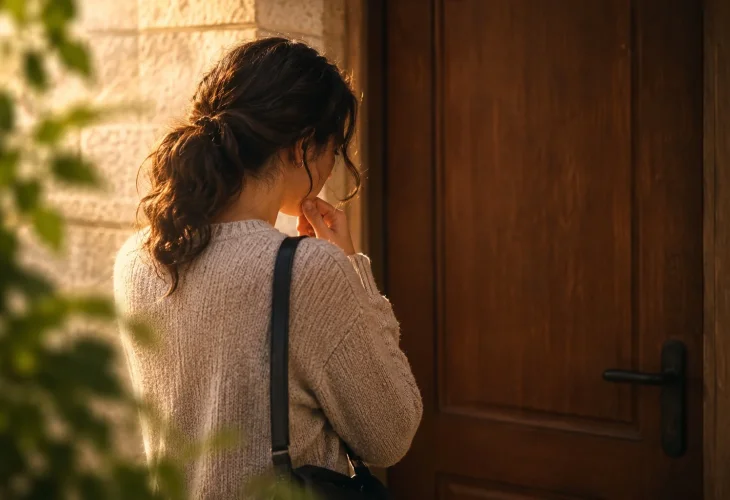
Hila stood outside the rabbi’s room feeling close to despair. She desperately wanted to leave her old life behind, yet parts of it seemed to pull her back with a force stronger than her own will.
For three years, she had struggled to break free from a relationship with a man who, as she puts it today, was simply not good for her. At the same time, something inside her was awakening. She wanted Torah. She wanted Shabbat. Most of all, she dreamed of one day building a Jewish home of her own.
But she had no idea how to get from where she was to where she wanted to be.
“I desperately wanted a home filled with Torah, but the life I was leading, including the Shabbat desecration in my parents’ home, weakened me to the point where I could hardly imagine how I would ever build my own home,” Hila recalls. “Sometimes thoughts crept in that perhaps, God forbid, I simply wasn’t worthy.”
“I Broke Down Every Time I Failed”
Every Thursday, Hila would visit a rabbi during his office hours. Throughout the week, questions and doubts accumulated, and by Thursday she often felt as though she were running out of air.
Usually, the rabbi’s answers strengthened her and gave her enough encouragement to continue for another week.
“For 28 years, my soul had been thirsting for holiness, and when I finally understood that, I encountered tremendous obstacles that left me feeling completely drained,” she says.
“On the one hand, I felt that something new and special was beginning in my life. On the other, I had no idea how to take the first steps.
“I wanted to experience a true Jewish Shabbat. I wanted a daily life filled with holiness. It was painful when I didn’t have that, and every time I failed in something I was trying to observe, I broke down all over again.”
Hila was also navigating a stage of life that made her journey particularly lonely. Most of her friends were already married with children, and she did not want to impose by inviting herself to their homes for Shabbat.
Together with the few single friends she still had, she tried to find whatever opportunities she could for Torah and spiritual connection during the week and on Shabbat.
But what she truly longed for was a framework—a place where she could belong while learning how to build a Torah-observant life.
Then, one Thursday, the rabbi gave her an answer she had not expected.
“How Can I Go to a Seminary at 28?”
“You need to attend a charedi seminary for women,” the rabbi told her.
Hila was stunned.
“His words pierced me,” she remembers. “All I could see was the enormous distance between who I was and the image I had of a charedi seminary.
“I’m sure the rabbi meant only good. I had told him about my struggles and how desperately I needed a religious framework. But I felt so ashamed. How could I, at 28 years old, go to a charedi seminary? Would anyone there understand me?
“I imagined everyone being much younger than I was. I had lived a completely different life, and I felt that my past was sitting on my heart like a heavy stone.”
On the bus ride home, Hila’s mind filled with questions.
At the time, she did not yet understand that there was nothing shameful about beginning her journey later than others. She had not chosen to grow up in a non-observant home. She was only now discovering a world that others had been raised with from childhood.
Nor had she internalized the powerful teaching of Chazal that “in the place where ba’alei teshuvah stand, even the completely righteous cannot stand.”
Yet knowing that intellectually and feeling that she truly belonged were two very different things.
Looking for Someone Who Understood
Part of the difficulty was that Hila hardly knew anyone in her situation.
She knew one other ba’alat teshuvah, but that woman was 42 and already a mother. Hila was 28 and single, trying to navigate relationships, Shabbat, religious observance, and her future all at once.
She needed more than occasional answers to individual questions. She needed people who understood the particular challenges of building an observant life from the ground up.
Looking back, Hila believes that a structured environment could have made an enormous difference.
“If only I had had a warm rabbinic figure who could guide me regularly,” she says. “If only I had entered a structured framework with uplifting Torah classes that could have helped keep me from making mistakes and falling into fantasies and despair.
“Perhaps I would have found a more stable path into teshuvah. I might have saved time and spared myself a great deal of heartache.”
Hila emphasizes that the rabbi she consulted genuinely wanted to help her. He was a respected Torah scholar, and many people waited to speak with him. The problem, she believes, was not a lack of concern.
Rather, what she needed could not be provided in a few minutes of guidance once a week.
“I don’t think that 20 years ago there was enough understanding of what a single ba’alat teshuvah was experiencing,” she reflects. “Even when there was a sincere desire to help, it was difficult to give the right answers when there was no supportive framework surrounding me.”
No One Should Have to Make the Journey Alone
Hila’s story highlights a side of teshuvah that is not always visible from the outside.
Choosing a Torah-observant life can bring tremendous excitement, meaning, and closeness to Hashem. But for someone beginning without a supportive community, it can also bring loneliness, uncertainty, and the feeling of standing between two worlds.
Sometimes what a person needs is not simply another answer, but a place to belong: teachers who understand where she came from, friends walking a similar path, and a framework in which spiritual growth can happen gradually and steadily.
Looking back, Hila does not question her desire to change her life. She wishes only that, when her soul first began reaching for something more, she had known that she did not have to find the way there alone.

